
You need a Karnataka GSTIN, starting with state code 29, the day your stock starts selling from a fulfilment centre in Karnataka. Until now that meant your own premises or a VPOB in Karnataka, a documented virtual place of business. Rule 14B, recommended by the GST Council on 8 October 2026, adds a third route for small marketplace-only sellers: the marketplace's Karnataka warehouse becomes your principal place of business.
Rule 14B fits a narrow profile, and it is not yet in force. Sellers who supply businesses, sell outside marketplaces, sell services, or need the GSTIN this month will still register through a Karnataka VPOB. This guide shows which group you fall in, with the numbers to check.
VPOB in Karnataka at a glance
Point | Position on 26 October 2026 |
|---|---|
When Karnataka registration is needed | When goods are supplied from Karnataka, typically from stock in a fulfilment centre there (Section 25(1), CGST Act) |
Karnataka state code | 29; every Karnataka GSTIN begins with these two digits |
VPOB route | Available now; officer processing under CBIC Instruction No. 03/2025-GST, dated 17 April 2025 |
Rule 14B route | Recommended by the 57th GST Council on 8 October 2026; applies only after the CGST Rules are amended and notified |
Rule 14B limit | ITC passed on of up to ₹2.5 lakh a month, excluding stock transfers between distinct persons |
Government fee | None for GST registration on either route |
Karnataka professional tax | ₹2,500 a year for persons registered under the Karnataka GST Act, 2017 |
E-way bill within Karnataka | Required above ₹50,000 for all taxable goods |
Do you need a Karnataka GSTIN at all?
Selling to customers in Bengaluru does not, by itself, require a Karnataka registration. Supplying goods from Karnataka does. If your stock stays in your home state and ships out from there, your home GSTIN covers those interstate sales. If you have leased real premises in Karnataka, register those through a standard GST registration in Karnataka instead; no virtual address is needed.
The trigger is the fulfilment centre's address, not the city it serves. Some large warehousing clusters serving Bengaluru sit across the border in Tamil Nadu: Hosur, for example, is a Tamil Nadu town. Read the state in the warehouse address on your seller panel before you register anywhere; a Tamil Nadu fulfilment centre needs a Tamil Nadu GSTIN, however close it is to Bengaluru.
One Karnataka GSTIN covers every place of business in the state. A second fulfilment centre in Karnataka is added to that registration as an additional place of business, not registered separately. The full need test, with Karnataka's biometric position, is in our guide to virtual office GST registration in Bengaluru.
Three routes to a Karnataka GSTIN
Point | Your own premises | Karnataka VPOB | Rule 14B warehouse PPOB |
|---|---|---|---|
Principal place of business | Office or godown you lease in Karnataka | A documented unit at a provider's premises | The marketplace's warehouse, with its consent |
Available | Now | Now | After notification |
Approval | Officer processing | Officer processing; physical verification possible | Automatic grant, as reported from the Council's decision |
Sales covered | All supplies from Karnataka | All supplies from Karnataka | Reported to be marketplace supplies only |
Goods or services | Both | Both | Goods only |
ITC you can pass on | No limit | No limit | Up to ₹2.5 lakh a month |
Who controls the address | You | You, through your agreement | The marketplace |
Yearly address cost | Full commercial rent | Provider fee | No separate address fee expected |
Best for | Teams working in Karnataka | Most sellers with Karnataka stock today | Small B2C sellers selling only on marketplaces |
What Rule 14B will change in Karnataka
According to the Ministry of Finance's release on the recommendations of the 57th GST Council meeting, dated 8 October 2026, Rule 14B will let small suppliers of goods through e-commerce operators register in a state where they have no physical presence by declaring the operator's warehouse in that state as their principal place of business. The facility is limited to suppliers who intend to pass on ITC of no more than ₹2.5 lakh a month, excluding stock transfers between distinct persons.
For a Karnataka-bound seller, that means the fulfilment centre where your stock already sits could become your principal place of business, instead of a virtual office address plus the fulfilment centre as an additional place.
Conditions reported so far
Published summaries of the Council's decisions describe further conditions. Treat these as expected, not final, until you read the notified rule.
Reported condition | What it means for a Karnataka application |
|---|---|
Regular registration with physical presence in a home state | Your home-state GSTIN stays the base; Rule 14B is a dependent registration |
Operator consent to use its warehouse | Amazon, Flipkart or another operator must agree to its Karnataka warehouse being declared |
Supplies through operators that collect TCS under Section 52 | Covers marketplace sales; not your website, distributors or offline sales |
Rule 14A registrants withdraw first, through REG-32 | A home registration under Rule 14A must exit that scheme before applying |
Warehouse changes through REG-14 | A move to another Karnataka warehouse is an amendment, not a fresh application |
Cancelled if the home registration is cancelled | Your Karnataka GSTIN rises or falls with your home GSTIN |
What is still unknown
Four answers matter before anyone relies on Rule 14B in Karnataka: the date the rule is notified, how operators will grant and withdraw warehouse consent, what happens to the registration if the operator closes or relocates the warehouse, and whether existing Karnataka registrations can move to the new route. A Finance Ministry official has reportedly indicated a launch on 1 November 2026; until the notification is published, the VPOB route is the only one open.
The ₹2.5 lakh test, worked for Karnataka sellers
The limit is about tax on your invoices to GST-registered buyers, because that is the ITC you pass on. Sales to consumers pass on no ITC, so a B2C seller rarely gets close. Stock you transfer from your home GSTIN to your own Karnataka registration does not count.
To test yourself, add the tax on your B2B invoices to registered buyers (table 4A of GSTR-1) for your busiest recent month, for the supplies you expect to make from Karnataka.
Example seller | Monthly B2B taxable value | Tax rate | ITC passed on |
|---|---|---|---|
Home décor, almost all B2C on Amazon and Flipkart | ₹1,50,000 | 18% | ₹27,000: within the limit |
Office supplies to businesses through a B2B marketplace | ₹16,00,000 | 18% | ₹2,88,000: over the limit |
Packaged staples to registered retailers | ₹40,00,000 | 5% | ₹2,00,000: within the limit |
At 18%, the limit is reached at about ₹13.9 lakh of monthly B2B sales; at 5%, at ₹50 lakh. A seller close to either line should plan for a VPOB, because a seasonal spike can push one month over.
Who still needs a VPOB in Karnataka
Seller profile | Why Rule 14B does not fit |
|---|---|
Sells to businesses above the ₹2.5 lakh ITC limit | Over the limit in any month closes the route |
Brand selling on its own website as well as through Karnataka fulfilment | Website orders shipped from Karnataka fall outside platform supplies |
Seller supplying Karnataka distributors or a retail counter | Offline supplies need a registration covering all supplies |
Service provider with clients or staff in Karnataka | Rule 14B covers goods only |
Seller using more than one marketplace in Karnataka | A single principal place you control avoids depending on one operator's consent |
Seller with a launch date before notification | The rule cannot be used until it is notified and live on the portal |
Seller whose home registration may change constitution | A dependent registration is exposed if the home GSTIN is cancelled |
A more general comparison, not limited to Karnataka, is in Rule 14B or a virtual office for your next state.
Karnataka rules that apply on either route
Whichever route produces your Karnataka GSTIN, the state's own rules come with it.
Rule | What to do |
|---|---|
GSTIN prefix 29 | Check that marketplace seller panels show the Karnataka GSTIN against Karnataka fulfilment centres |
One GSTIN, many fulfilment centres | Add each Karnataka fulfilment centre as an additional place of business before stock moves there |
E-way bill above ₹50,000 within Karnataka | Generate an e-way bill for movements inside the state, such as returns or transfers between Karnataka warehouses, above ₹50,000 (Karnataka notification FD 47 CSL 2017, dated 23 March 2018) |
Professional tax of ₹2,500 a year | Obtain an enrolment certificate and pay the annual tax; the Schedule covers persons registered under the Karnataka GST Act, 2017 |
Quarterly GSTR-3B by the 22nd | If you opt for QRMP, Karnataka falls in the group that files GSTR-3B by the 22nd of the month after the quarter |
Returns even in quiet months | File nil GSTR-1 and GSTR-3B for the Karnataka GSTIN when no sales ship from the state; e-commerce GST return filing support covers each state GSTIN |
Karnataka's professional tax Schedule, as amended, is published by the Karnataka professional tax department. The enrolment is easy to miss because it is handled outside the GST portal.
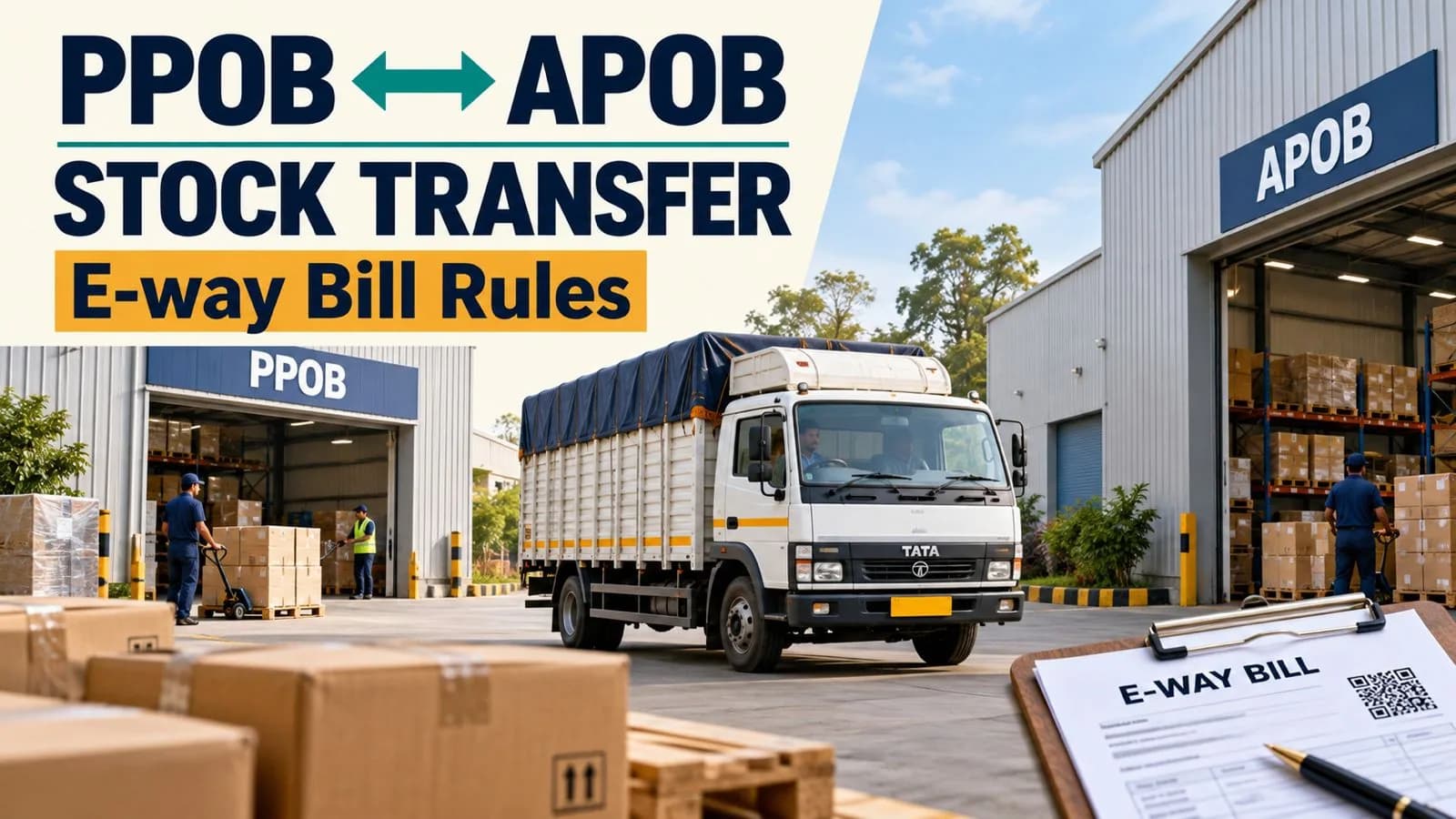
Stock moving from your home state to Karnataka is a supply between distinct persons under Section 25(4): it needs a tax invoice from the home GSTIN and an e-way bill, as explained in moving stock between your PPOB and APOB.
Adding fulfilment centres will get faster
The 57th GST Council also recommended that amendments to registration particulars, other than the principal place of business, be accepted automatically. Once notified, adding a new Karnataka fulfilment centre as an additional place of business should no longer wait for an officer. Until then, the process in how to add an additional place of business applies.
Cost and time: Karnataka VPOB vs Rule 14B
Point | Karnataka VPOB | Rule 14B (as recommended) |
|---|---|---|
Address cost | ComplyLocal: ₹11,999 onwards as a first state; ₹10,999 to ₹14,999 as an additional state, plus GST | No address fee expected; operator terms not yet known |
Government fee | None | None |
Official processing time | 7 working days if not flagged; up to 30 days with physical verification | Automatic grant reported |
Typical end-to-end time | 15 to 25 working days, including documents and any clarification | Not yet available |
In-person steps | Biometric authentication at a Karnataka GST Suvidha Kendra if flagged | Not yet known |
Exit | Cancel through REG-16 and file GSTR-10 | Expected to end if the home registration or operator consent ends |
Example, for planning only: a Jaipur seller of cotton home textiles, selling only to consumers on two marketplaces, wants stock in a Karnataka fulfilment centre for the December sale season. Her B2B tax is under ₹30,000 a month, so she fits Rule 14B on paper. Her launch is in four weeks and the rule is not yet notified, and she plans a website next year. A Karnataka VPOB now gives her a registration that will still fit after the website launches; waiting gives her a cheaper route only if the rule goes live on time and her plans stay marketplace-only.
A 4-week Karnataka VPOB launch plan
For sellers who choose a VPOB now, this sequence keeps each step ahead of the one that depends on it.
Week 1: confirm from the seller panel that the fulfilment centre is in Karnataka, and run the ₹2.5 lakh test for your records.
Week 1: sign a VPOB agreement in your legal name that names a specific unit, with an NOC mentioning GST registration and one premises proof.
Week 1: file REG-01, copying the address exactly as it appears on the agreement and the utility bill, and complete Aadhaar authentication.
Week 2: if the application is flagged, complete biometric authentication at a Karnataka GST Suvidha Kendra within 15 days of filing Part B.
Week 2 to 3: reply to any REG-03 notice within seven working days.
On approval: add the fulfilment centre as an additional place of business, enrol for Karnataka professional tax, and display the certificate and name board.
Week 4: invoice the first stock transfer from your home GSTIN with an e-way bill, and update the Karnataka GSTIN on each marketplace seller panel.
The document set for each possession type is listed in documents for GST registration with a virtual office, and what happens at a Suvidha Kendra appointment is covered in physical verification and biometric authentication.
If you already hold a Karnataka GSTIN on a virtual office
Keep it. The Council's recommendation describes registration for suppliers without a physical presence, not a conversion of existing registrations. Moving would mean cancelling the current GSTIN, filing GSTR-10 and applying afresh, with days in between when nothing can ship from your Karnataka stock.
Reconsider only after the notified rule is out, and only if you are marketplace-only, comfortably under the ₹2.5 lakh limit, and paying for an address you would otherwise drop.
Our view
Rule 14B is good news for the smallest Karnataka sellers, and we will tell you if you fit it. For everyone else, the VPOB route is not a stopgap: it is the only registration that covers every way you will sell from Karnataka. If your plans for the next twelve months include business buyers, your own website or a second channel, register through a documented Karnataka address now and keep the fulfilment centre as an additional place.
Not sure which route fits? Send us your last three months' GSTR-1 B2B totals and your Karnataka launch date. We will tell you whether to wait for Rule 14B or start a Karnataka VPOB, before you pay for anything. |
Ready to register in Karnataka? Talk to Keshav's team about a Karnataka virtual place of business at ComplyLocal →