ComplyLocal - Business Registration & Compliance Services
1 in 3 applications gets objected — search first

Trademark Search — Know If Your Brand Name Is Safe Before You Spend a Rupee

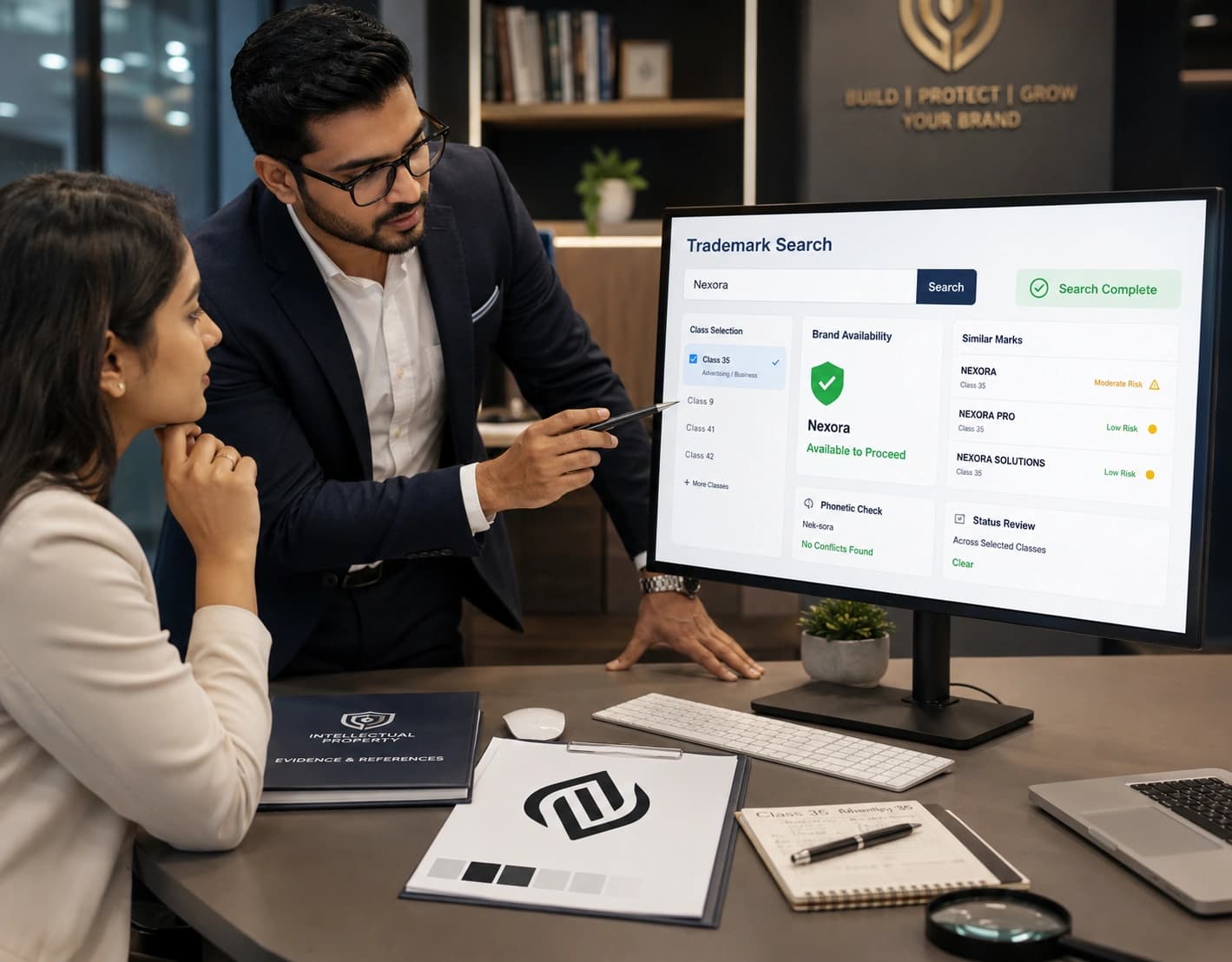
A trademark search is the systematic check of the Trade Marks Registry and market sources for identical or deceptively similar marks — the single step that most reduces the risk of a Section 11 objection or a costly rebrand.

  • Phonetic, visual and common-law screening
  • Adjacent-class spillover scan
  • Risk-graded file / modify / avoid verdict
  • Report in 1–2 working days
  • Class & filing strategy included

Check your brand name

Our expert will call you within 2 hours

  • 4.9 star Google
  • 10,000+ Filed
  • CA-led team
Or chat on WhatsApp

TRUSTED BY GROWING BRANDS

Names cleared before filing for founders across India

  • Punjab National Bank
  • Meesho
  • Shiprocket
  • Dayz Footwear
  • Motherwood
  • Nayasa
  • Magbros
  • Magic Fasteners
  • Suzu Steel
  • Kiero
  • Manna
  • Punjab National Bank
  • Meesho
  • Shiprocket
  • Dayz Footwear
  • Motherwood
  • Nayasa
  • Magbros
  • Magic Fasteners
  • Suzu Steel
  • Kiero
  • Manna

1 in 3

Applications objected

Search first to stay out of that third

45

Classes to scan

Conflicts hide in adjacent classes too

S.11

The conflict section

Relative-grounds refusals a search pre-empts

₹0

Cost of searching

Against months lost to an objection

What a real trademark search covers

A trademark search is the systematic check of the Trade Marks Registry database and market sources to find identical or deceptively similar existing marks before filing — the single step that most reduces the risk of a Section 11 objection or a costly rebrand. Done properly, it is not one query but a layered investigation across every dimension on which a mark can clash.

A professional search runs five screens, not one. The wordmark screen checks the literal name; the phonetic screen catches names that merely sound alike, including creative misspellings; the visual screen compares logos and device elements; the class-spillover screen looks beyond your primary class into adjacent classes where confusion can still arise; and the common-law screen sweeps the market for unregistered prior users who can block you through passing-off. A conflict can live in any one of these layers while the others look completely clear.

The output is a risk-graded report, not a raw list. Each proposed name is graded against what the search found and tagged with a clear verdict — file as-is, modify the mark or specification, or avoid the name entirely — so you walk into the filing with an informed decision instead of a hopeful guess. That is the difference between a free database lookup and a search you can actually build a brand on.

WHEN TO SEARCH

The moments a search saves you

A search pays for itself at exactly these points — before money, design, or reputation is on the line.

When

Naming a startup

The issue

A shortlist of names but no idea which are actually ownable

We do

Names risk-graded so you build on a clear one

When

Rebranding

The issue

Investing in a new identity that must not collide with an existing mark

We do

Conflicts surfaced before the new name goes live

When

Marketplace brand registry prep

The issue

Need a registrable mark to gate Amazon or Flipkart listings

We do

A clean name confirmed before the filing that unlocks it

When

Received a cease-and-desist

The issue

A rival claims your name conflicts with theirs

We do

A search clarifies the real risk and your options

WHY THE FREE SEARCH ISN'T ENOUGH

What the free public search misses

The IP-India public search is a useful first look — but it checks one dimension. These are the conflicts it routinely fails to surface, and any one of them can sink your application.

Phonetics & misspellings

The public search matches text, not sound. Names that are pronounced almost identically — or are deliberate creative misspellings of an existing brand — slip straight past it, then collide at examination where examiners weigh phonetic similarity heavily.

Regional-language transliterations

A mark can conflict with its own transliteration into Hindi or another Indian language, or with an existing regional-script mark. The free search will not bridge scripts, so a clash that an examiner or opponent will see remains invisible to you.

Logo similarity via Vienna codes

If you are registering a logo, the figurative elements matter as much as any text. A proper search uses Vienna codes to find visually similar device marks; the public text search cannot compare images, so a near-identical logo can go entirely undetected.

Unregistered prior users

A business that has used a name in the market without registering it still holds common-law rights and can block you or sue for passing off. Because it never filed, it appears nowhere in the Registry — only a market sweep catches it.

Get a professional search
HOW WE SEARCH

From brief to a verdict you can file on

Five steps that turn a name into a graded, defensible filing decision.

  1. 1

    Brief

    Step 1

    We capture your proposed names or logos, your goods or services, and your target markets — the inputs that define which classes and dimensions the search must cover.

  2. 2

    Registry deep-search

    Step 2

    We search the Trade Marks Registry for identical and similar marks across the relevant classes, recording their status and owners — live, abandoned, opposed or registered.

  3. 3

    Phonetic & visual screen

    Step 3

    We test the name for phonetic clashes and creative misspellings, and — for logos — run a Vienna-code visual comparison to catch device marks the text search cannot.

  4. 4

    Risk-graded report

    Step 4

    We compile the findings into a report that grades each name and returns a clear verdict: file as-is, modify the mark or specification, or avoid the name.

  5. 5

    Class & filing strategy

    Step 5

    For names cleared to file, we recommend the right class or classes and the strongest specification, so the search flows straight into a confident TM-A filing.

WHAT WE NEED FROM YOU

A short brief is all it takes

  • Shortlist of proposed brand names
  • Logo or device files (if registering a logo)
  • Any tagline or slogan to be searched
  • Preferred spelling and stylisation
  • What you sell or the services you offer
  • Industry and product categories
  • Goods/services to map to classes
  • Planned future product lines
  • States or regions you operate in
  • Online marketplaces you sell on
  • Export or overseas markets, if any
  • Languages your brand appears in

There is no government filing at the search stage, so no statutory documents are required — just a clear brief. We turn it into a risk-graded report that tells you whether to file, modify or avoid each name before any money goes to the Registry.

Transparent pricing

Trademark search pricing

A clear starting price for a professional trademark search. There is no government fee for a search.

Trademark Search

A Registry search with phonetic and visual similarity screening and a risk-graded file, modify, or avoid verdict.

₹499onwards

No government fee.

  • Registry search in your primary class
  • Phonetic & visual similarity screen
  • Risk-graded file/modify/avoid verdict
  • Report within 1–2 working days
Check a name
WHERE SEARCHES GO WRONG — HANDLED

The three ways a thin search fails you

Most self-done searches fail in one of these three ways. Here is how a real search closes each gap.

The risk

Searching for identical marks only

A text-only, identical-match search misses phonetic clashes that surface at examination and refuse the mark under Section 11.

How we handle it

We run a multi-dimension screen — phonetic, visual and textual — so sound-alike conflicts are caught before filing.

The risk

Searching the wrong class

Checking only your primary class lets a conflict hide in an adjacent class where confusion is still likely.

How we handle it

We run a spillover scan across related classes so no clash hides in plain sight.

The risk

Skipping the common-law check

Ignoring unregistered prior users invites a passing-off suit even after your mark is registered.

How we handle it

We sweep market sources for established unregistered users so you know the real-world risk, not just the Registry one.

FAQ

Trademark Search FAQs

Clear answers on free vs professional search, deceptive and phonetic similarity, Vienna codes, common-law rights, report contents, and searching across classes.

Fast answersExpert support
  • No, a search is not legally required, but skipping it is the single biggest avoidable risk in the whole process. Roughly one in three applications gets objected, and a Section 11 conflict found after filing means lost fees, lost time, and sometimes a forced rebrand — all of which a search before filing is designed to prevent.
  • The free IP-India public search checks for identical and obviously similar marks in the exact class you query. A professional search adds phonetic similarity, regional-language transliterations, logo similarity via Vienna codes, adjacent-class spillover, and unregistered common-law marks — the dimensions where most real conflicts actually hide.
  • Two marks are deceptively similar when an average consumer with imperfect recollection could confuse one for the other — in sound, appearance, or meaning. A mark does not have to be identical to be refused under Section 11; it only has to be close enough to cause confusion among the relevant public.
  • Phonetic similarity is when two marks sound alike even if spelled differently — for example a name and its creative misspelling, or two words that are pronounced almost the same. Examiners and courts weigh how a mark sounds heavily, so a phonetic clash can sink an application that looks unique on paper.
  • It depends on how close the mark is, whether it is live or abandoned, and whether it covers your goods or services. Our risk-graded report tells you whether to file as-is, modify the mark or specification to clear the conflict, or avoid the name entirely — so you make an informed call before spending on government fees.
  • Yes. Running a wordmark and concept search before you invest in logo design and packaging saves you from building a visual identity around a name you cannot own. It is far cheaper to discover a conflict at the naming stage than after you have printed labels and built recognition.
  • Vienna codes are an international classification of the figurative (image) elements in logos — shapes, animals, objects and symbols. A professional logo search uses them to find visually similar device marks that a plain text search would never surface, which is essential when you are registering a logo rather than just a name.
  • Common-law rights belong to a business that has used a mark in the market without registering it. Such an unregistered prior user can still block your registration or sue you for passing off, which is why a thorough search sweeps market sources — not just the Registry — for established but unregistered users.
  • A focused single-name search and report is typically delivered within one to two working days. A more complex multi-name or multi-class search, or one involving detailed logo and common-law analysis, may take a little longer — but it is always far quicker than the months lost to an avoidable objection.
  • A professional report lists the conflicting and near-conflicting marks found across each dimension — identical, phonetic, visual, adjacent-class and common-law — with their status and owners, and concludes with a clear risk grade and a file, modify or avoid recommendation for each proposed name and class.
  • No search can guarantee registration, because examination also tests absolute grounds under Section 9 and new marks are filed every day. What a thorough search does is dramatically cut the most common cause of refusal — a Section 11 conflict — and let you file with confidence rather than hope.
  • Yes, where your goods or services touch more than one class, or where a conflict in an adjacent class could still cause confusion. Searching only your primary class is how a clash hides in plain sight and surfaces at examination — a spillover scan across related classes closes that gap.

Search first. File once.

A multi-dimensional search with a clear file, modify or avoid verdict — so you build your brand on a name you can actually own.

Phonetic · visual · spillover · common-law — all screened