₹500
Government fee
One-time, paid to DGFT on filing
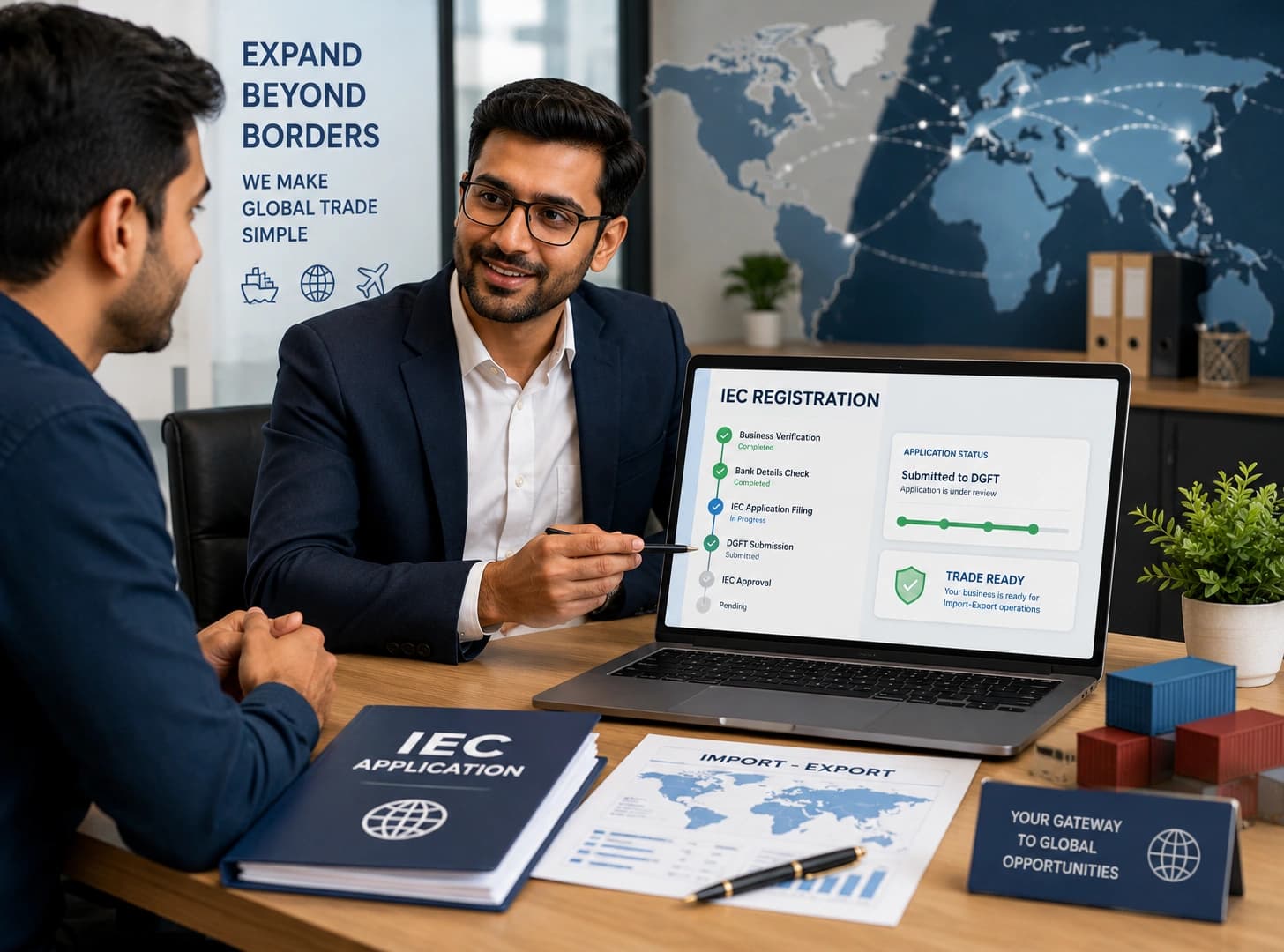
An Import Export Code is the 10-digit, PAN-based DGFT identifier that customs requires to clear any import or export of goods — issued in 1-3 working days at a ₹500 government fee, valid for the life of the business, subject to a mandatory annual updation each April to June.
TRUSTED BY EXPORTERS & IMPORTERS











₹500
One-time, paid to DGFT on filing
1-3 days
With documents and authentication in order
30 June
Every year, even with no changes
Auto-deactivated
All shipping bills and claims frozen
An IEC is rarely top of mind until a consignment is waiting on it. These are the situations we resolve most.
When
First international order
The issue
Customs is asking for an IEC and the shipment cannot move without it
We do
IEC registered before the consignment ships
When
IEC deactivated for a missed updation
The issue
Shipping bills are blocked mid-season because the annual update lapsed
We do
Overdue update filed and IEC status restored
When
Amazon Global Selling onboarding
The issue
The marketplace needs an active IEC and port readiness to go live
We do
IEC plus AD Code chain completed end to end
When
Service exporter claiming FTP benefits
The issue
Scheme eligibility requires an IEC the business never obtained
We do
IEC issued so the FTP benefit can be claimed
An Import Export Code (IEC) is a 10-digit, PAN-based identification number issued by the Directorate General of Foreign Trade under Section 7 of the Foreign Trade (Development and Regulation) Act, 1992 — the mandatory prerequisite for customs clearance on any import or export of goods from India, valid for the lifetime of the business subject to a mandatory annual updation each April to June. It is, in effect, your business passport for crossing India's borders with goods, and no consignment of merchandise clears customs without it.
The system is PAN-based, which means one IEC per PAN, valid across every branch, division, and unit of the business. Since the post-GST reforms, your IEC number is your PAN itself — but the number existing on paper is not the same as an active code: a formal application to DGFT on Form ANF-2A is still required to issue and activate the IEC before customs will recognise it. There is also a clean line between goods and services: importing or exporting goods makes the IEC mandatory, whereas service providers need it only to claim benefits under the Foreign Trade Policy.
What the IEC unlocks is the entire machinery of cross-border trade. It is the key to customs clearance, to receiving and remitting foreign currency through your bank's trade desk, to claiming export incentives such as RoDTEP and duty drawback, and to onboarding onto global marketplace programmes like Amazon Global Selling. Ten digits sit between a domestic business and an international one — and getting them, then keeping them active, is the foundation everything else in export-import is built on.
If goods or trade benefits cross a border in your business, an IEC is the first thing customs and your bank will ask for. These are the owners we register most.
Selling on Amazon Global, Etsy, or an international Shopify store means shipping goods abroad, and that makes an IEC the gateway to your first overseas order. We register the code and line up the port readiness so a marketplace launch is not held up by a missing customs prerequisite.
Bringing goods into India for resale requires an IEC before a single bill of entry can be filed — customs will not release the consignment otherwise. We get importers their code quickly so inventory is not stuck at the port accruing demurrage while paperwork catches up.
A manufacturer shipping its own production abroad needs the IEC to generate shipping bills and to claim export incentives like RoDTEP and duty drawback. We register the code and connect it to the AD Code and ICEGATE setup that turn an export order into an actual, clearable shipment.
Service exporters can be paid from abroad without an IEC, but the moment they want Foreign Trade Policy benefits, the code becomes essential. We secure the IEC so software, consulting, and other service businesses can claim the scheme eligibility their export earnings entitle them to.
Trading houses and the clients of freight forwarders need an active IEC behind every consignment they move. We register and maintain the code so that when a forwarder is ready to ship, the trade documentation is not stalled by an inactive or missing IEC at the last moment.
Sellers sourcing stock from overseas suppliers need an IEC to clear each inbound shipment through customs. We pair the code with the port and ICEGATE setup so imported inventory flows in predictably, rather than being held up by an incomplete import-side registration.
The IEC has almost no recurring compliance — except one rule that quietly deactivates thousands of codes every year. Here is exactly how it works, and what happens if you miss it.
Every IEC holder must confirm or update their details on the DGFT portal each year — and crucially, even a 'no change' confirmation is mandatory. The rule is not about whether your details changed; it is about actively logging in and confirming. Silence is treated as non-compliance, not as agreement that nothing changed.
The updation window runs from 1 April to 30 June every year. It is free when there are no changes, with only a nominal fee for modifications. But the 30 June date is a hard cliff: there is no grace period built into the rule, so an IEC not updated by that date falls off the edge automatically.
A deactivated IEC does not just carry a warning — it blocks everything. No shipping bills can be filed for exports, no bills of entry for imports, and RoDTEP and other benefit claims are frozen. If this happens mid-season, consignments stop moving until the code is brought back to life.
Reactivation is done by simply completing the overdue update online, after which the status restores and transmits to Customs so you can trade again. But it is 'without prejudice' to any DGFT action for the non-compliant period — so reactivation fixes the function, it does not erase the lapse.
Six steps that take you from eligibility to a code that actually works at the port — and stays active year after year.
We confirm the entity's PAN and structure, and check there is no existing IEC on the PAN — because the one-IEC-per-PAN rule means a duplicate attempt will simply be rejected.
We gather the PAN, Aadhaar and photograph, bank proof, and address proof, and verify the details match across them so the application is not returned for a KYC mismatch.
We file Form ANF-2A on the DGFT portal with the ₹500 government fee, authenticated by Aadhaar OTP for individuals and proprietors or by DSC for companies and LLPs.
With a clean application, DGFT issues the IEC within one to three working days, and we deliver the certificate so you have the code on record.
We guide AD Code registration at each customs port you ship from and ICEGATE registration for filing documents — the steps that make an issued IEC actually usable at the port.
We diarise the 1 April to 30 June updation as a standing service, so the code is confirmed every year and never falls off the 30 June cliff into deactivation.
The IEC is PAN-based, so the single biggest cause of a returned application is a mismatch between the PAN, Aadhaar, and bank or business name. We cross-check every detail before filing, so the code issues cleanly within the 1-3 day window.
The DGFT fee is only ₹500 — but a code that's issued wrong, left unusable at the port, or quietly deactivated costs far more than the filing ever saved.
Each of these is a stalled consignment or a frozen code. Here is how we engineer them out.
Details that don't agree across PAN, Aadhaar and bank records get the application returned by DGFT.
We run a KYC cross-check first so every detail matches before filing.
The code is granted, but with no AD Code registered the customs system won't let you generate shipping bills.
We include port readiness — AD Code and ICEGATE — so the IEC works where it matters.
A forgotten annual updation deactivates the IEC at 30 June, freezing trade during peak season.
We run a standing April calendar so the updation is filed every year on time.
Treating each branch as needing its own IEC leads to multiple rejected attempts on a single PAN.
We map the one-IEC-per-PAN rule to all your branches under a single code.
Real reviews from importers and exporters who got their IEC — and kept it active — with us.
Rahul Saini
Ludhiana
“Got our IEC in two days and they set up the AD Code at our port too. First export shipped without a hitch.”
Farah Khan
Mumbai
“Our IEC had been deactivated and shipments were stuck. They filed the overdue update and restored it fast.”
Vikram Shah
Surat
“They handle our annual updation every April now, so we never worry about the 30 June deadline again.”
Ananya Das
Kolkata
“Needed an IEC for Amazon Global Selling. They explained the AD Code and ICEGATE steps clearly and set it all up.”
Imran Sheikh
Delhi
“Transparent on the ₹500 govt fee versus their charges. Clean process, no surprises.”
Priya Menon
Kochi
“As a service exporter I needed the IEC for FTP benefits. They sorted it quickly and explained the scheme side.”
One simple professional fee to get your IEC. The DGFT government fee is billed separately.
PAN-based DGFT registration that lets you legally import or export goods, with annual updation handled.
₹1,499+ govt fee
Government fee: ₹500 (DGFT), billed separately.
Clear answers on who needs an IEC, the ₹500 fee and timeline, IEC-vs-PAN, annual updation, the 30 June deadline, reactivation, AD Code, ICEGATE, and documents.
New IEC in 1-3 days, AD Code and ICEGATE setup, and annual updation handled every April — so your code is issued right and never deactivated.
₹500 govt fee · 1-3 day issuance · updation & reactivation covered