










ComplyLocal - Business Registration & Compliance Services
Order-level. Marketplace-wise. Month-wise.

E-commerce Payment & Marketplace Reconciliation - The 7-Stream Match for Every Order

Reconciled by Chartered Accountants. Not by algorithms.

Match every order across platform settlement, COD, payment gateway, bank, books, GST return, GSTR-8 TCS and 194-O TDS data.

  • Amazon, Flipkart, Meesho and Shopify settlements matched
  • COD and payment gateway cycles tracked to bank credits
  • GSTR-8 TCS and 26AS 194-O credits reconciled
  • Fee overcharge, short-paid and reimbursement exceptions reported
  • Order-level close, not sample-based checking

Find my reconciliation gaps

Our expert will call you within 2 hours

  • 4.9 star Google
  • 10,000+ Filed
  • CA-led team
Or chat on WhatsApp

Platforms we work with

  • Amazon logo
  • Flipkart logo
  • Meesho logo
  • Myntra logo
  • Nykaa logo
  • Ajio logo
  • JioMart logo
  • Snapdeal logo
  • ONDC logo
  • Shopify logo

Settlement formats we read natively.

7

Data streams every order must match

The canonical 7-Stream Match

0.5% + 0.1%

TCS and TDS in settlements

GST cash ledger plus 26AS/AIS credit

T+2

Typical gateway settlement lag

Tracked against order and bank date

100%

Orders reconciled

Not samples or averages

Where is your money leaking?

Four common places reconciliation finds cash and tax gaps

When

Marketplace fee overcharges

The issue

Commission, closing fee or weight-handling fee differs from the expected rate card.

We do

We flag fee exceptions and dispute-ready evidence.

When

Unclaimed TCS/TDS credits

The issue

GSTR-8 or 26AS credits are visible but never mapped to books.

We do

Credits are reconciled and moved into the right tax workflow.

When

COD remittance gaps

The issue

Courier remits late, deducts charges or misses orders.

We do

COD cycles are matched to order IDs and bank credits.

When

RTO costs never booked

The issue

Revenue reverses but forward and reverse shipping stay hidden.

We do

RTO cost lands against the order and SKU.

Order-level reconciliation

Marketplace Reconciliation Services for Indian Online Sellers

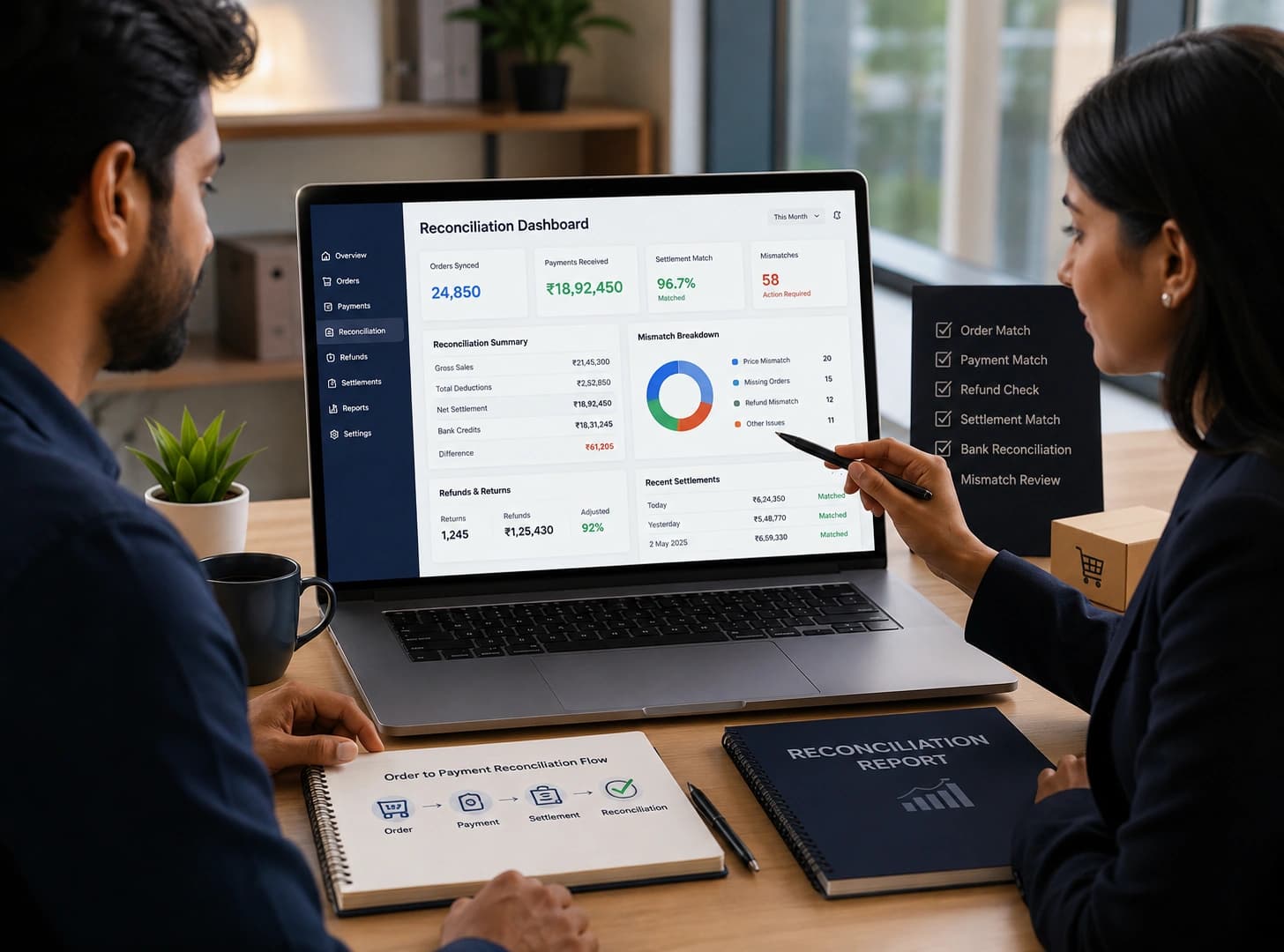
Our marketplace reconciliation services connect order reports, settlement reports, COD cycles, gateway payouts, bank credits, books and tax credits. We do not sample orders; the monthly workflow is designed to surface every settlement gap that affects money or tax.

Ecommerce payment reconciliation is strongest when it feeds e-commerce accounting and bookkeeping plus e-commerce GST return filing. That is how platform deductions, GSTR-8 credits and 194-O TDS stay visible instead of becoming unexplained bank differences.
Start reconciliation review

What is the 7-Stream Match?

Marketplace reconciliation is the order-level matching of seven data streams: order reports, settlement reports, bank credits, books, GSTR-1, GSTR-8 TCS and Form 26AS TDS, so the money Amazon, Flipkart or Razorpay says it paid you is the money your books, returns and tax credits actually show.

For a Rs.1,000 COD order, the settlement may deduct Rs.120 marketplace fees, Rs.60 shipping, Rs.5 GST TCS and Rs.1 income-tax TDS before any courier or payment timing issue. The bank may receive only the net amount days later, while books still need Rs.1,000 gross revenue, the deductions, the TCS credit, the 194-O credit and any return or RTO impact.

The point is not only clean books. The 7-Stream Match turns reconciliation into a control system for short remittances, fee overcharges, missed reimbursements, unaccepted TCS, 26AS differences and filing mismatches.

What each reconciliation catches

Different reconciliations catch different leaks

FactorRecommendedWhat it matchesWhat leaks without it
Bank reconciliationBank credits to expected settlementsUnexplained short receipts
Settlement reconciliationOrder value to platform deductionsFee overcharges and missed reimbursements
COD reconciliationDelivered orders to courier remittanceUnremitted COD and delayed cash
Gateway reconciliationD2C orders to T+1/T+2 payoutsMDR and GST-on-MDR ITC missed
GSTR-8 TCS reconciliationMarketplace TCS to GST portal creditCash-ledger credit left unused
26AS 194-O reconciliationMarketplace TDS to income-tax creditITR credit mismatch
GST books-vs-returnsBooks to GSTR-1 and 3BDRC-01C and liability mismatch

← Scroll →

A healthy close checks all seven streams, because each stream catches a different kind of leakage.

Run my 7-Stream Match
Seller scenarios

Who needs order-level reconciliation?

COD-heavy Meesho seller

COD remittance delays, RTO and courier deductions can hide the real margin on every order.

Shopify brand on Razorpay

Gateway payouts, MDR, GST on MDR, refunds and bank credits need a T+ cycle check.

Reconciliation workflow

How we close the 7 streams

  1. 1

    Settlement report ingestion

    Step 1

    Marketplace, gateway, COD, courier and bank reports are collected for the month.

    • Orders
    • Settlements
    • Bank
  2. 2

    Order-level matching setup

    Step 2

    Order IDs, settlement IDs, SKUs, dates and GSTIN mapping are normalized.

    • Order IDs
    • GSTINs
  3. 3

    Fee and deduction verification

    Step 3

    Commission, shipping, ads, MDR, closing fees and penalties are checked against expected logic.

    • Rate cards
    • Fee exceptions
  4. 4

    TCS acceptance and 26AS tracking

    Step 4

    GSTR-8 TCS and 194-O credits are linked to marketplace sales and books.

    • GSTR-8
    • 26AS/AIS
  5. 5

    Exception report

    Step 5

    Short-paids, fee overcharges, COD gaps and reimbursement issues are listed for action.

    • Short-paid
    • Claims
  6. 6

    Recovery follow-up and monthly close

    Step 6

    Evidence is packaged for platform disputes and clean entries are posted into books.

    • Recovery trail
    • Books close
Recovery engine

Marketplaces make mistakes in their favour

Fee overcharges, missed reimbursements for lost or damaged RTO inventory, short COD remittances and unexplained deductions are not rare. Exception reports turn reconciliation from hygiene into recovery.

Fee overcharges

Unexpected platform charges are isolated by order and fee type.

RTO reimbursements

Lost, damaged or returned inventory claims are tracked against platform records.

Short COD remittance

Courier remittance differences become evidence-backed follow-up items.

Plans

Reconciliation plans by monthly order count

Final pricing depends on platforms, COD share, gateway count, GSTINs and cleanup period.

Starter Recon

For lower-volume sellers with one or two channels.

Custom/mo

  • Up to 1,000 orders
  • Marketplace and bank match
  • TCS/TDS credit check
  • Recovery follow-up
Ask for quote
Popular

Scale Recon

For sellers with multiple platforms, COD and gateway cycles.

Custom/mo

  • Order-level matching
  • COD and gateway reconciliation
  • Exception report
  • Recovery evidence pack
Start review
DIY vs CA-run

VLOOKUPs can find differences. They cannot close the money trail.

Filing it yourself

  • Spreadsheets break when platform report formats change.
  • TCS and 194-O credits are not tied back to orders.
  • COD and gateway lags get treated as timing noise.
  • Fee disputes lack evidence by order.

Filing with ComplyLocal

  • Reports are normalized into a repeatable monthly workflow.
  • Tax credits, books and bank data are matched together.
  • COD, gateway and RTO exceptions are separated.
  • You receive dispute-ready exception evidence.
Move reconciliation to ComplyLocal
Problems solved

The differences sellers usually discover too late

The risk

Books show profit, bank shows less

Net settlements hide fees, reversals and timing gaps.

How we handle it

We rebuild gross-to-net order trails and match them to bank credits.

The risk

TCS sitting unaccepted for months

GSTR-8 credits are visible but not moved into the cash ledger.

How we handle it

We reconcile TCS and flag credits ready for portal acceptance.

The risk

COD aggregator gaps nobody chases

Courier remittance cycles include deductions, delays and missed orders.

How we handle it

We match delivered orders to remittance and bank credit.

The risk

26AS surprise at ITR time

194-O TDS was deducted but never mapped to books or sales.

How we handle it

We reconcile marketplace TDS with 26AS/AIS before return season.

FAQ

Marketplace reconciliation FAQs

Answers for sellers trying to make platform settlements, COD, payment gateways and tax credits agree.

Fast answersExpert support
  • Marketplace reconciliation matches every order, fee, return, tax deduction and payout from platforms like Amazon, Flipkart and Meesho with your bank and books. Online sellers need it because marketplaces settle net, not gross. Without reconciliation, profit leaks, unclaimed TCS/TDS credits and short remittances stay hidden.
  • The 7-Stream Match is ComplyLocal's order-level framework for matching order reports, settlement reports, bank credits, books of account, GSTR-1, GSTR-8 TCS and Form 26AS/AIS 194-O TDS. If one stream does not agree, the exception is investigated before monthly close.
  • Amazon settlement reports are split into gross sales, commission, closing fees, shipping fees, advertising recoveries, TCS, TDS, reimbursements, returns and net bank remittance. Each line is mapped to accounting ledgers and then matched with GSTR-1, GSTR-8 and bank credits.
  • COD reconciliation matches order IDs, delivery status, courier remittance cycles, deductions, bank credits and marketplace or Shopify order data. Short remittances, delayed remittances, RTO cases and courier deductions are reported as exceptions for follow-up.
  • GST TCS deducted by marketplaces appears through GSTR-8 data and the TCS credit tab on the GST portal. It must be accepted to move into the electronic cash ledger. We reconcile platform TCS with order and settlement reports before acceptance.
  • Section 194-O TDS deducted by marketplaces appears in Form 26AS and AIS. If it is not reconciled with marketplace sales and books, it can create differences at income-tax return filing time. We track it as a tax credit rather than a payout gap.
  • Monthly reconciliation is the minimum for every seller. High-volume sellers should reconcile major platforms weekly because fee changes, RTO, reimbursements, COD delays and TCS credits can pile up quickly. Reconciliation close should happen before tax filing and MIS reporting.
  • Yes, reconciliation can identify fee overcharges, missed reimbursements, short COD remittances, lost or damaged inventory claims and wrongly deducted charges. Recovery depends on platform rules and claim windows, but exception reports give the seller evidence to raise disputes.
  • Payment gateway reconciliation matches Shopify or D2C orders with gateway settlements from Razorpay, Cashfree, PayU and similar providers. Gateways settle T+1 or T+2 after MDR and GST on MDR. The GST charged on gateway fees is generally claimable ITC if properly booked.
  • RTO orders reverse revenue, but the forward shipping fee and reverse logistics cost may remain a real expense. The product may also return damaged or delayed. We track RTO at order level so revenue, tax, shipping and inventory effects are not buried in courier expense.
  • We usually need marketplace order reports, settlement reports, fee reports, GSTR-8 data, bank statements, payment-gateway reports, courier/COD remittance reports, Form 26AS/AIS and existing books. Read-only platform access is preferred where available.
  • Pricing depends on order volume, platform count, COD percentage, gateway count, number of GSTINs and historical cleanup. A low-volume D2C seller needs a simpler workflow than a multi-marketplace seller with COD, FBA, GSTR-8 and 26AS differences.
Related services

Connect reconciliation to books, GST and tax

Run the 7-Stream Match before the month closes

We reconcile orders, settlements, bank credits, books, GST and tax-credit data so leakage is visible while it can still be fixed.