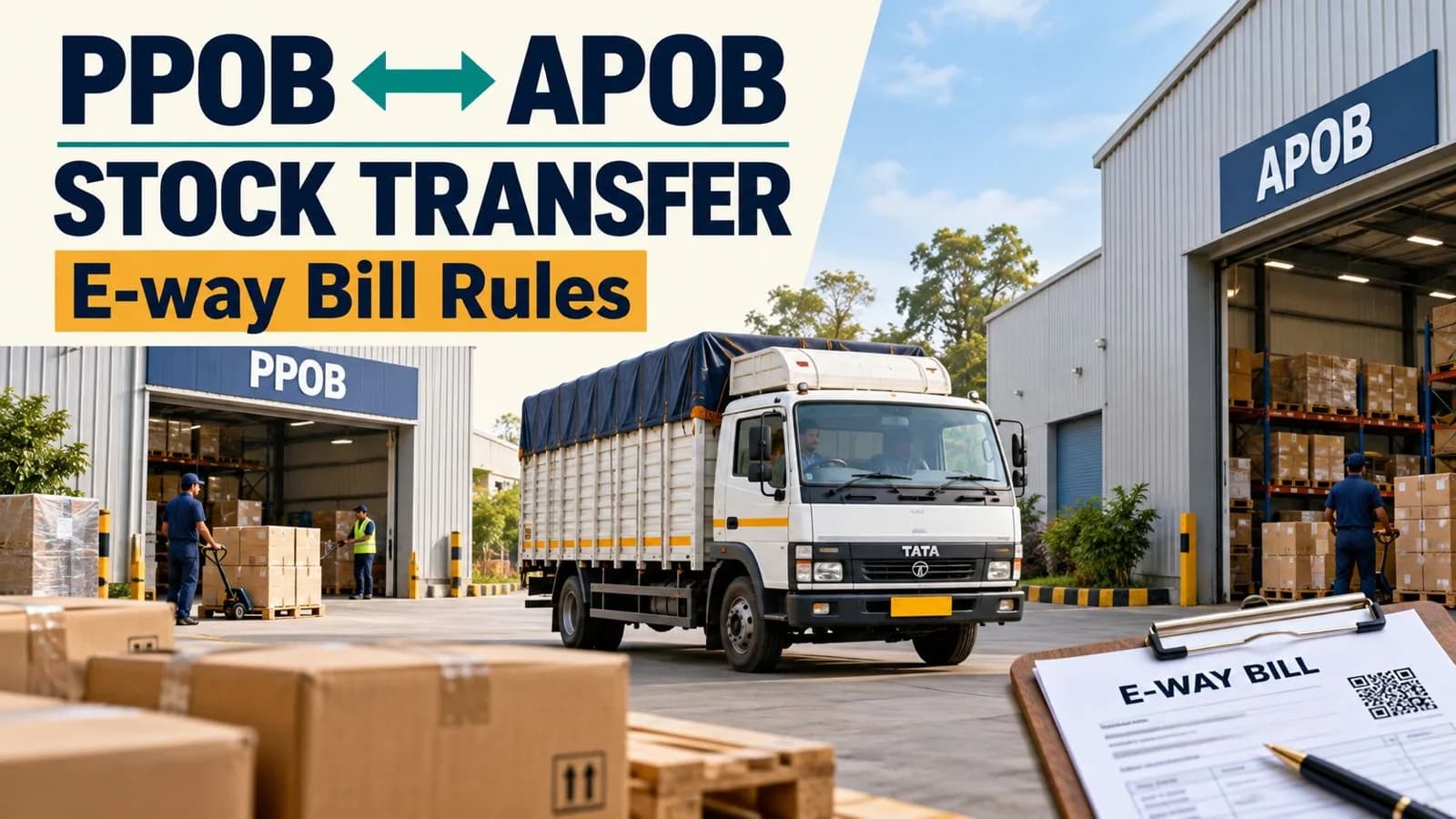
Moving goods between your principal place of business (PPOB) and an additional place of business (APOB) under the same GSTIN is not a supply, so there is no tax invoice and no GST to pay. You move the goods on a delivery challan under Rule 55 of the CGST Rules and generate an e-way bill if the consignment value exceeds ₹50,000, choosing sub-type "For own use" with document type "Delivery Challan".
Move the same goods to a warehouse registered under a different GSTIN, even your own in another state, and the answer flips. That movement is a supply between distinct persons, and it needs a tax invoice and tax.
The difference turns on one question: is the destination on the same registration certificate as the origin?
Key facts at a glance
Movement | Supply? | Document | E-way bill |
|---|---|---|---|
PPOB to APOB, same GSTIN | No | Delivery challan (Rule 55) | Yes, if value exceeds ₹50,000; Outward, For own use, Delivery Challan |
APOB back to PPOB, same GSTIN | No | Delivery challan | Yes, if value exceeds ₹50,000; Inward, For own use, Delivery Challan |
To your own GSTIN in another state | Yes, between distinct persons | Tax invoice | Yes, if value exceeds ₹50,000; supply type Supply |
To your own separately registered place in the same state (Rule 11) | Yes | Tax invoice | Yes, if value exceeds ₹50,000 |
Why movement within one GSTIN is not a supply
Supply under GST needs two persons. Every place listed on one registration certificate belongs to the same taxable person, so moving goods between them is a person moving its own stock.
Two registrations under the same PAN are different. Section 25(4) of the CGST Act treats a person with more than one registration as distinct persons for each registration, and Schedule I, para 2, makes a supply between distinct persons taxable even without consideration.
So the first thing to check before any movement is whether the destination appears on the same certificate. Our guide on how to check an additional place of business shows where to see that.
The delivery challan for PPOB to APOB movement
Rule 55 of the CGST Rules provides for a delivery challan where goods are transported for reasons other than by way of supply. Movement within one GSTIN is such a case, along with job work and a few others.
The e-way bill FAQs issued by the states confirm that the delivery challan must carry the value of the goods as required by Rule 55, and that this value is the one entered in the e-way bill. A challan without a value does not work for the e-way bill.
Number your challans in one series for the financial year and keep the copy at both places. Section 35(1) requires the accounts relating to each place of business on the certificate to be kept at that place.
How to generate the e-way bill for own-use movement
The e-way bill is needed even though there is no supply. According to the e-way bill FAQs, movement of goods for reasons other than supply still requires an e-way bill once the consignment value crosses ₹50,000. States can notify areas exempt from the requirement under Rule 138(14)(d), so check your state's notification for movement within the state.
The official e-way bill system maps own-use movement as follows:
Transaction type: Outward from the origin, or Inward when goods return to it.
Sub-supply type: For own use.
Document type: Delivery Challan.
From GSTIN and To GSTIN: both your own GSTIN, because both places are on the same registration.
Enter the delivery challan number, date and value, the APOB or PPOB address as the dispatch or ship-to place, and the vehicle details in Part B.
Validity runs from generation: one day for under 100 km and one more day for every further 100 km or part of it, according to the e-way bill FAQs.
Stock returning from a fulfilment centre
Goods coming back to your PPOB from a fulfilment centre declared as your APOB, under the same GSTIN, follow the same rule in reverse. Use Inward, For own use, Delivery Challan.
Customer returns are different. A sales return involves a buyer, so the e-way bill mapping offers a separate Sales Return type with a delivery challan. Do not label recalled unsold stock as a sales return, because no sale was made.
Moving stock to your GSTIN in another state
Stock sent from a Haryana GSTIN to your own Karnataka GSTIN is an inter-state supply between distinct persons. Raise a tax invoice, charge IGST, and generate the e-way bill with supply type Supply. The Karnataka registration takes the ITC.
Value the invoice under Rule 28 of the CGST Rules, which governs supplies between distinct or related persons. Our guide to the warehouse APOB rules explains how this links to the APOB declaration at the receiving end.
This is where most marketplace sellers make their first expensive mistake. A delivery challan is used for stock going to a fulfilment centre in another state, the receiving state treats it as an undocumented supply, and the goods are detained.
What changes after the 57th GST Council
On 8 October 2026 the GST Council recommended amendments to Sections 68, 129 and 130 of the CGST Act that change how goods in transit are checked. According to the PIB release, para 12.1:
A conveyance can be intercepted only on specific intelligence and with authorisation from an officer not below Joint Commissioner rank.
Inspection, detention or seizure can be taken only where the supplier or the recipient is located or registered in the state of interception, so no interception in transit states.
Where no e-way bill has been generated, or the vehicle carries no document showing origin or destination, goods can still be inspected, detained or seized in any state.
Confiscation under Section 130 will not apply to goods or conveyances in transit.
These are recommendations until the CGST Act is amended. Note the third point: the relief is for compliant movement. A consignment above ₹50,000 moving without an e-way bill stays exposed everywhere.
The Council also recommended reducing the maximum general penalty under Section 125 from ₹25,000 to ₹10,000. Until that amendment is in force, the current ceiling of ₹25,000 applies.
Moving stock between warehouses every week? Talk to Ankush's team about e-way bill services set up for your own-use and inter-state transfers.
Your next step: list every place your stock moves between, mark which are on the same GSTIN, and fix the document type for each route before the next dispatch.