
30
Section 61 · Form SH-7 · 30 days
Authorized Capital Increase, Ready Before the Round
Capital raised on paper by Chartered Accountants. Then raised for real.
Investors wire against shares you're allowed to issue. We check your Articles, pass the resolution, compute the stamp duty to the rupee, and file SH-7 inside 30 days - so the cap table never waits on the paperwork.
- AoA authority checked before the EGM is called
- MCA fee and state stamp duty modelled before the resolution
- SH-7 filed within 30 days and master data verified after approval
2
cost layers: MCA fee plus state stamp duty
1
MoA capital clause this changes
0
shares you can allot above the ceiling
Capital route
Does your AoA even allow it?
A capital increase can be ordinary-resolution simple, or it can need an AoA amendment and MGT-14 first.
AoA permits
Ordinary resolution under Section 61 and SH-7 within 30 days.
AoA silent
Section 14 special resolution and MGT-14 come before SH-7.
Round timed
Increase must precede allotment and PAS-3 filing.
Stamp duty modelled
State-wise duty is computed before the EGM, not after.
ROC filing desk
Authorized Capital Increase Services in India
Authorized capital is the ceiling your Memorandum puts on the shares you may issue - and every funding round, ESOP pool expansion or bonus issue must fit under it before a single share moves. Raising the ceiling is an ordinary resolution under Section 61 and Form SH-7 within 30 days, plus the two costs founders discover late: the MCA fee on the incremental capital and your state's stamp duty on top. We compute both before the EGM, not after the invoice.
The ceiling, and how it moves
An authorized capital increase is the alteration of the capital clause of a company's Memorandum under Section 61(1)(a) of the Companies Act, 2013 - approved by an ordinary resolution where the Articles permit, and notified to the Registrar in Form SH-7 within 30 days.
If the Articles do not permit the increase, Section 14 requires a special resolution and MGT-14 before SH-7. In a funding sequence, the route is term sheet, capital increase, allotment, then PAS-3 within 30 days of allotment; the ceiling must move before the shares do.
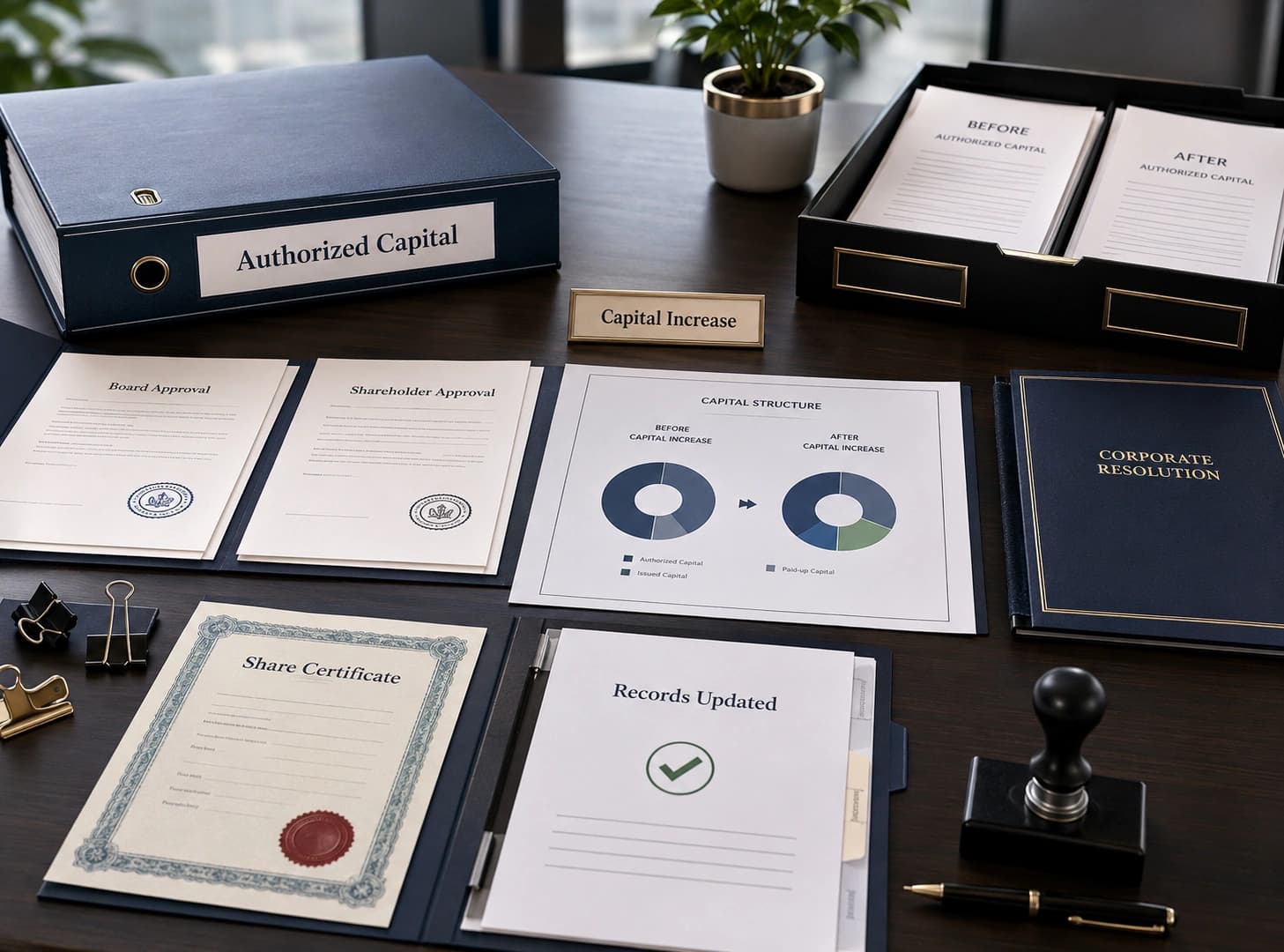
Decision table
Authorized vs paid-up vs subscribed
The funding round only works when the ceiling, subscription and paid-up records sit in the right order.
| Factor | Authorized | Subscribed | RecommendedPaid-up |
|---|---|---|---|
| Meaning | Maximum share capital allowed | Shares investors agree to take | Money actually paid on shares |
| Where stated | MoA capital clause | Subscription/allotment records | Balance sheet and registers |
| Who changes it | Members by resolution | Board/allotment process | Payment and allotment records |
| Form | SH-7 | PAS-3 where allotted | PAS-3 and accounts |
| Founder touchpoint | Before round or ESOP pool | At allotment | After money comes in |
← Scroll →
Every ROC answer changes once dates, DIN status, and MCA V3 master data are checked. We confirm the route before a form reaches certification.
Check your filing routeFiling sequence
From board note to bigger ceiling
The increase is prepared before the EGM, priced before filing, and verified before allotment starts.
- 1
AoA review
Step 1Articles are checked for a capital-increase clause.
- 2
Fee and duty
Step 2MCA fee and state stamp duty on incremental capital are computed.
- 3
Meeting papers
Step 3Board meeting, EGM notice and explanatory statement are drafted.
- 4
Resolution passed
Step 4Ordinary resolution is passed, or SR and MGT-14 first where AoA changes.
- 5
SH-7 filed
Step 5Altered MoA and resolution are filed within 30 days.
- 6
Master data checked
Step 6ROC master data is verified and allotment paperwork queued if needed.
Where it breaks
Where capital increases stall
Most delays happen because the AoA, stamp duty, SH-7 clock or PAS-3 sequencing was checked too late.
The risk
AoA silent
The increase clause is missing at the EGM.
How we handle it
We check the Articles before calling the meeting.
The risk
Wrong stamp slab
Duty is estimated using another state's rate.
How we handle it
We compute state-wise duty upfront.
The risk
Late SH-7
Filing slips into additional fee multiples.
How we handle it
We file within 30 days of resolution.
The risk
PAS-3 blocked
Allotment is ready but the ceiling is too low.
How we handle it
We move authorized capital before allotment.
Registry risk
Term sheets don't wait for SH-7
The week a round closes is the worst week to learn your ceiling is Rs.1 lakh and the investor expects Rs.15 crore of shares. The increase itself takes days when sequenced right - AoA check, EGM, SH-7 - and weeks when it isn't. We keep growing companies one resolution ahead of their cap table.
Documents
The SH-7 pack
The ROC filing rests on clean articles, a correct resolution, altered MoA and paid fee/stamp duty challans.
- Current MoA and AoA
- Board resolution
- EGM notice and explanatory statement
- Ordinary or special resolution
- Altered MoA
- Director DSCs
- MCA fee challan
- State stamp duty challan
We confirm the final list after checking the company's master data, DIN status, DSC validity, and prior-year ROC filings.
Annual retainer
Capital increase pricing
Straight SH-7
Custom quote
AoA permits increase; ordinary resolution and SH-7.
AoA amendment
Custom
Section 14 special resolution and MGT-14 before SH-7.
Funding round
Custom
Capital increase plus allotment-ready sequencing.
Retainers are scoped to your entity type, authorised capital and filing history, so we quote per company rather than publish a list price.
Get a custom quoteManaged desk
Priced before the EGM, not after
Exact fee model
Incremental authorized capital and state duty are computed before papers go out.
AoA detour
Section 14 and MGT-14 are handled where the Articles are silent.
Round sequencing
Increase, allotment and PAS-3 are ordered correctly.
Master-data proof
Updated capital is verified after SH-7 filing.
Who this fits
Why companies raise the ceiling
Pre-Series A startup
Authorized capital moves before investors receive shares.
ESOP pool
Ceiling is raised before a larger option pool converts into shares.
Bonus issue
Family business uses reserves without breaching the capital clause.
Project subsidiary
Subsidiary is capitalized for a new project before allotment.
FAQ
ROC Filing Questions
Short answers for directors who need the date, the form number, the fee consequence, and the next step before MCA V3 turns a small miss into a larger default.
Fast answersExpert support
- Authorized capital is the maximum share capital a company may issue under its MoA capital clause.
- Check AoA authority, pass the required resolution and file SH-7 within 30 days with the altered MoA.
- SH-7 is the ROC form for notice of alteration of share capital.
- Usually an ordinary resolution is enough, unless the AoA must be amended first through a special resolution and MGT-14.
- Cost includes MCA slab fee on incremental capital plus state stamp duty on the increase.
- There is no statutory minimum since the 2015 amendment, though Rs.1 lakh remains common at incorporation.
- Late SH-7 can attract additional fee multiples and residual penalty exposure.
- Yes if the proposed allotment would exceed the current authorized capital ceiling; PAS-3 follows allotment.
Related
Next ROC Filings to Check
AOC-4, MGT-7, DIR-3 KYC and event filings often move together once the annual calendar starts.
SH-7 should not become a notice
Share the company name, DIN status or AGM date. A CA-led desk will map the filing route and send the next action before the meter starts.
MCA V3 filing, certification support, challan archive.