
30
Form DIR-12 · 30 days · Sections 152-170
Director Change, Filed Right the First Time
Board changes by Chartered Accountants. Not by template downloads.
Appointments, resignations, removals - each one is a DIR-12 the Registrar expects within 30 days, sitting on a chain of consents, resolutions and an active DIN. We run the chain end to end, the week it happens.
- DIN, DIR-2, board papers and DIR-12 sequenced within 30 days
- Board minimums, resident-director rule and KYC status checked first
- DIR-11 self-defence route handled where a company will not file
2
director floor a private company can never breach
182
days in India one director must clock every year
12x
where the late-fee multiple tops out
Board movement
Which change is yours?
A director appointment, resignation, removal or redesignation carries different documents, but DIR-12 still has a 30-day clock.
Appointment
DIN, DIR-2 consent, resolution and DIR-12 move together.
Resignation
Section 168 date is fixed by receipt or stated date, whichever is later.
Removal
Section 169 special notice and hearing opportunity must come before filing.
Redesignation
Executive and non-executive changes still update MCA master data.
ROC filing desk
Director Change Services for Private Limited Companies
A director joins or leaves on paper long before the Registrar knows - and the law gives you exactly 30 days to close that gap with Form DIR-12. Behind that one form sits a chain: an active DIN, a DIR-2 consent, a properly convened resolution, and a board that never dips below its statutory minimum. We run the whole chain the week the decision is made, so the MCA master data always says what your boardroom already knows.
The 30-day window, and what fills it
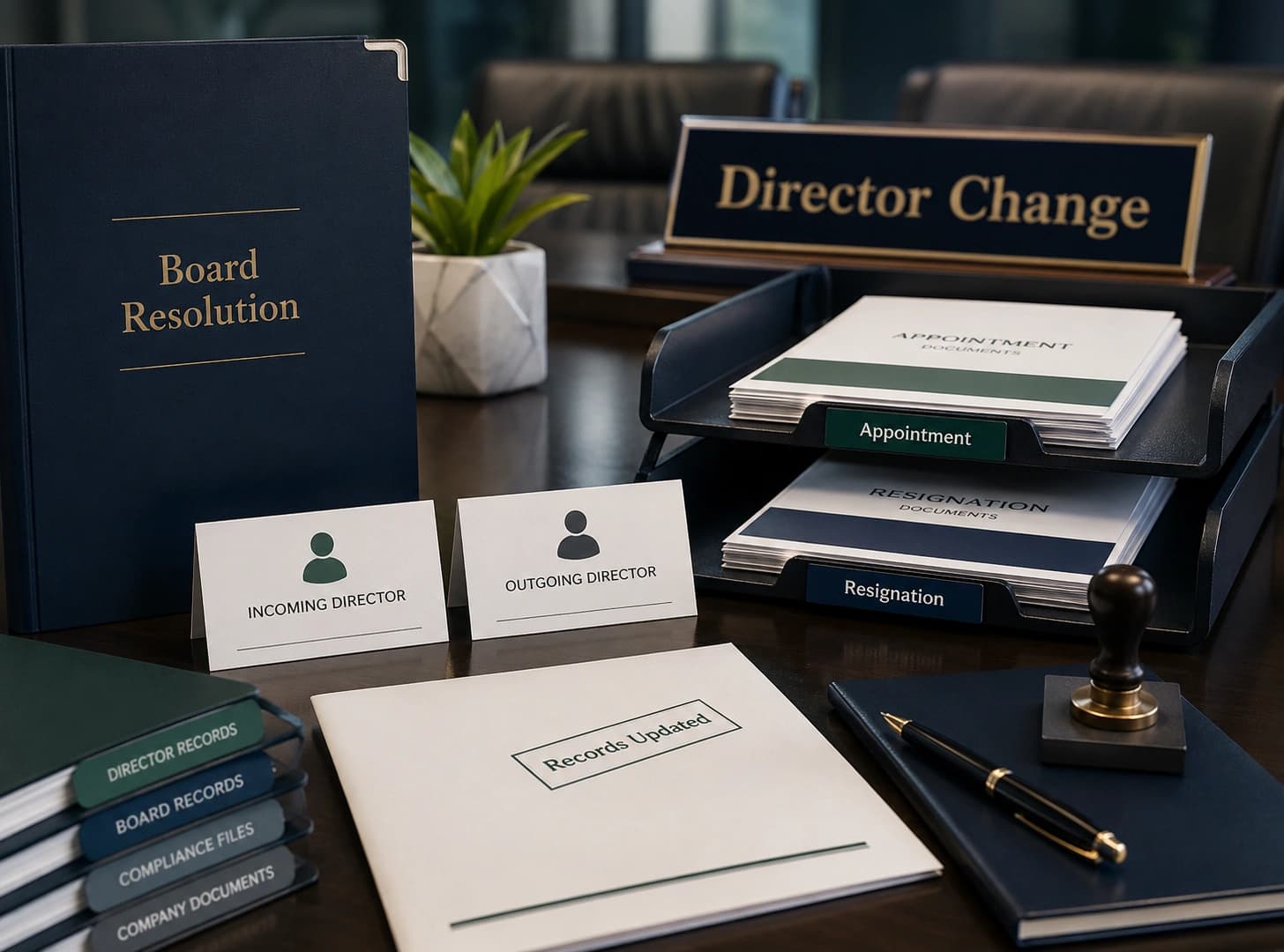
A director change is any appointment, resignation, removal or redesignation on a company's board - reported to the Registrar in Form DIR-12 within 30 days under Section 170 of the Companies Act, 2013.
For an appointment, the chain starts with an active DIN, then DIR-2 consent, then a board or shareholder resolution, then DIR-12. For resignation, Section 168 makes it effective from the date the company receives the notice or the stated date, whichever is later; DIR-11 remains the director's self-defence when the company stays quiet.
Decision table
Resignation, removal, retirement - not the same exit
Each exit has a different initiator, notice path, form strategy and protection for the person leaving.
| Factor | Resignation | Removal | RecommendedRetirement |
|---|---|---|---|
| Who initiates | Director | Shareholders | Articles/rotation |
| Governing section | Section 168 | Section 169 | Articles and Act |
| Notice | Written resignation | Special notice and hearing | Meeting papers |
| Forms | DIR-12, optional DIR-11 | DIR-12 after resolution | DIR-12 where change occurs |
| Friction | Company may not file | Dispute risk | Eligibility and timing |
← Scroll →
Every ROC answer changes once dates, DIN status, and MCA V3 master data are checked. We confirm the route before a form reaches certification.
Check your filing routeFiling sequence
From board decision to master data
A board change is complete only when MCA master data reflects the event and the records are archived.
- 1
DIN and KYC check
Step 1DIN status, DIR-3 KYC and DSC readiness are checked first.
- 2
Consents drafted
Step 2DIR-2, resignation letter or Section 169 special notice is prepared.
- 3
Meeting papers
Step 3Board, EGM and ordinary resolution documents are sequenced.
- 4
DIR-12 prepared
Step 4The form is drafted, certified and matched to the event date.
- 5
Filed in 30 days
Step 5DIR-12 is submitted before fee multiples start.
- 6
Master data verified
Step 6MCA records and internal registers are updated and archived.
Where it breaks
Where board changes go wrong
Most DIR-12 trouble starts before the form: frozen DINs, board minimums, missing notices or absent filings.
The risk
Deactivated DIN
Incoming director failed DIR-3 KYC and cannot sign.
How we handle it
We clear DIN status before the appointment chain.
The risk
Company never files
A resigned director stays on MCA records.
How we handle it
We prepare DIR-11 where self-defence is needed.
The risk
Below minimum board
Last directors try to resign together.
How we handle it
We appoint replacements before exits take effect.
The risk
Bad removal
Section 169 special notice was skipped.
How we handle it
We sequence notice, hearing and resolution first.
Registry risk
On paper, you're still the director
Resignation feels complete the day you email the letter. Legally, you remain on the register until DIR-12 says otherwise - and if the company never files it, every default that follows still carries your name. DIR-11 is the one form a director can file in self-defence. We file it for exiting directors whose companies have gone quiet.
Documents
The change pack
DIR-12 filings are supported by consents, notices, resolutions, identity proof and interest disclosures.
- DIR-2 consent
- Board/EGM resolution
- Incoming director PAN and address proof
- DSC and MBP-1
- Resignation letter
- Section 169 special notice
- Hearing record
- DIR-11 support where needed
We confirm the final list after checking the company's master data, DIN status, DSC validity, and prior-year ROC filings.
Annual retainer
Board change pricing
Appointment
Custom quote
DIN check, DIR-2, resolution and DIR-12.
Resignation
Custom quote
Section 168 record, DIR-12 and DIR-11 where needed.
Removal
Custom
Section 169 notice route and filing support.
Retainers are scoped to your entity type, authorised capital and filing history, so we quote per company rather than publish a list price.
Get a custom quoteManaged desk
A resolution template is not a process
Minimum-board math
Private, public and OPC director floors are protected.
Deadline discipline
DIR-12 is filed within 30 days of the event.
DIN readiness
DIR-3 KYC and DSC issues are caught before filing.
Master-data proof
MCA update is verified after submission.
Who this fits
Changes we file every week
Investor nominee
Startup adds a nominee director before the round closes.
Next generation
Family company brings a new director onto the board.
Silent company
A director exits when the company stops responding.
NRI director
Foreign appointment planned with DIN and 182-day resident rule in mind.
FAQ
ROC Filing Questions
Short answers for directors who need the date, the form number, the fee consequence, and the next step before MCA V3 turns a small miss into a larger default.
Fast answersExpert support
- Check DIN and DIR-3 KYC, take DIR-2 consent, pass the resolution and file DIR-12 within 30 days.
- DIR-12 reports appointment, resignation, removal or designation change of a director to the ROC.
- Under Section 168, resignation takes effect from company receipt or the stated date, whichever is later.
- DIR-11 is the resigning director's optional self-filing, useful when the company does not file DIR-12.
- Removal generally follows Section 169 with special notice, opportunity to be heard and ordinary resolution before DIR-12.
- A private company needs 2 directors, a public company 3, and an OPC 1.
- Late DIR-12 can attract additional fee multiples up to 12x and Section 172 penalty exposure.
- Yes. Board changes during the year are also reported in the annual return MGT-7.
Related
Next ROC Filings to Check
AOC-4, MGT-7, DIR-3 KYC and event filings often move together once the annual calendar starts.
DIR-12 should not become a notice
Share the company name, DIN status or AGM date. A CA-led desk will map the filing route and send the next action before the meter starts.
MCA V3 filing, certification support, challan archive.