Most GST applications are not rejected because the business was fake. They are rejected because a document did not match another document, or because an officer asked for something and nobody knew whether he was entitled to ask for it.
Since April 2025 there has been a clear answer to that second problem, and very few people are using it. CBIC Instruction No. 03/2025-GST fixes exactly which documents are sufficient for each type of premises, and expressly tells officers what they may not demand. If you are registering through a virtual office address, this instruction is the single most useful thing you can have read before you file.
I am Keshav Sehgal from ComplyLocal Consultants. This is the working checklist my team uses on multi-state applications, organised the way the instruction organises it.
Why this instruction exists
Instruction No. 03/2025-GST was issued on 17 April 2025, superseding Instruction No. 03/2023-GST dated 14 June 2023. The reason is stated plainly in the instruction itself: officers were seeking clarifications and additional documents not prescribed in the list appended to FORM GST REG-01, and genuine applicants were being harassed while the department tried to stop fraudulent registrations.
The instruction analyses what REG-03 notices were actually being issued for and finds three recurring causes — proof of principal place of business, constitution of business, and identity details of the owner or authorised signatory. It then removes the discretion around each one.
The two document sets
Every application has two halves. The premises half proves you have a right to the address. The entity half proves who you are. Virtual office applications fail on the premises half almost every time, so that is where most of this guide sits.
Premises documents, by possession type
Find your row. In each case, "any ONE" means exactly that — the instruction states that one document from the list is sufficient and no additional document should be requested.
Possession type | What is sufficient | What the officer cannot demand |
|---|---|---|
Owned by you | Any ONE of: latest property tax receipt, municipal khata copy, electricity bill, water bill, or a similar document prescribed under state or local law that clearly establishes ownership | Additional ownership documents. Original physical copies. The instruction says a query should not be raised seeking originals |
Rented or leased, agreement registered | The registered rent or lease agreement plus any ONE ownership document of the lessor from the list above | Identity proof of the lessor |
Rented or leased, agreement not registered | The agreement, plus any ONE ownership document of the lessor, plus a copy of the lessor's identity proof | The lessor's PAN card, Aadhaar card, or a photograph of the lessor in front of or inside the property |
Electricity or water connection in your own name | That utility document plus the rent agreement | Any documents pertaining to the lessor at all |
Premises owned by spouse, relative or similar | A consent letter on plain paper from the owner, plus a copy of the consenter's identity proof, plus any ONE ownership document of the consenter | Additional documents from the applicant |
Shared premises, agreement available | The agreement plus any ONE ownership document. Add the lessor's ID only where the agreement is unregistered | Lessor ID where the agreement is registered |
Shared premises, no agreement | A consent letter on plain paper from the consenter, the consenter's identity proof, and any ONE ownership document of the consenter | Additional documents |
Rented but the agreement is genuinely unavailable | An affidavit to that effect on non-judicial stamp paper of minimum value, sworn before a First-Class Judicial Magistrate, Executive Magistrate or Notary Public, plus a possession document such as an electricity bill in your name | — |
Premises in a Special Economic Zone | The necessary SEZ documents or certificates issued by the Government of India | — |
Where a virtual office actually sits in this table
A standard virtual office pack is an agreement in your legal name, the provider's ownership document for the premises, and an owner NOC. Depending on how the provider papers it, that lands in the shared premises with an agreement row or the rented, agreement not registered row. Both are inside the instruction. Neither requires anything exotic.
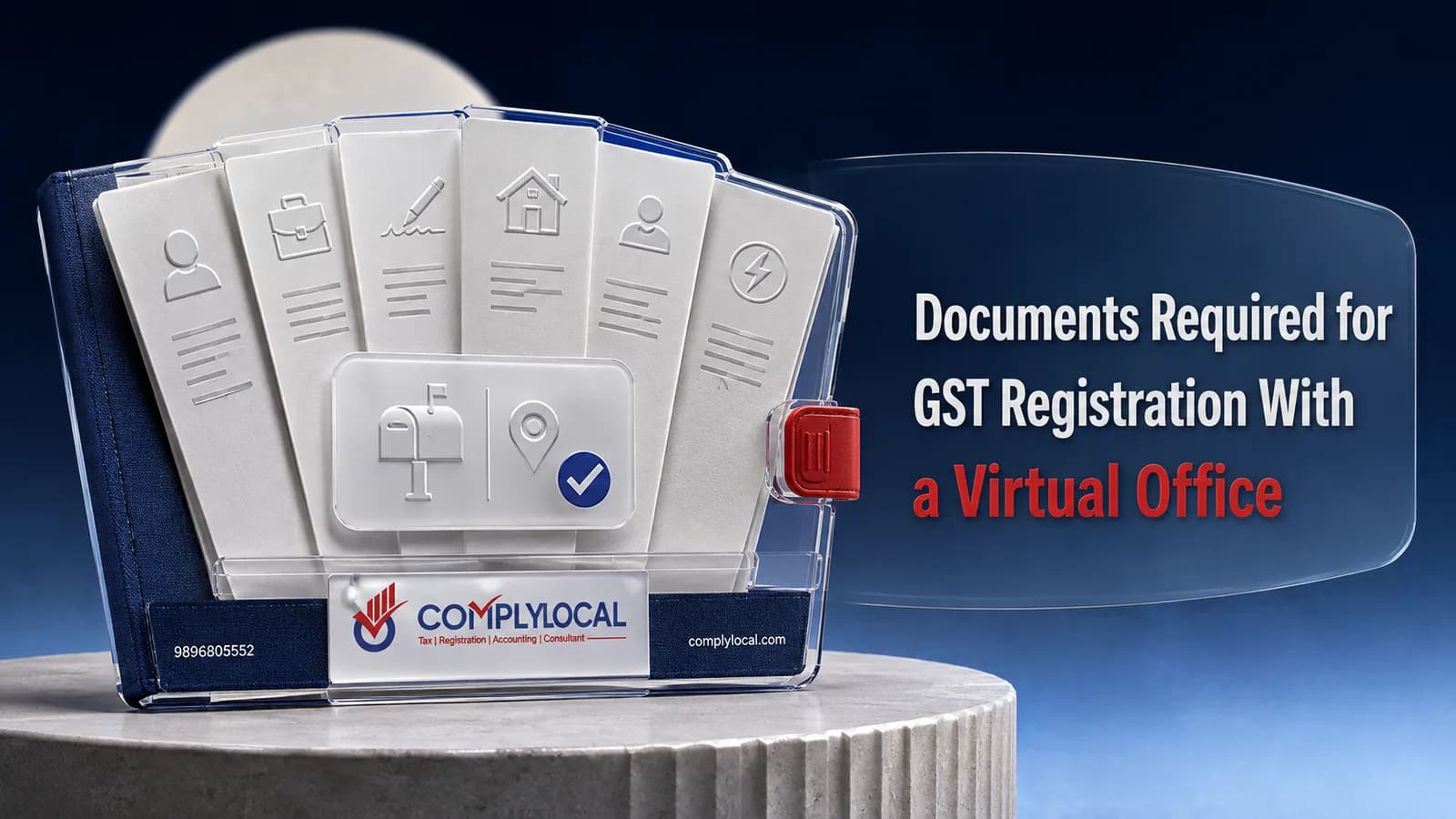
This is why the phrase "verification-ready document pack" is not marketing filler. A properly assembled virtual place of business file is one where the possession category, the agreement, the ownership proof and the NOC were chosen to sit together in a single row of that table before anything was uploaded.
Entity documents
The instruction is equally firm on the constitution side. For a partnership firm, the partnership deed alone is required — and officers are told not to seek an Udyam certificate, MSME certificate, shop and establishment certificate or trade licence. For a society, trust, club, government department, association of persons, body of individuals, local authority or statutory body, the registration certificate or proof of constitution is what is required.
Entity type | Constitution proof required |
|---|---|
Proprietorship | PAN of the proprietor; no separate constitution document |
Partnership firm | Partnership deed only |
LLP | Certificate of incorporation / registration |
Private limited or public company | Certificate of incorporation |
Society, trust, club, AOP, BOI, local authority, statutory body | Registration certificate or proof of constitution |
Alongside constitution proof you will need the photograph, PAN and Aadhaar of the authorised signatory and of promoters or partners as applicable, plus a board resolution or authorisation letter appointing the authorised signatory where the entity type requires one.
The three questions officers are not allowed to ask
Paragraph 7 of the instruction addresses "unwarranted documents being sought by raising presumptive queries" and names them. These are worth knowing verbatim because two of the three hit out-of-state applicants directly:
That the residential address of the applicant, managing director or authorised signatory is not in the same city or state where registration is sought.
That the HSN code of the goods mentioned in the application is banned or prohibited for sale in the state where the applicant wishes to do business.
That the kind of activity mentioned in the registration application cannot be conducted from those particular premises.
The instruction concludes that officers handling registration applications should not ask any presumptive query unrelated to the documents or information submitted. It also provides that where a document outside the listed set is genuinely needed, the officer must obtain approval from the concerned Deputy or Assistant Commissioner before asking for it.
The address string: where applications actually die
More rejections trace to this than to any other cause, and it is entirely preventable. Your address appears in at least three places — the agreement, the ownership or utility document, and the REG-01 field. All three must say the same thing.
Document | Common mistake | What it should say |
|---|---|---|
Agreement | Unit 4B, 2nd Floor, Shree Aarambh, DLF Colony | One canonical string agreed before drafting |
Electricity bill | 4-B, Shree Aarambh Building, DLF Cly. | The same canonical string, allowing only for the utility's fixed formatting |
REG-01 field | 402, Shree Arambh, DLF Colony | Copied, never retyped — including spelling of the building name |
Two practical rules. First, agree the exact address string with your provider in writing before any document is drafted, then copy and paste it everywhere. Second, check the building name spelling — "Aarambh" against "Arambh" is enough to generate a query, and a query costs you a week even when you win it.
What a good NOC contains
A generic NOC is one of the most common weak points. The owner writing "we have no objection to the use of the premises" is not saying the thing the officer needs to see. A usable NOC states:
The full name and address of the owner or lessor granting consent.
The complete premises address, matching the canonical string exactly, including unit or floor reference.
The full legal name of your entity, as it appears on your PAN.
Express consent to use the premises as a place of business and for the purpose of GST registration.
The date, and the owner's signature.
Document format and upload
The portal enforces file format and size limits on uploads, and these change from time to time. Check the current limits on the GST portal before you scan rather than relying on a figure quoted in an article, including this one. What does not change is the practical requirement: the instruction directs officers to ensure documents are legible, complete and relevant, and permits a REG-03 where a document is incomplete or not legible. A blurred phone photograph of a rent agreement is a self-inflicted rejection.
The four grounds a REG-03 can be issued on
If a notice does arrive, check it against the permitted grounds. Under the instruction the officer may issue FORM GST REG-03 where:
A document is incomplete or not legible, in which case a complete or legible copy may be sought.
The address of the place of business does not match the document uploaded, or the uploaded document does not appear to be valid proof of that address.
The address is incomplete or vague, in which case complete and unambiguous details with documentary proof may be sought.
A GSTIN linked to the applicant's PAN is found cancelled or suspended, in which case clarification may be sought.
You have 7 working days to reply in FORM GST REG-04. Address the ground actually raised and attach evidence for it — a reply that restates your original position without new proof rarely succeeds. If the notice is asking for something outside the listed document set, saying so politely and citing the instruction is a legitimate reply. We handle this routinely as part of GST notice and litigation support.
Documents you will need later, but not now
The registration is not the finish line for a marketplace seller. Once the GSTIN is issued you will need a fresh document set to add the fulfilment centre as an additional place of business — typically the marketplace's own address confirmation or agreement for that warehouse. That is a separate core-field amendment, and it has to be completed before your stock arrives there. Getting the registration and the amendment sequenced correctly is most of the work in a multi-state expansion.