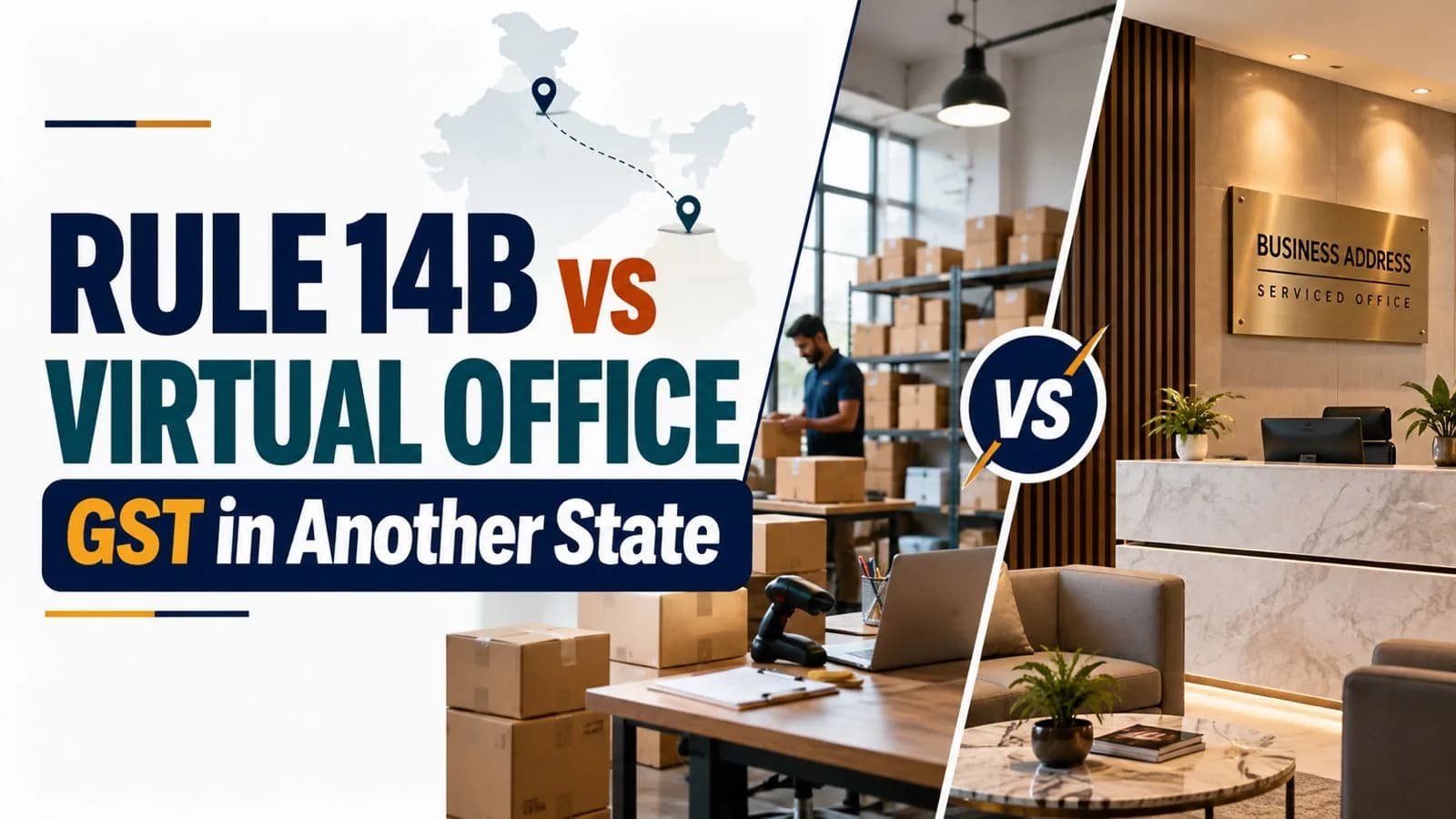
Choose Rule 14B if you sell goods only through marketplaces, mostly to consumers, and can wait for the rule to be notified. Choose a virtual office GSTIN if you sell to registered businesses at scale, sell through your own website or offline in that state, sell services, or need the registration before CBIC notifies Rule 14B.
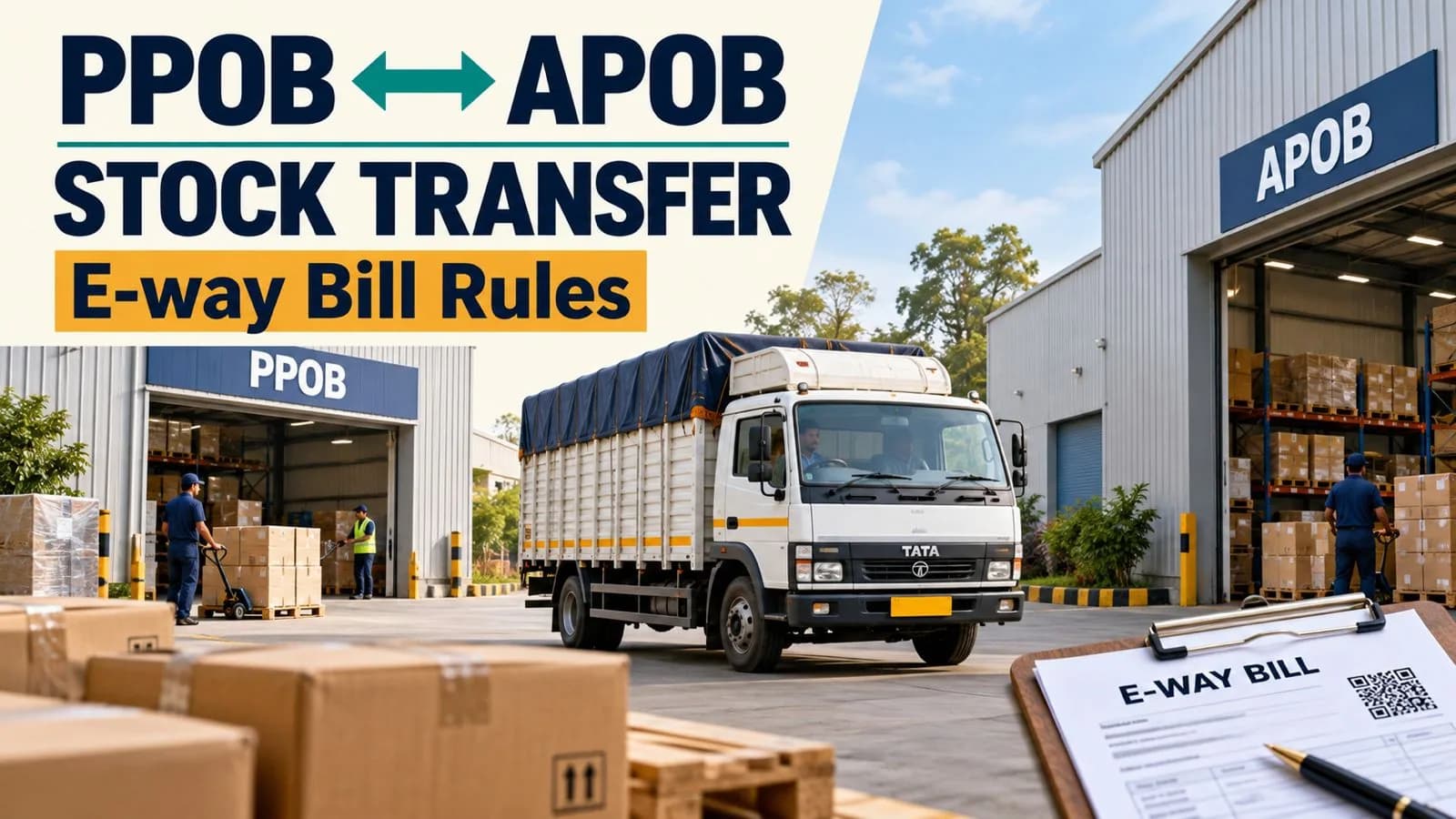
Rule 14B was recommended by the 57th GST Council on 8 October 2026. It lets a small supplier of goods through an e-commerce operator declare the operator's warehouse in another state as its principal place of business (PPOB), with registration granted automatically. A virtual office does the same job today with premises you contract for yourself.
Both routes give you a GSTIN in the new state. They differ in who controls the address, which sales the registration covers, and when you can use them.
Key facts at a glance
Question | Rule 14B (recommended) | Virtual office route |
|---|---|---|
Status on 9 October 2026 | Recommended by the GST Council; not yet notified | Available now |
Whose address is the PPOB? | The e-commerce operator's warehouse | Premises you contract for, with your own documents |
Approval | Automatic grant by the system, subject to conditions | Officer processing under CBIC Instruction No. 03/2025-GST |
ITC you can pass on | Up to ₹2.5 lakh a month, stock transfers excluded | No limit |
Sales covered | Expected to be platform supplies only | Every supply from that state |
Goods or services | Goods only | Both |
The deciding questions, in order
Run through these four questions before you commit to either route. The first one that points to a virtual office settles it.
Do you supply services, or goods? Rule 14B covers supplies of goods through e-commerce operators. A service provider needs its own premises.
Does your ITC passed on exceed ₹2.5 lakh in any month? Add up the tax on invoices to GST-registered buyers in your recent GSTR-1 filings. Above the limit, Rule 14B is closed to you.
Will you sell in that state outside the marketplace? Your own website, a distributor, or a retail counter all fall outside platform supplies, which press briefing reports say the Rule 14B registration will be limited to.
Do you need the GSTIN before the rule is notified? If the launch date is fixed, the virtual office route is the only one that exists today.
If you answered goods, no, no and no, plan for Rule 14B.
When Rule 14B is the better choice
Rule 14B suits the seller it was designed for: small, B2C, marketplace-only, expanding into a state where it has nothing on the ground. For that seller it removes three costs at once.
The first is the yearly fee for a virtual office in each state. The second is the verification exposure: under para 8(iii) of Instruction No. 03/2025-GST, an application flagged as risky goes to physical verification and can take up to 30 days. The third is the risk of an address that fails a visit later, which our guide to a GST notice on a virtual office address covers in detail.
A Rule 14B registration, as recommended, avoids all three because the PPOB is a warehouse that physically exists and the grant is automatic.
When a virtual office still wins
A virtual office gives you a registration that covers everything you do in the state. That breadth is the point for three kinds of seller.
B2B-heavy sellers. A seller supplying registered retailers or restaurants through a B2B marketplace will cross ₹2.5 lakh of ITC passed on quickly. At 18% GST, that is roughly ₹13.9 lakh of taxable B2B sales in a month.
Multi-channel brands. A D2C brand shipping from its own website into Maharashtra, while also stocking an Amazon fulfilment centre there, needs one registration that covers both channels.
Sellers who cannot wait. A seller with a festival-season launch booked for November cannot plan around a rule whose notification date is unknown.
If any of these is you, the virtual office route is not a stopgap. It is the correct structure, and our explainer on what GST law requires from a virtual office sets out the documents that hold up.
Who controls the address
This is the difference most sellers overlook. Under Rule 14B your PPOB is the operator's warehouse, so your registration depends on a building you have no contract for.
Reports of the press briefing say the operator's consent is needed to declare its warehouse. That means the operator decides whether you can use it, and a warehouse closure, relocation or end of your seller account would leave your registration without a PPOB. How the rules will handle that is not yet known.
With a virtual office, the agreement is yours. You can renew it, change provider through a core field amendment, or keep the registration alive while you change marketplaces. Our position: a seller that expects to stay in a state for years, or to work with more than one marketplace there, should value that control.
If you already hold a virtual office GSTIN
Keep it. The 57th GST Council release describes registration for suppliers without physical presence in a state and says nothing about converting existing registrations. Cancelling a working GSTIN in the hope of re-registering under Rule 14B risks a gap in which you cannot sell from that state.
Review the question again once the notification is out. If a migration path is provided and your profile fits, compare the yearly virtual office fee against the cost of a cancellation, a final return in FORM GSTR-10 and a fresh registration.
A practical plan for the next 60 days
Your situation | What to do now |
|---|---|
Marketplace-only B2C seller, launch can wait | Finalise products and stock plans; apply once Rule 14B is notified |
Marketplace-only B2C seller, launch fixed for this quarter | Register through a documented virtual office now |
B2B or multi-channel seller | Register through a virtual office; Rule 14B does not fit your model |
Already registered through a virtual office | Keep the GSTIN; revisit after the notification |
Service provider | Rule 14B does not apply; use your own premises in the state |
Not sure which route fits your next state? Talk to Keshav's team about a virtual place of business and whether you should wait for Rule 14B instead.
Your next step: answer the four deciding questions for each state on your expansion list, and mark which states can wait for Rule 14B and which cannot.