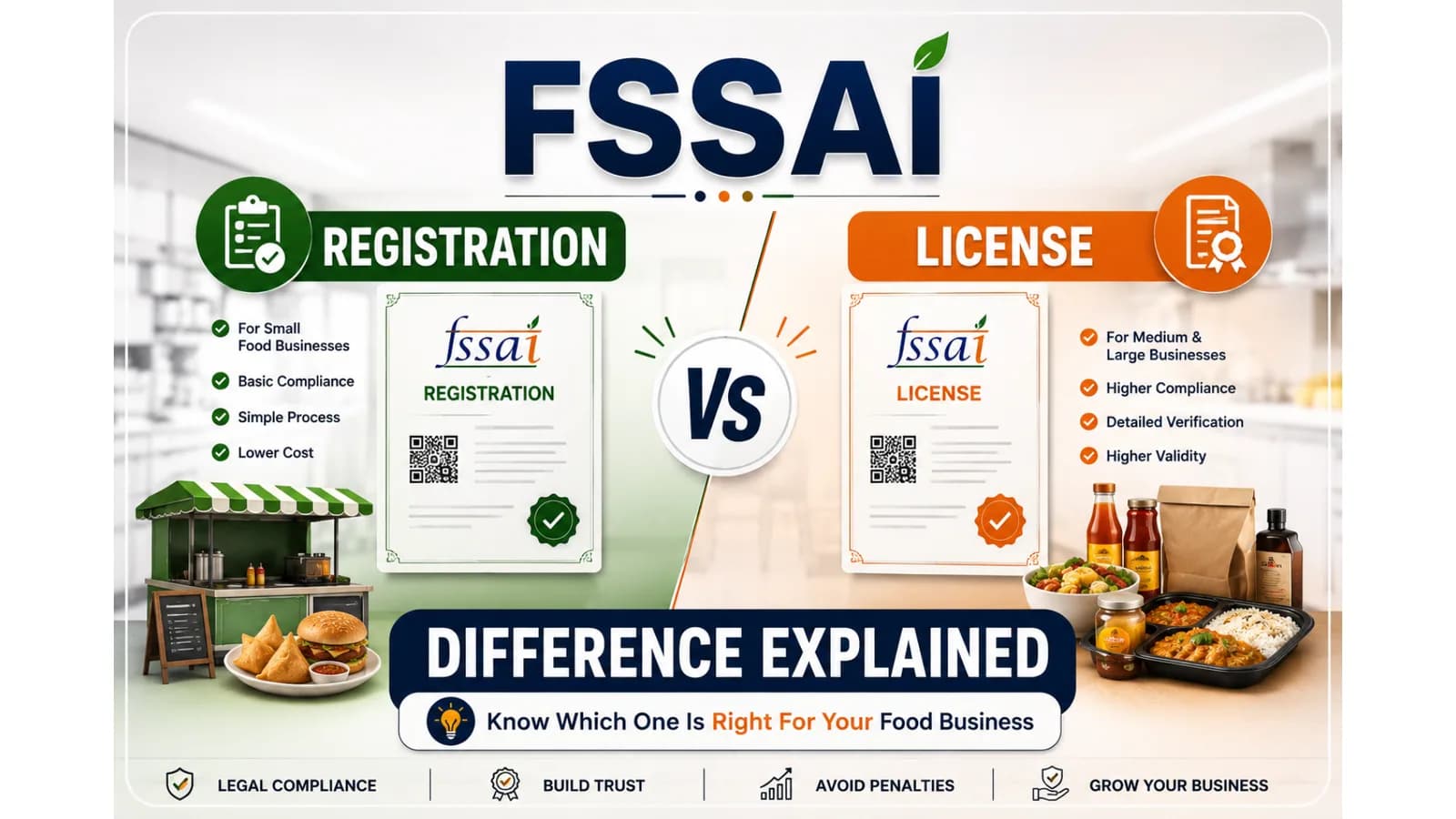
FSSAI registration and an FSSAI licence are two different approvals under the same Act. Registration covers petty Food Business Operators with turnover up to ₹1.5 crore, filed in Form A at ₹100 a year. A licence covers everyone above that ceiling, and every licence-only category, filed in Form B.
Most comparisons stop at turnover. The differences that actually cost money sit elsewhere: the enabling sub-section, the penalty if you get caught without one, and a list of business types that can never use registration however small they are.
FSSAI registration vs licence at a glance
Parameter | Registration | Licence |
|---|---|---|
Enabling provision | Section 31(2), FSS Act, 2006 | Section 31(1), FSS Act, 2006 |
Who it covers | Petty Food Business Operators | Everyone else, plus licence-only categories |
Turnover band | Up to ₹1.5 crore | Above ₹1.5 crore (State), above ₹50 crore (Central) |
Application form | Form A | Form B |
Government fee | ₹100 per year | ₹2,000 to ₹5,000 (State); ₹7,500 (Central) |
Physical inspection | Normally none | Usually required |
Penalty if operating without it | Up to ₹2 lakh (Sections 55 and 58) | Up to ₹10 lakh (Section 63) |
Certificate | 14-digit registration number | 14-digit licence number |
What is the legal difference between registration and licence?
Section 31(1) of the FSS Act, 2006 states the general rule: no person shall carry on a food business except under a licence. Section 31(2) then creates the exception, allowing petty Food Business Operators to register instead. Registration is not a smaller licence. It is a separate route out of the licensing requirement.
That structure explains everything downstream. Registration uses a lighter form and a smaller document set, and the FSSAI document checklist for Form A runs to three items where Form B runs to a dozen or more.
The penalty difference most comparisons miss
Operating without a required licence attracts a penalty of up to ₹10 lakh under Section 63, as amended by the Jan Vishwas (Amendment of Provisions) Act, 2023, which came into force for the FSS Act on 8 November 2023 and removed the earlier six-month imprisonment term.
Section 63 does not reach petty operators. It applies except to persons exempted from licensing under Section 31(2), which is exactly the provision registrants use. A business that should have registered and did not falls under the residual provisions, Sections 55 and 58, at up to ₹2 lakh. The FSSAI penalty position is set out in full separately.
[VERIFY: confirm the Sections 55, 58 and 63 ceilings against the bare FSS Act, 2006 as amended, and have a CA or advocate sign off on the registration-versus-licence reading before publishing.]
Which businesses can never use FSSAI registration?
Some kinds of business must hold a licence at any turnover. Being under ₹1.5 crore does not help if you fall in one of these groups, and this is where wrongly filed Form A applications come from.
Kind of business | Minimum approval |
|---|---|
Caterers, including event and mid-day-meal caterers | State Licence |
Hotels below 5-star serving food | State Licence |
Importers of any food product | Central Licence |
E-commerce food businesses and online food platforms | Central Licence |
Nutraceuticals, health supplements, proprietary foods | Central Licence |
Businesses operating in more than one state | Central Licence |
Caterers are the sharpest case. The 2026 amendment rewrote the definition of a petty Food Business Operator and carved them out in three words, "except a caterer", so a home cook taking event orders is outside registration on definition rather than on revenue.
Does the instant route work for both?
The Tatkal route covers registrations and licences, but its eligibility list is drawn on kind of business rather than on tier. Food manufacturers and processors are excluded from instant issuance whether they would be registering or licensing.
What changes when you move from registration to licence?
Crossing ₹1.5 crore means applying afresh in Form B rather than amending Form A. Expect a larger document set, a likely physical inspection, and a fee that moves from ₹100 to at least ₹2,000 a year. Our guide to the FSSAI turnover thresholds covers the bands and the effective dates. For the tier itself, see State FSSAI Licence filing.
Mistakes people make between the two
Calling registration a "basic licence". It is legally a different instrument, and the penalty exposure differs by ₹8 lakh.
Assuming turnover alone decides it. Kind of business overrides turnover in several categories.
Trying to amend a Form A registration upward instead of filing Form B.
Quoting the Section 63 penalty for a missing registration. Wrong section, wrong tier, wrong number.
Waiting for a notice before upgrading after crossing the ceiling. The duty to move up is yours.
What we see on tier decisions at Complylocal
[EXPERT INPUT NEEDED: Keshav Sehgal to add one real, anonymised observation. Strongest options: (a) how often clients arrive holding a registration when their kind of business required a licence, as a proportion of FSSAI files we take on; (b) a client who crossed ₹1.5 crore and what the Form A to Form B transition actually took in days and fees; (c) the most common tier misjudgement we correct before filing. One real number required.]
Not sure which tier applies to you? Talk to Keshav’s team at Complylocal for FSSAI registration support.
Official sources
Food Safety and Standards Act, 2006, Section 31(1) and Section 31(2), and Sections 55, 58 and 63.
FSS (Licensing and Registration of Food Businesses) Regulations, 2011, Form A and Form B under Schedule 2, and fees under Schedule 3.
FSS (Licensing and Registration of Food Businesses) Amendment Regulations, 2026, notified 10 March 2026 and published in the Gazette of India on 11 March 2026.
FSSAI order dated 13 March 2026, revised turnover thresholds effective 1 April 2026.
Jan Vishwas (Amendment of Provisions) Act, 2023, amending Sections 59, 61 and 63 of the FSS Act.