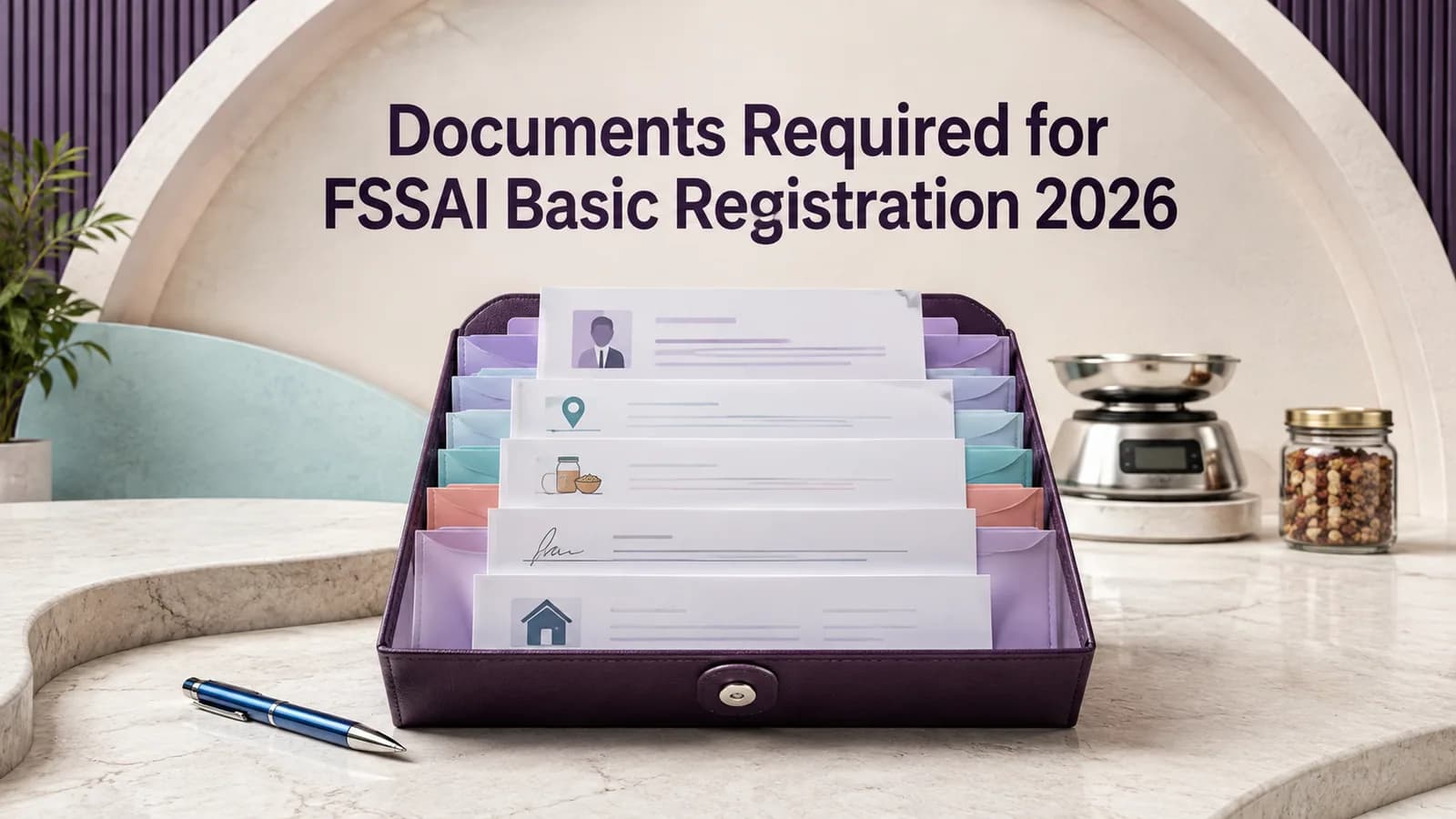
FSSAI basic registration needs three documents on FoSCoS: a passport-size photograph, a government-issued photo ID such as Aadhaar, PAN or Voter ID, and proof of the business address, which applies only if that address differs from the one on your photo ID. Every upload must be self-attested.
That is the entire list FSSAI publishes for a Registration Certificate. Search results will hand you eight or ten items instead: bank details, a cancelled cheque, a water test report, a board resolution. Those belong to State and Central Licence applications. Treating them as mandatory is what stops small operators from filing at all.
FSSAI basic registration documents at a glance
Item | Position as on 27 August 2026 |
|---|---|
Documents FSSAI lists | Three: photograph, government photo ID, address proof if different from the ID |
Where the list is published | FoSCoS, Documents required for Registration Certificate (foscos.fssai.gov.in) |
Application form | Form A, Schedule 2 of the FSS (Licensing and Registration of Food Businesses) Regulations, 2011 |
Statutory declaration | Self-attested declaration of Part I, Schedule 4 hygiene compliance, in the Annexure 1 format under Schedule 2 |
Attestation | Every document self-attested by the proprietor or authorised signatory before upload |
Who can use this route | Food businesses up to ₹1.5 crore turnover (FSSAI order dated 13 March 2026, effective 1 April 2026) |
Government fee | ₹100 per year |
What documents does FSSAI require for basic registration?
FSSAI requires three documents for a Registration Certificate, and it publishes them on FoSCoS in exactly this order.
# | Document | What it does |
|---|---|---|
1 | Photograph | Recent passport-size photo of the applicant. It is printed on the registration certificate alongside the QR code. |
2 | Government-issued photo ID | Aadhaar, PAN, Voter ID or similar, for the proprietor or authorised applicant. |
3 | Proof of address of business activity | Required only where the business address is different from the address on the photo ID. |
The regulation itself asks for even less. Regulation 2.1.1 of the FSS (Licensing and Registration of Food Businesses) Regulations, 2011 requires a petty Food Business Operator to file Form A under Schedule 2 with the fee under Schedule 3, plus a self-attested declaration that the business follows the Part I, Schedule 4 hygiene requirements, in the format at Annexure 1 of Schedule 2. On FoSCoS that declaration is built into the form, so you tick it rather than upload it.
Why most FSSAI document checklists are wrong
The long checklists you find online are State and Central Licence lists reused for the registration tier. A water test report, a layout plan, an equipment list, a Food Safety Management System plan and Form IX all attach to Form B applications, not to Form A.
Two of the most-repeated extras are worth naming. A cancelled cheque or bank passbook is not on the FSSAI registration list. Neither is an NOC from the local municipal or health authority, which appears in some State FSSAI Licence documents sets. If your kind of business sits in a licence-only category, you are filing Form B anyway, and the Central FSSAI Licence requirements are a different document set again.
Which photo ID does FoSCoS accept for registration?
Aadhaar, PAN and Voter ID are named on the FSSAI list, and a passport or driving licence is accepted on the same footing as a government-issued photo ID. Use the ID of the proprietor for a proprietorship, or of the authorised signatory where the business is a firm or a company.
Pick Aadhaar if the address on it matches your business premises. Document three then falls away entirely, and you file with two uploads instead of three. This one choice is the difference between a five-minute application and an evening spent hunting for a utility bill.
When do you need separate proof of the business address?
You need address proof only when the address of the business activity is different from the address printed on your photo ID. A home baker whose Aadhaar shows the same house needs nothing further. A shop in a rented unit, a cloud kitchen in another locality, or an operator whose Aadhaar still shows a previous city all need document three.
FoSCoS commonly accepts a recent electricity or utility bill, a rent or lease agreement, or an ownership document such as a property tax receipt or sale deed. Where the premises are rented or shared, carry a no-objection letter from the owner in case the officer asks for it.
[VERIFY: FSSAI does not publish an exhaustive list of acceptable premises proofs for the registration tier. Confirm the accepted set and any recency condition on FoSCoS before publishing this paragraph as definitive.]
Type the address into Form A exactly as it appears on the proof, punctuation included. If the premises change later, you file an FSSAI licence modification rather than a fresh registration.
Do documents change with your business structure?
The official three do not change. What changes is whose photo ID goes in, and what the officer may also ask for when the applicant is not an individual.
Business structure | Whose photo ID | What an officer may also seek |
|---|---|---|
Proprietorship or home kitchen | Proprietor | Nothing beyond the three |
Partnership firm | Any authorised partner | Partnership deed |
LLP or company | Authorised director or designated partner | Certificate of incorporation, and authorisation for the signatory |
Society or trust | Authorised office bearer | Registration certificate of the society or trust |
Keep the constitution document ready as a scan rather than uploading it unasked. FSSAI lists it for licence applications, not for registration, and an unrequested upload in the wrong slot is its own reason for a query.
Extra documents for instant registration
Instant registration, the route that grants the certificate on the spot for eligible petty FBOs, asks for more identity detail than the standard Form A path. Reported requirements are PAN together with Aadhaar for most petty categories, Aadhaar alone for petty snack and tea shops and for hawkers, and a photograph of the premises in every case, showing the signboard or address with the applicant in frame.
[VERIFY: the instant registration document set, the premises-photograph specification, and the list of states where the route is not enabled are sourced from secondary reporting. Confirm on FoSCoS before publishing this section.]
How to prepare your documents for FoSCoS
Self-attest every document. FSSAI requires uploads to be self-attested by the proprietor or authorised signatory.
Scan legibly rather than photographing at an angle. An unreadable ID is a query, and a query costs days.
Match the applicant name character for character across the photo ID, Form A and the premises proof.
Match the premises address character for character between the proof and Form A, including flat and plot numbering.
Keep the food product list ready before you start, because Form A asks for your kind of business and products in the same session.
[VERIFY: current FoSCoS file format and per-file size limits. Secondary sources cite PDF under 1 MB, but FSSAI does not publish this consistently. Confirm on the portal and insert the exact specification, or drop the claim.]
Document mistakes that get registration applications reverted
Uploading a licence document set. A water test report or layout plan on a Form A application signals the wrong category to the officer.
Address mismatch between the premises proof and Form A. The single most common revert, and entirely preventable.
Using an ID in a different name from the applicant, such as a spouse’s Aadhaar for a home kitchen. The photo ID and the applicant must be the same person.
Skipping address proof when the business address does differ from the ID. Document three is conditional, not optional.
Uploading an unattested scan. Self-attestation is required on every document.
Choosing the wrong kind of business before uploading. The KoB decides your category, and a licence-only KoB cannot be saved by a clean document set.
What we see on these filings at Complylocal
[EXPERT INPUT NEEDED: Keshav Sehgal to add one real, anonymised observation from Complylocal FSSAI filings. Strongest options: (a) the share of Form A queries we handle that trace to the premises-proof address mismatch, with an actual proportion or count; (b) a client who delayed filing for weeks because a competitor checklist told them a water test report and cancelled cheque were mandatory, and what the filing actually took once corrected; (c) the document defect our team most often catches before submission. One real number required. Do not publish this section empty.]
Want the documents checked before you file? Talk to Keshav’s team at Complylocal for FSSAI basic registration filing.
Related reading
Not sure the registration tier is the right one for you? Check the FSSAI turnover limit and the categories that need a licence whatever their turnover.
Official sources
FoSCoS, Documents required for Registration Certificate, foscos.fssai.gov.in.
FSS (Licensing and Registration of Food Businesses) Regulations, 2011, Regulation 2.1.1, Form A and Annexure 1 under Schedule 2, and Part I of Schedule 4.
FSSAI order on Kind of Business wise documents to be submitted with licence applications, and the FoSCoS Kind of Business eligibility matrix.
FSSAI order dated 13 March 2026, F. No. RCD-01002/1/2021-Regulatory-FSSAI-Part(1), revised turnover thresholds effective 1 April 2026.
FSSAI Licensing and Registration FAQs published on foscos.fssai.gov.in.