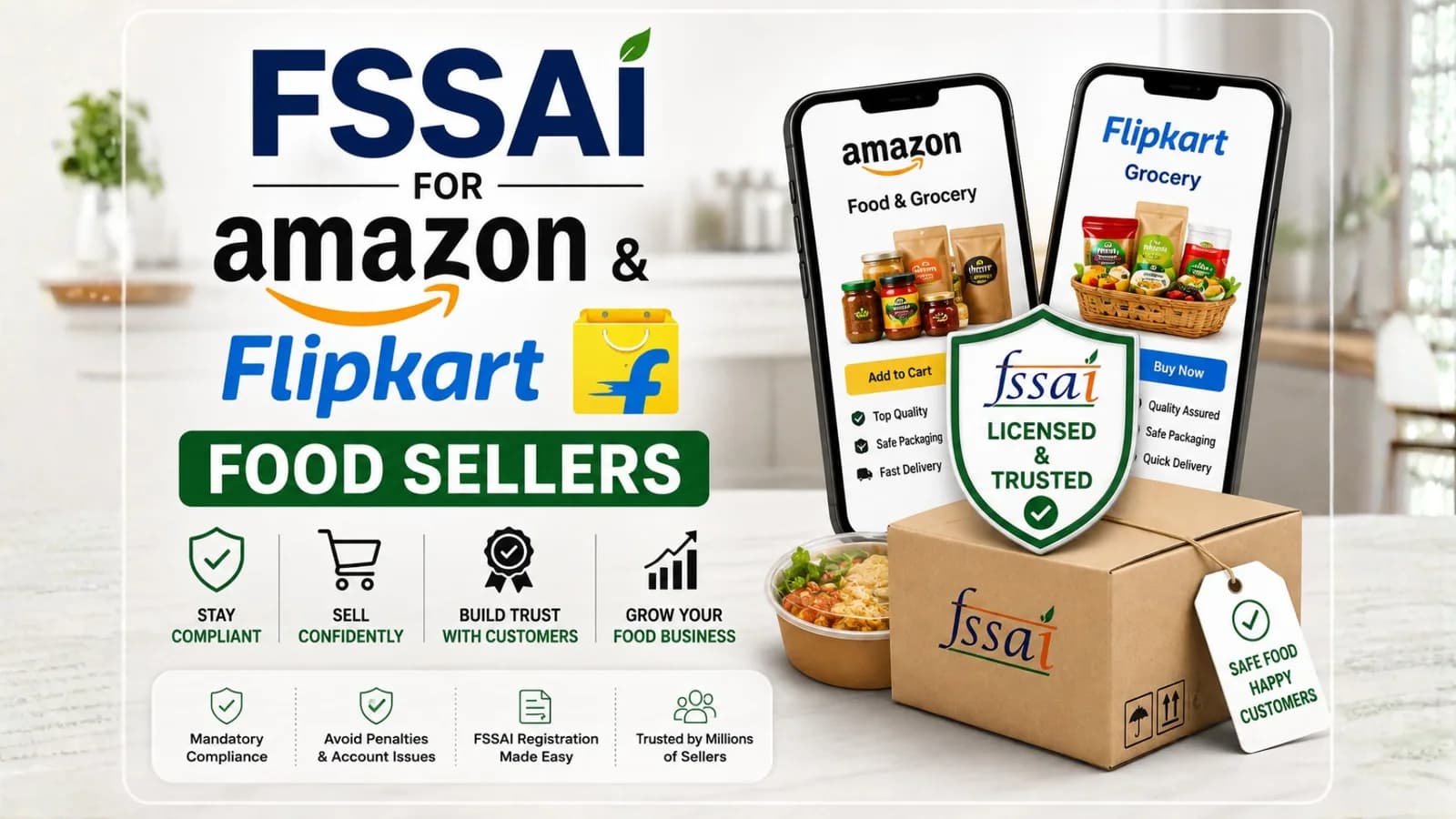
Food sellers on Amazon and Flipkart usually need a Central FSSAI licence rather than basic registration. FSSAI approvals are premises-based, so once your stock sits in fulfilment centres in more than one state through Amazon FBA or Flipkart’s fulfilment programme, you are outside the registration tier whatever your turnover.
This catches new sellers hard. Turnover of ₹15 lakh feels like a registration case, and it would be for a local shop. Send one pallet to a fulfilment centre in a second state and the tier question is answered by geography instead.
Marketplace FSSAI at a glance
Item | Position as on 27 August 2026 |
|---|---|
Licence basis | Premises-based. The approval attaches to an address, not to the business alone |
Self-ship within one state | Registration may apply if turnover is within ₹1.5 crore |
FBA or fulfilment across states | Multi-state operation, which points to a Central licence |
Kind of business for a fulfilment centre | Retailer, with the centre address as the business premises |
Name matching | Legal name on the FSSAI must match the marketplace seller account exactly |
Platform verification | Automated FoSCoS check at onboarding and periodic re-verification |
[VERIFY: platform onboarding requirements and the fulfilment-centre licensing position change often and are not published as regulation. Confirm current Amazon and Flipkart seller policy and the FoSCoS kind of business matrix before publishing.]
Can Amazon and Flipkart food sellers use basic registration?
Only in a narrow case: you sell within a single state, you ship every order yourself from your own premises, your turnover stays within ₹1.5 crore, and your kind of business is not in a licence-only category. Most sellers fail at least one of those tests within the first year.
The moment any of them breaks, the tier moves. Our guide to the FSSAI turnover thresholds covers the bands, but for marketplace sellers turnover is rarely the binding constraint.
Why premises-based licensing changes everything for FBA
An FSSAI approval names the premises the food business operates from. Under Amazon FBA and comparable programmes your stock is stored at, and sold from, the fulfilment centre. That address therefore needs to sit on your FSSAI, with the kind of business recorded as retailer.
If that sounds familiar, it should. It is the same logic that forces a separate GST registration for every state you hold stock in, which is why sellers end up needing an additional place of business alongside the licence. We have set that out in VPOB, PPOB and APOB explained, and the tax side in GST registration for e-commerce sellers.
Plan the two together. Sellers who arrange GST state by state and leave FSSAI until a listing is blocked end up paying for speed twice.
When a Central licence applies
A Central licence is indicated when any one of these is true, regardless of how small the business is.
You operate in more than one state, including holding stock in fulfilment centres across states.
You import or export food products.
You run the e-commerce platform itself rather than selling on it.
Your turnover exceeds ₹50 crore.
For the tier itself and what filing it involves, see Central FSSAI Licence filing.
What Amazon and Flipkart check at onboarding
Both platforms run an automated check against FoSCoS rather than a visual look at your certificate, and they repeat it periodically.
The FSSAI number must return as active on FoSCoS.
The legal name on the FSSAI must match the legal name on your seller account exactly.
The food categories on the FSSAI must cover every product you list.
Brand names you list should appear on the licence where the platform requires brand mapping.
The premises address should correspond to the location the stock is sold from.
The category test is the quiet one. A licence covering bakery products will not carry a listing for supplements, and the mismatch surfaces at re-verification rather than at onboarding, when you already have sales running.
Displaying your FSSAI number
Print the 14-digit number on the label of every packaged product, and add it to your seller profile so it appears on your seller detail page. On Amazon that lives under the seller information settings. Listings and packaging both get checked, and a number on one but not the other is a common complaint trigger.
What gets marketplace sellers suspended after going live
The FSSAI lapses or is suspended, and the automated re-check returns a non-active number.
A new brand is added to listings without being mapped to the licence.
Products are listed outside the food categories declared on the FSSAI.
Stock moves to a new fulfilment centre in a state the licence does not cover.
The legal name on the seller account is changed without updating the FSSAI.
What we see on marketplace filings at Complylocal
[EXPERT INPUT NEEDED: Keshav Sehgal to add one real, anonymised observation from Complylocal marketplace food seller onboarding. Strongest options: (a) how often sellers arrive holding a basic registration when FBA had already put them in Central territory, as a proportion; (b) a seller delisted on a category or brand mismatch and the days of sales lost; (c) the sequencing advice we give on GST state registration alongside FSSAI. One real number required.]
Selling food online and unsure which tier you are in? Talk to Keshav’s team at Complylocal for FSSAI registration for online sellers.
Official sources
Food Safety and Standards Act, 2006, Section 31, and the requirement to conduct a food business from licensed or registered premises.
FSS (Licensing and Registration of Food Businesses) Regulations, 2011, Schedule 1 on businesses under the Central Licensing Authority.
FSSAI order dated 13 March 2026, revised turnover thresholds effective 1 April 2026.
FoSCoS, foscos.fssai.gov.in, kind of business eligibility matrix and licence verification.
FSSAI guidance for e-commerce food business operators.