Why Every E-Commerce Seller Needs to Understand VPOB, PPOB and APOB
If you sell on Amazon, Flipkart, Meesho, or any other marketplace in India, your GST registration is tied to an address. Not just any address — a legally declared place of business that determines your compliance status, your ability to claim Input Tax Credit, and whether you can legally store inventory in a particular state.
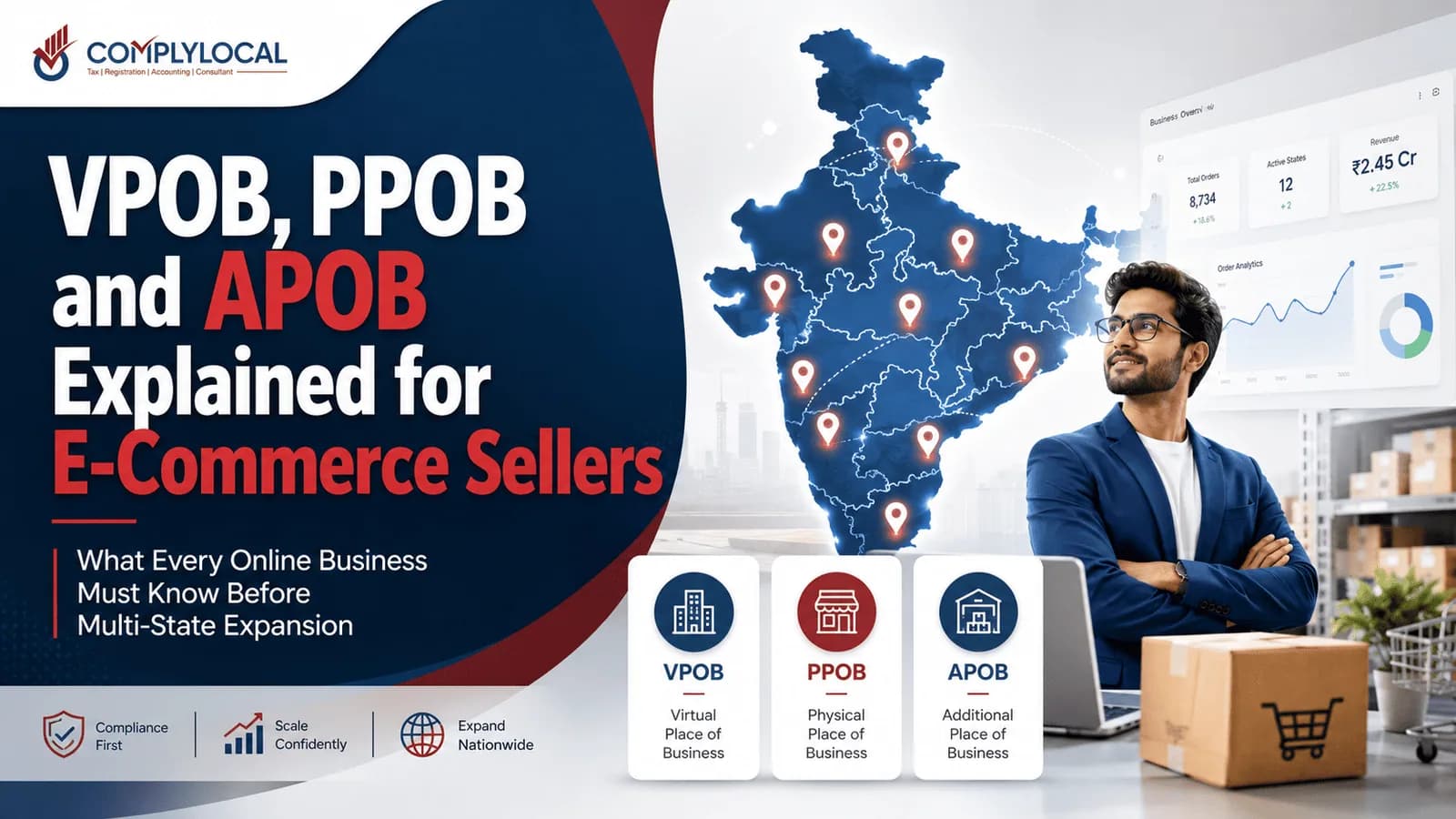
Three terms define this address structure under GST: VPOB (Virtual Place of Business), PPOB (Principal Place of Business), and APOB (Additional Place of Business). Most sellers encounter them when they try to expand to a new state and realise they cannot simply ship goods from a warehouse without a local GSTIN.
This guide breaks down all three concepts with their legal backing, practical application for online sellers, the documentation required, and the exact steps to get each one set up. Whether you are a solo seller operating from home or a D2C brand scaling across 10 states, this is the reference you need before making multi-state decisions. For a broader overview of our virtual office services, visit our Virtual Place of Business service.

What the Law Actually Says: Place of Business Under the CGST Act
Before diving into how sellers use these terms, it helps to understand what the law defines. The definitions are precise and they matter because GST officers use them during verification.
Place of Business — Section 2(85) of the CGST Act, 2017
The CGST Act defines a “place of business” as an inclusive term. It covers any place from where business is ordinarily carried on, including warehouses, godowns, and any other place where a taxable person stores goods, supplies or receives goods or services. It also includes a place where a taxable person maintains books of account, and a place where business is conducted through an agent.
This definition is wide enough to include fulfilment centres. If Amazon stores your inventory in a warehouse in Haryana, that warehouse qualifies as your “place of business” in Haryana under Section 2(85). You are expected to declare it.
Principal Place of Business (PPOB) — Section 2(89)
Under Section 2(89), the Principal Place of Business means the place of business specified as the principal place of business in the certificate of registration. In practical terms, it is the primary address that anchors your GSTIN. Your statutory books under Section 35 are maintained here. All official GST correspondence, notices, and assessments are directed to this address. Learn more about PPOB requirements on our Principal Place of Business.
Additional Place of Business (APOB)
An APOB is any place of business within the same state, other than the PPOB, where business-related activities are carried out. For e-commerce sellers, this typically means a fulfilment centre, a godown, a branch warehouse, or a storage location operated by a third-party logistics partner. CBIC Circular No. 61/35/2018-GST specifically clarifies that even a transporter’s godown where you store goods must be declared as an APOB. Visit our Additional Place of Business service for detailed APOB registration support.
What is a Virtual Place of Business (VPOB) and How Does It Work?
A Virtual Place of Business is not a separate legal category under the CGST Act. It is a commercial service arrangement where a virtual office provider gives you a documented business address — backed by a rent or service agreement, a No Objection Certificate from the property owner, and a utility bill — so you can register for GST in a state without renting or owning physical office space there.
The address itself is real and physically accessible. The term “virtual” refers to the model of usage: you do not sit and work from that office every day. Instead, the address exists as a compliance-ready location that satisfies Rule 8 and Rule 9 of the CGST Rules, 2017, which govern document requirements for GST registration applications.
Why Do E-Commerce Sellers Need VPOB?
The answer lies in how marketplace fulfilment works. When you sell through Amazon FBA or Flipkart Smart Fulfilment, the platform stores your inventory in warehouses across multiple states. Under GST law, each state where your goods are stored requires a separate GSTIN registration. You cannot operate from one GSTIN for the entire country if your inventory is spread across state lines.
Setting up a physical office in each of those states is impractical and expensive. A VPOB solves this by providing a GST-compliant address in each required state, allowing you to register, get a GSTIN, and then add the fulfilment centre as an APOB under that GSTIN.
VPOB vs PPOB vs APOB: The Key Differences
Understanding how these three terms relate to each other is critical. Here is a clear comparison:
Parameter | PPOB | APOB | VPOB |
Legal definition | Section 2(89) CGST Act | Section 2(85), Circular 61/35/2018 | Not defined in statute; commercial service |
What it represents | Primary address on GSTIN certificate | Secondary location within same state | Address arrangement for GST registration |
Creates a new GSTIN? | Yes, one per state | No, added to existing GSTIN | Supports new GSTIN as PPOB or added as APOB |
Books of account kept here? | Yes, mandatory under Section 35 | Optional; can be at PPOB | Not typically; records stay at PPOB |
Physical verification? | Likely, especially for new registrations | Possible during amendments | Must be verification-ready with signage |
E-commerce seller use case | Main office or home address in home state | Warehouse/FC in the same state as PPOB | Address in a new state for GSTIN + FC as APOB |
Amendment type on GST portal | Core field amendment | Non-core or core amendment | N/A (used during registration) |
How VPOB, PPOB and APOB Work Together for Multi-State Sellers
Let us walk through a practical scenario that most Amazon or Flipkart sellers face:
Scenario: A seller based in Delhi wants to store inventory at a Flipkart Smart Fulfilment Centre in Karnataka. The seller has no office, warehouse, or any business presence in Karnataka.
Step-by-Step: What Actually Happens
The seller obtains a VPOB address in Karnataka through a virtual office provider like ComplyLocal. This address comes with a rent agreement, NOC, and utility bill — the three documents required under Rule 8 of CGST Rules.
Using this VPOB address, the seller applies for a new GST registration in Karnataka. The VPOB address is declared as the Principal Place of Business (PPOB) in the application (Form GST REG-01).
Once the Karnataka GSTIN is approved, the seller files an amendment to add the Flipkart FC’s warehouse address as an Additional Place of Business (APOB) under that Karnataka GSTIN.
The seller can now legally inward goods to the Flipkart warehouse in Karnataka, generate GST-compliant invoices from Karnataka, and claim Input Tax Credit on stock transfers into the state.
This VPOB plus APOB combination is the standard compliance structure used by thousands of e-commerce sellers operating across multiple states in India. The VPOB provides the GSTIN anchor, and the APOB connects the actual warehouse to that GSTIN.
Documents Required for VPOB, PPOB and APOB Registration
Document preparation is where most applications fail. A mismatch between the name on your rent agreement and your PAN, or a utility bill older than 60 days, can trigger a REG-03 notice and delay your registration by weeks. Here is what you need:
For VPOB (New GST Registration in a New State)
Rent or service agreement for the virtual office premises (in the applicant’s name)
No Objection Certificate (NOC) from the property owner, specifically permitting use for GST registration
Recent utility bill for the premises (not older than 2 months from application date)
PAN card of the applicant (individual or business entity)
Aadhaar card of the authorised signatory
Photograph of the authorised signatory
Proof of business registration (Certificate of Incorporation, Partnership Deed, etc.)
Bank account details with a cancelled cheque or bank statement
For APOB Addition (Adding a Warehouse or FC to Existing GSTIN)
NOC or consent letter from the warehouse owner or marketplace platform
Utility bill or municipal document for the warehouse address
Copy of existing GST certificate showing the current PPOB
Details of the nature of business at the additional location
Important: Address on the rent agreement, NOC, and utility bill must be identical. Even minor differences — an abbreviated street name, a missing floor number, or a PIN code typo — trigger queries from the reviewing officer.
Where ComplyLocal Provides VPOB, PPOB and APOB Services
ComplyLocal offers verification-ready virtual office addresses and APOB registration support across all major fulfilment, commerce, and business expansion states in India. The following table shows states and key cities where our VPOB and APOB services are active:
State | Key Cities | Common Use Case |
Maharashtra | Mumbai, Pune, Nagpur, Bhiwandi | Amazon/Flipkart FCs, D2C warehousing |
Karnataka | Bangalore, Hubli | Tech sellers, south zone fulfilment |
Haryana | Gurgaon, Faridabad, Panipat | NCR fulfilment, Shiprocket hubs |
Delhi | New Delhi, Dwarka, Okhla | Headquarter GSTIN, marketplace onboarding |
Tamil Nadu | Chennai, Coimbatore | South India dispatch, textile sellers |
West Bengal | Kolkata, Howrah | East zone coverage, Meesho sellers |
Telangana | Hyderabad, Secunderabad | Central dispatch, pharma/health sellers |
Gujarat | Ahmedabad, Surat, Rajkot | Textile, FMCG, export-oriented sellers |
Uttar Pradesh | Noida, Lucknow, Agra | NCR overflow FCs, north zone expansion |
Rajasthan | Jaipur, Jodhpur, Udaipur | Handicraft sellers, emerging FC hubs |
Madhya Pradesh | Indore, Bhopal | Central India coverage |
Kerala | Kochi, Thiruvananthapuram | South zone, spice and agro sellers |
Need VPOB or APOB support in a state not listed above? Contact our GST team to check availability.
Five Mistakes That Get VPOB and APOB Applications Rejected
Based on thousands of GST registrations and amendments filed by ComplyLocal, these are the errors that cause the most delays and rejections:
1. Address Mismatch Across Documents — The name and address on your rent agreement, NOC, and utility bill must be character-for-character identical. Even a difference between “Road” and “Rd.” can trigger a REG-03 query.
2. Utility Bill Older Than Two Months — The GST portal now auto-flags utility bills dated more than 60 days before the application filing date. Always request a fresh bill from your VPOB provider before filing.
3. Unsigned or Generic NOC — The NOC must be signed by the actual property owner and must specifically state that the address is being permitted for use as a place of business for GST registration purposes. A generic “to whom it may concern” letter is not sufficient.
4. Not Declaring Fulfilment Centres as APOB — Many sellers register a VPOB as PPOB in a new state but forget to add the fulfilment centre as an APOB. Operating from an undeclared location exposes you to penalties under Section 122(1) and Section 125 of the CGST Act, and your ITC claims from that location can be challenged.
5. Wrong Reason for Registration in the Application — E-commerce sellers must select “Liable to be registered under Section 24” as the reason for registration — not the turnover-based reason. Selecting the wrong reason signals incorrect compliance intent to the reviewing officer.
Which Service Do You Need? A Quick Decision Framework
Not every seller needs all three. Here is a quick way to decide:
Your Situation | What You Need |
You sell online and have a physical office or home as your registered address | PPOB is already set. No VPOB needed unless you expand to a new state. |
You want to store inventory in Amazon/Flipkart FCs in another state | You need a VPOB in that state to get a GSTIN, then add the FC as APOB. |
You are adding a warehouse in the same state where you already have a GSTIN | You need an APOB addition only. No new GSTIN or VPOB required. |
You are scaling to 5+ states for Pan-India fulfilment | You need VPOB + APOB in each new state, plus multi-state GST compliance. |
Your current PPOB address has changed (you moved offices) | You need a PPOB core field amendment on your existing GSTIN. |
How Place of Business Declarations Affect Your Input Tax Credit
This is the section most blogs skip, but it is arguably the most important for sellers focused on profitability.
Input Tax Credit under GST is tied to the place of business. If you receive goods at a location that is not declared on your GSTIN — whether as PPOB or APOB — the ITC on those goods can be disallowed during assessment or audit. The logic is straightforward: if the tax department does not know that your business operates at a particular address, purchases and stock movements linked to that address cannot be verified against your GSTR-2A/2B.
For e-commerce sellers, this directly affects stock transfers. When you transfer goods from your home state to a fulfilment centre in another state, you issue a delivery challan and treat it as a supply under Section 25(4). The ITC on the GST paid on that inter-state transfer is claimable in the receiving state — but only if the receiving address (the FC) is a declared place of business under the receiving state’s GSTIN.
This is why proper VPOB and APOB declarations are not just compliance checkboxes — they directly protect your working capital by ensuring uninterrupted ITC claims. ComplyLocal’s e-commerce GST compliance services are structured to keep your place-of-business declarations aligned with your actual operations.
Frequently Asked Questions
Is VPOB legally valid for GST registration in India?
Yes. A Virtual Place of Business is legally valid for GST registration when it is supported by proper documentation — a rent or service agreement, a No Objection Certificate from the property owner, and a recent utility bill. The CGST Act does not require you to own or physically occupy the premises; it requires verifiable proof of the address under Rule 8 and Rule 9 of the CGST Rules. GST officers may conduct physical verification, particularly for multi-state or high-risk applications, and the VPOB provider must ensure the premises are verification-ready with signage and access.
What is the difference between VPOB and PPOB?
PPOB (Principal Place of Business) is the primary address on your GST certificate, defined under Section 2(89) of the CGST Act. VPOB (Virtual Place of Business) is a commercial service arrangement that provides a documented address — it can serve as your PPOB or support your APOB. PPOB is a legal term that appears on your registration. VPOB is the mechanism through which you obtain a compliant address in a state where you do not have a physical office.
Can I add multiple APOBs under one GSTIN?
Yes. There is no statutory limit on the number of Additional Places of Business you can add under a single GSTIN, as long as all locations are within the same state as your PPOB. Each APOB is added through a core amendment on the GST portal and requires separate address proof documents.
What happens if I do not declare my fulfilment centre as an APOB?
Operating from an undeclared location is a compliance violation. Under Section 125 of the CGST Act, the general penalty can reach Rs. 25,000 each under CGST and SGST (Rs. 50,000 total). Under Section 122(1), offences related to storage at unregistered premises can attract higher penalties. Additionally, ITC on purchases and stock transfers linked to the undeclared location can be disallowed, and goods in transit to or from that location may be detained under Section 129.
How long does it take to get a VPOB-based GST registration approved?
With complete and correctly matched documents, a VPOB-based GST registration typically takes 7 to 15 working days. Applications that use Aadhaar-based e-KYC tend to be processed faster. Delays most commonly occur due to document mismatches, expired utility bills, or incomplete NOC — all of which trigger a REG-03 clarification notice that adds another 7 to 15 working days to the timeline.
Do I need a separate GSTIN for every state where my inventory is stored?
Yes. Under Section 25 of the CGST Act, GST registration is state-specific. If your inventory is stored in an Amazon FBA warehouse in Maharashtra and another in Karnataka, you need a separate GSTIN for each state. You cannot operate across state lines with a single GSTIN when goods are physically present in multiple states. This is where VPOB becomes essential — it provides the address required to obtain a GSTIN in each new state.
Can I use a VPOB address for purposes other than GST?
A VPOB address obtained for GST registration is primarily intended for GST compliance. It can also be used for official correspondence and documentation. However, it should not be confused with a full commercial office. The address serves as a registered location for regulatory purposes, and its use should remain aligned with the terms of the service agreement and the applicable GST regulations.
What is the cost of VPOB and APOB registration?
The cost varies by state, provider, and the scope of support included. ComplyLocal’s VPOB packages include the complete document set (agreement, NOC, utility bill), GST registration filing, physical verification support, and REG-03 response handling. APOB additions are handled as amendments to your existing GSTIN at a separate fee. For current pricing, contact our GST team or reach us on WhatsApp at +91-9896805552.
Setting Up Your Multi-State GST Structure the Right Way
Expanding to multiple states is not just a logistics decision. It is a compliance decision that determines whether your inventory movement, invoicing, ITC claims, and GST returns are legally sound. VPOB, PPOB, and APOB are the three building blocks that make multi-state operations work under GST.
The difference between a smooth expansion and months of REG-03 notices, stalled applications, and blocked ITC often comes down to one thing: document preparation. When the rent agreement, NOC, and utility bill are perfectly matched, the application is filed with the correct reason for registration, and the fulfilment centre is promptly declared as an APOB — the process works exactly as designed.
ComplyLocal handles VPOB registration, PPOB setup, APOB additions, and ongoing multi-state GST compliance for e-commerce sellers across India. Our CA-led team prepares every application with officer-ready documentation, responds to department queries within deadlines, and coordinates physical verification when required. If you are planning multi-state expansion, start with a free consultation to map the right GST structure for your business.
Related services & next steps