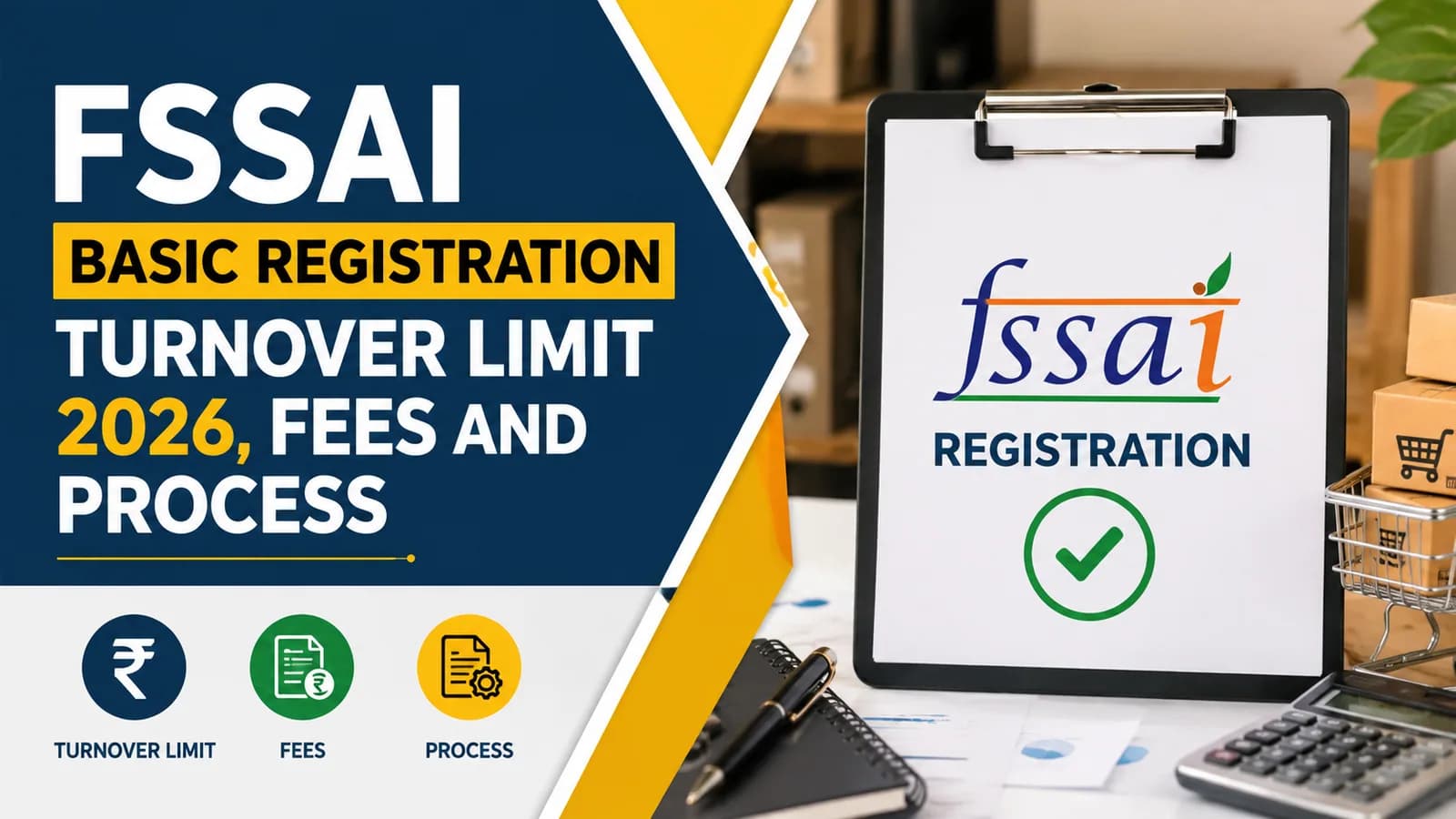
FSSAI basic registration covers food businesses with annual turnover up to ₹1.5 crore. FSSAI raised that ceiling from ₹12 lakh by order dated 13 March 2026, effective 1 April 2026. You apply in Form A on the FoSCoS portal, pay ₹100 a year, and receive a 14-digit FSSAI registration number.
Most pages ranking for this question still show ₹12 lakh. That single stale number is what pushes a ₹40 lakh tiffin service into applying for a State Licence it no longer needs, or a caterer into applying for a registration it was never eligible for. This guide works from the current position and marks anything you should confirm on FoSCoS before you file.
FSSAI basic registration at a glance
Item | Position as on 26 August 2026 |
|---|---|
Turnover ceiling | Up to ₹1.5 crore a year, raised from ₹12 lakh |
Effective from | 1 April 2026 |
Authority for the change | FSSAI order dated 13 March 2026, F. No. RCD-01002/1/2021-Regulatory-FSSAI-Part(1) [Comp. No. 4550] |
Enabling regulation | FSS (Licensing and Registration of Food Businesses) Amendment Regulations, 2026, Gazette CG-DL-E-12032026-270872, notified 10 March 2026 |
Application form | Form A |
Government fee | ₹100 per year |
Where you apply | FoSCoS, foscos.fssai.gov.in |
Validity | Perpetual for registrations granted on or after 1 April 2026 |
What you receive | Registration certificate with a 14-digit FSSAI number |
What is FSSAI basic registration?
FSSAI basic registration is the entry-level food-safety approval granted under Section 31 of the Food Safety and Standards Act, 2006 to small operators, whom the law calls petty Food Business Operators. It is granted in Form A and carries a 14-digit registration number.
Every Food Business Operator (FBO), meaning anyone who manufactures, processes, stores, distributes or sells food, must hold one of three approvals: basic registration, a State Licence, or a Central Licence. Which one you need depends on your annual turnover and on the kind of business (KoB) you run.
Basic registration is the lightest of the three. It is a registration rather than a licence, so the document set is smaller, the fee is ₹100 instead of ₹2,000 or more, and there is normally no physical inspection before grant. Your 14-digit number goes on your packaging, on display at your premises, and into the seller forms of any marketplace or aggregator you sell through.
What is the turnover limit for FSSAI basic registration in 2026?
₹1.5 crore of annual turnover. FSSAI raised the basic registration ceiling from ₹12 lakh through its order dated 13 March 2026, which directed all licensing authorities to apply the revised thresholds with effect from 1 April 2026.
The order followed the Food Safety and Standards (Licensing and Registration of Food Businesses) Amendment Regulations, 2026, notified in the Gazette of India (CG-DL-E-12032026-270872) on 10 March 2026. According to FSSAI, the revision implements recommendations of the NITI Aayog High-Level Committee on Non-Financial Regulatory Reforms, approved by the Food Authority and the Ministry of Health and Family Welfare.
Category | Until 31 March 2026 | From 1 April 2026 | Form |
|---|---|---|---|
Basic registration | Up to ₹12 lakh | Up to ₹1.5 crore | Form A |
State Licence | ₹12 lakh to ₹20 crore | ₹1.5 crore to ₹50 crore | Form B |
Central Licence | Above ₹20 crore | Above ₹50 crore | Form B |
Read the middle row twice if you are a mid-sized operator. A food business turning over ₹80 lakh needed a State Licence in March 2026 and needs only basic registration today. A ₹25 crore manufacturer that held a Central Licence now sits inside the State Licence band.
Who needs FSSAI basic registration?
Any food business with annual turnover up to ₹1.5 crore that does not fall in a licence-only category needs FSSAI basic registration. Turnover is the first test. The kind of business you run is the second, and it overrides turnover in several categories.
Inside the ₹1.5 crore ceiling, basic registration typically covers:
Home bakers, tiffin and dabba services, and small cloud kitchens
Kirana stores, petty retailers, tea stalls and snack counters
Wholesalers, distributors and retailers below the turnover limit
Food transporters and storage operators without atmospheric or temperature control
Food vending agencies, direct sellers and small dhabas
Hawkers, itinerant vendors and petty milk vendors
The 2026 amendment also brought food trucks and food carts inside the petty FBO definition. Before that, mobile units sat in a grey area and different state offices treated them differently. If you run a food truck under ₹1.5 crore, basic registration is now the clear answer.
Street vendors already registered with a Town Vending Committee under the Street Vendors (Protection of Livelihood and Regulation of Street Vending) Act, 2014 are deemed registered under the FSS Act by the 2026 amendment. They file no separate FSSAI application, but they still have to meet the hygiene requirements of Schedule 4.
When low turnover still needs a State or Central Licence
Some kinds of business must hold a licence no matter how small they are. Being under ₹1.5 crore does not make you eligible for basic registration if you fall in one of these groups, and this is where most wrongly-filed applications come from.
Kind of business | Minimum approval, even below ₹1.5 crore |
|---|---|
Caterers, including event and mid-day-meal caterers | State Licence |
Hotels below 5-star that serve food | State Licence |
Importers of any food product | Central Licence |
E-commerce food businesses and online food platforms | Central Licence |
Nutraceuticals, health supplements, proprietary foods | Central Licence |
5-star and above hotels, airport and seaport food units | Central Licence |
Head office of a business operating in more than one state | Central Licence |
A caterer billing ₹5 lakh a year still needs a State FSSAI Licence. A home-based seller listing on a food marketplace still needs a Central FSSAI Licence. Check your exact KoB against the eligibility matrix on FoSCoS before you choose a category, because the matrix is what the officer applies.
[VERIFY: confirm the current FoSCoS Kind of Business eligibility matrix for each row above, and the FSSAI FAQ dated 27 March 2026 on dairy, meat and fish categories, before publishing.]
Basic registration vs State Licence vs Central Licence
The three tiers differ on turnover band, form, fee and issuing authority. Place your business against all four columns rather than turnover alone.
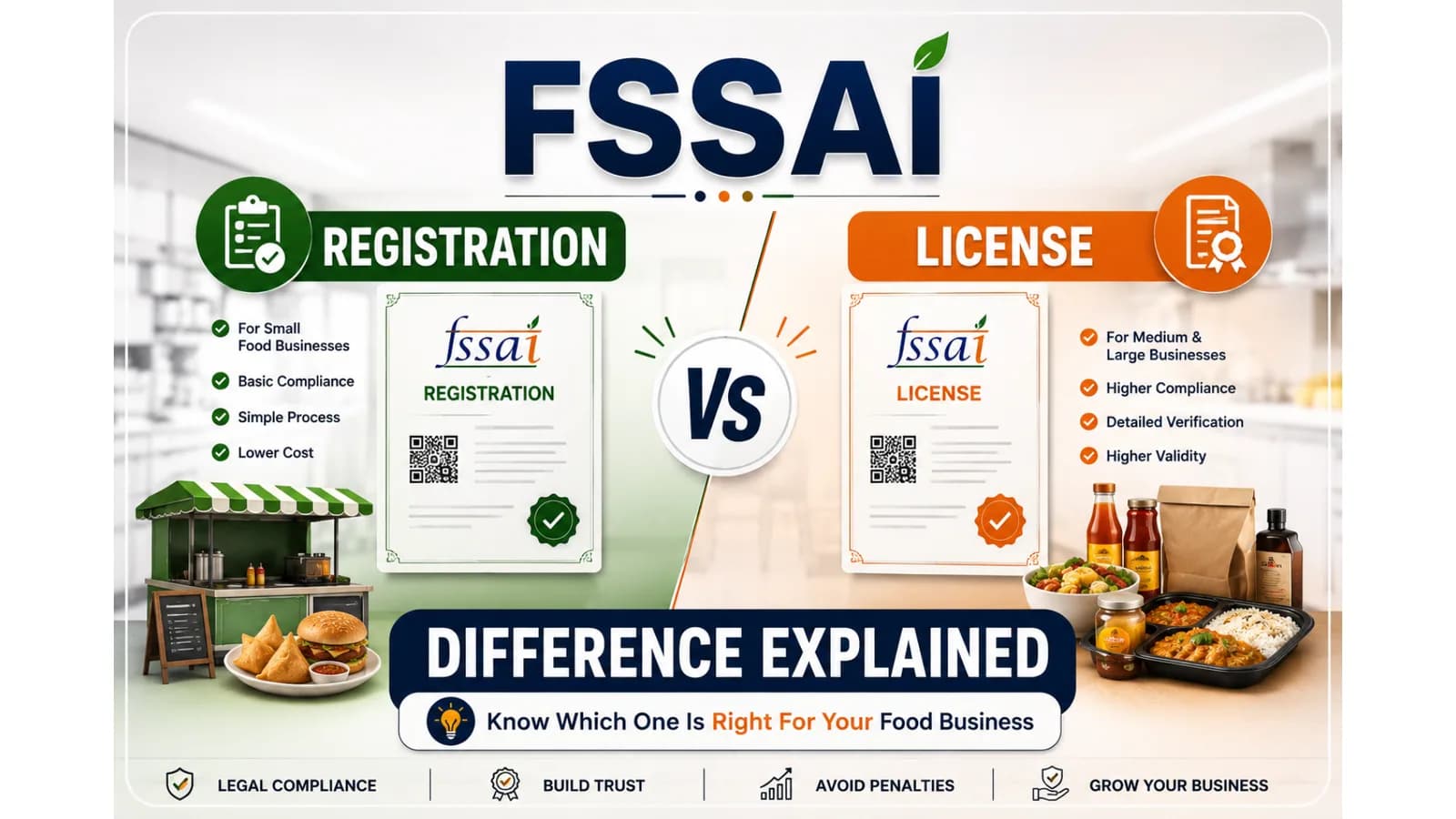
Parameter | Basic registration | State Licence | Central Licence |
|---|---|---|---|
Annual turnover | Up to ₹1.5 crore | ₹1.5 crore to ₹50 crore | Above ₹50 crore |
Application form | Form A | Form B | Form B |
Government fee | ₹100 per year | ₹2,000 to ₹5,000 per year | ₹7,500 per year |
Issued by | State authority | State authority | FSSAI |
Physical inspection | Normally none | Usually required | Usually required |
Typical business | Home kitchen, kirana store | Mid-size manufacturer, caterer | Importer, e-commerce, large unit |
State Licence fees vary with the category of business and production capacity, so confirm your figure on FoSCoS at the time of filing.
FSSAI basic registration fees
The government fee for FSSAI basic registration is ₹100 per year, paid online on FoSCoS. It is the same in every state. Consultant charges, if you use one, sit outside this ₹100.
Tier | Government fee per year | Who pays it |
|---|---|---|
Basic registration | ₹100 | Petty FBOs up to ₹1.5 crore turnover |
State Licence | ₹2,000 to ₹5,000 | Businesses from ₹1.5 crore to ₹50 crore, and licence-only categories |
Central Licence | ₹7,500 | Businesses above ₹50 crore, importers, e-commerce food businesses |
Since the 2026 amendment you can prepay the fee for any number of years, at any time in the year. There is no fixed annual payment date to miss, which removes the old scramble around expiry. FSSAI confirmed this in its FAQ dated 27 March 2026.
Hawkers filing under the Hawker (itinerant or mobile food vendor) kind of business on FoSCoS pay a nil registration fee. [VERIFY: confirm the FSSAI order number and effective date for the hawker fee waiver before citing it.]
If your category changes because of the revised thresholds, FSSAI has said the migration carries no modification fee and any fee already paid against the higher category is adjusted.
Documents required for FSSAI basic registration
Three documents cover most small operators: a photograph, a government photo ID, and proof of the business premises. Firms and companies add their constitution document.
Document | What it proves |
|---|---|
Passport-size photograph | Identity of the proprietor or authorised applicant |
Government photo ID | Aadhaar, PAN, voter ID, passport or driving licence of the applicant |
Proof of business premises | Electricity or utility bill, rent agreement, or ownership document for the address |
Kind of business and food product list | The category you operate in and the food items you handle |
Constitution proof, where applicable | Partnership deed, certificate of incorporation, or society or trust registration |
Declaration and owner NOC, where needed | Self-declaration of compliance, plus owner consent for rented or shared premises |
Keep the address on your premises proof character-for-character identical to the address you type into Form A. A flat number written as "B-12" on the electricity bill and "B 12" on the portal is enough to generate a query, and a query costs you more days than the whole application would have taken.
How to apply for FSSAI basic registration on FoSCoS
FSSAI basic registration is filed entirely online on FoSCoS (foscos.fssai.gov.in), the portal that replaced the older FLRS system. Seven steps take you from login to certificate.
Confirm your category against the turnover ceiling and the kind-of-business matrix above.
Create a FoSCoS login at foscos.fssai.gov.in and start a new application.
Select Registration and open Form A.
Enter your business details, premises address, kind of business and food product list.
Upload your photograph, photo ID and premises proof within the stated file size limits.
Pay the ₹100 fee online and choose how many years you want to prepay.
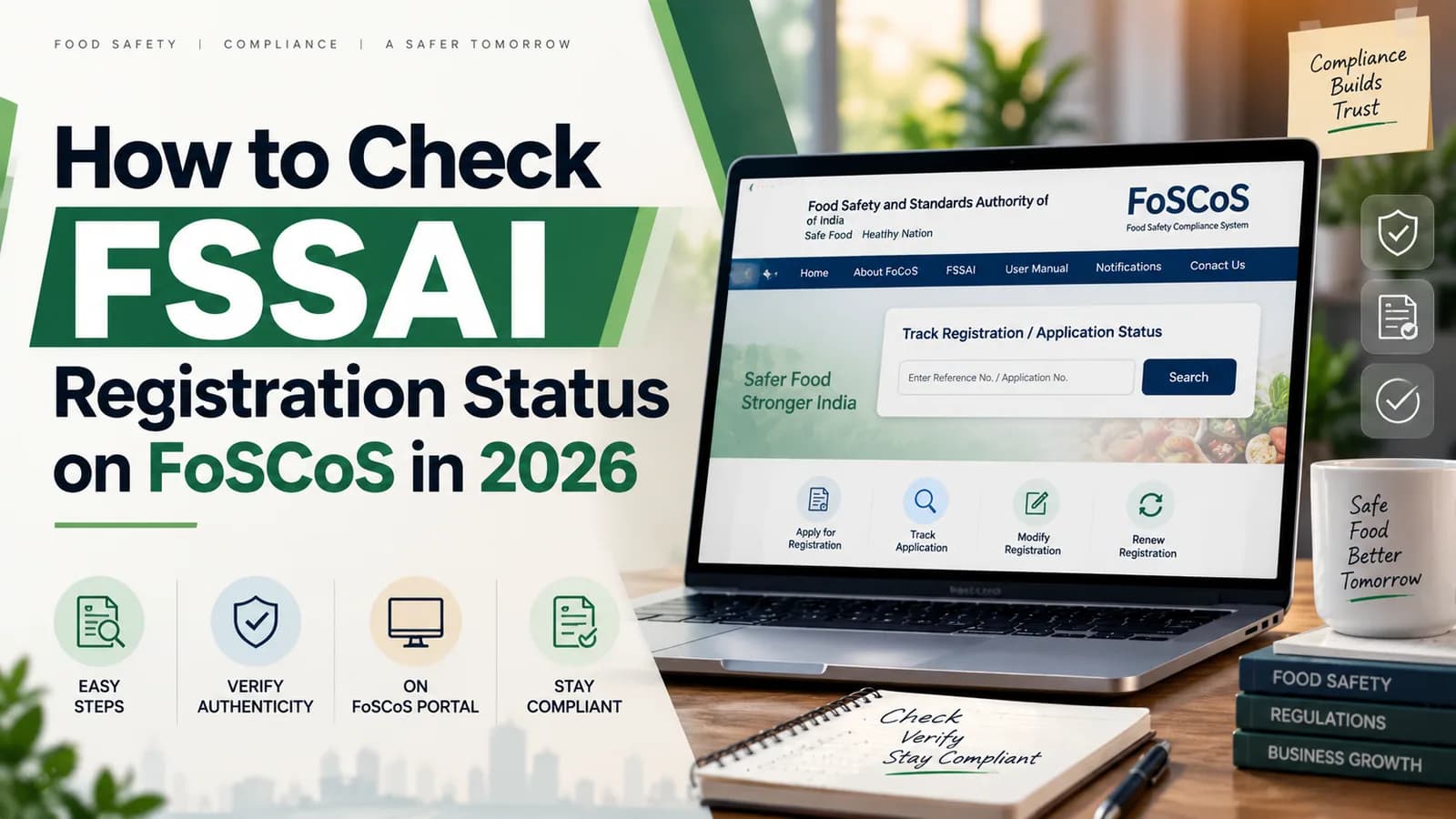
Submit and save the application reference number, then track status on the same login.
The officer scrutinises the application and grants the certificate carrying your 14-digit FSSAI number. Print that number on your packaging and display the certificate at your premises. Both are routine inspection points.
How long does FSSAI basic registration take?
Basic registration is usually granted within a few working days, because the registration tier does not normally require a physical inspection the way State and Central Licences do. The 2026 amendment went further and introduced instant grant of the registration certificate for eligible petty FBOs on FoSCoS once the fee is paid and documents are submitted.
[VERIFY: confirm the exact statutory grant window for registration under Regulation 2.1.3 of the Licensing and Registration Regulations, 2011, and the current conditions attached to instant registration on FoSCoS.]
What actually costs time is a query. Every officer query resets your clock while you respond, which is why the address-matching point above is worth ten minutes of checking before you submit.
How long is FSSAI basic registration valid?
Registrations granted on or after 1 April 2026 are perpetual. The 2026 amendment substituted Regulation 2.1.7, which now provides that a licence or registration certificate granted under the regulations stays valid and subsisting unless it is suspended, cancelled or surrendered.
This is the detail most guides get wrong. Perpetual validity is not retrospective. A registration issued before 1 April 2026 runs to its original expiry date and picks up perpetual validity at FSSAI licence renewal. An application that was still pending on 1 April 2026 carries perpetual validity when granted.
Perpetual does not mean unattended. If you fail to pay the annual fee or fail to file a return that applies to you, the registration is suspended, and you may not operate while it is suspended. The suspension is revoked once the dues and any penalty are paid.
Two duties keep a perpetual registration alive: the annual fee, and FSSAI annual return filing where it applies to your category. Manufacturers file Form D-1 by 31 May for the previous financial year. Most non-manufacturing basic registration holders are outside that requirement, so confirm your own position rather than assuming either way.
Watch the ₹1.5 crore line as you grow. Cross it and you move up to a State Licence. Staying on basic registration above the ceiling is non-compliance, not a grace period.
Penalty for running a food business without FSSAI registration
Operating a food business without the approval you are required to hold is an offence under the Food Safety and Standards Act, 2006. Section 63 deals with carrying on business without a licence and provides for imprisonment that may extend to six months and a fine that may extend to ₹5 lakh.
[VERIFY: confirm which provision applies specifically to operating without a registration as distinct from a licence, and the exact amounts, against the bare FSS Act, 2006 (Sections 55, 58 and 63) before publishing.]
In practice the commercial consequence arrives long before any prosecution. Swiggy, Zomato, Amazon and Flipkart all require a valid FSSAI number at onboarding, and an existing listing can be pulled when the number lapses. At ₹100 a year, the registration is the cheapest line item in a food business. Not having it is what gets expensive.
Common mistakes that delay FSSAI basic registration
Working from the ₹12 lakh figure. That ceiling died on 31 March 2026. Applying in the wrong category because of a stale number means a rejected application and a fresh filing.
Treating turnover as the only test. Caterers, importers and online food sellers need a licence below ₹1.5 crore. Check your kind of business first, revenue second.
Address mismatch between the premises proof and Form A. The most common query trigger, and entirely avoidable.
Assuming perpetual validity applies to an old registration. It applies to registrations granted on or after 1 April 2026, not to one issued in 2024.
Missing the annual fee. Non-payment suspends the registration automatically, and you may not trade during suspension.
Leaving the 14-digit number off packaging and off the premises display. Both are checked in routine inspections.
Crossing ₹1.5 crore and doing nothing. The upgrade to a State Licence is your responsibility, not the portal’s.
What we see on these filings at Complylocal
[EXPERT INPUT NEEDED: Keshav Sehgal to add one real, anonymised scenario from Complylocal FSSAI filings since April 2026. Strongest options: (a) a specific client category that applied under basic registration and was rejected because their kind of business was licence-only, with the number of days lost; (b) the most frequent document defect we see on Form A and how often it appears across filings; (c) a client who was on a State Licence pre-April 2026 and what the migration to basic registration actually took on FoSCoS, with dates and fee adjustment. Include a real number. Do not publish this section until the scenario is filled in.]
Need this filed correctly the first time? Talk to Keshav’s team at Complylocal for basic FSSAI registration service.
Related reading
Crossing the GST threshold alongside your food business? Start with GST registration.
[FUTURE LINK: FSSAI licence for cloud kitchens]
[FUTURE LINK: FSSAI documents checklist across all three tiers]
Official sources
Food Safety and Standards Act, 2006, Section 31 (registration and licensing of food businesses) and Section 63 (carrying on business without a licence).
Food Safety and Standards (Licensing and Registration of Food Businesses) Regulations, 2011, and the Amendment Regulations, 2026, Gazette of India CG-DL-E-12032026-270872, notified 10 March 2026.
FSSAI order dated 13 March 2026, F. No. RCD-01002/1/2021-Regulatory-FSSAI-Part(1) [Comp. No. 4550], revised turnover thresholds effective 1 April 2026.
FSSAI FAQs dated 27 March 2026 on the Amendment Regulations, 2026.
FoSCoS, foscos.fssai.gov.in, including the Kind of Business eligibility matrix.
Street Vendors (Protection of Livelihood and Regulation of Street Vending) Act, 2014.