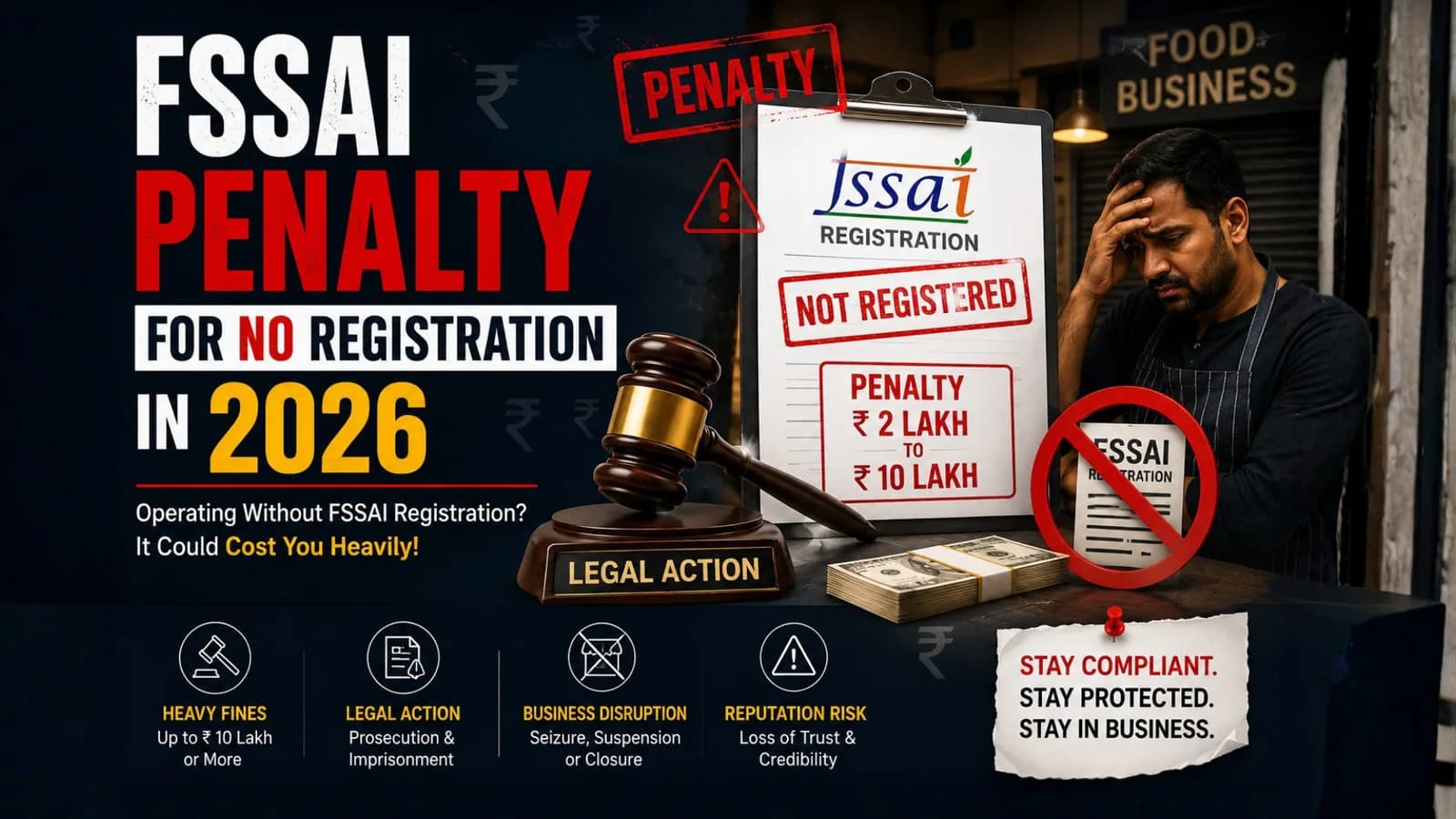
A petty food business operating without FSSAI registration faces a penalty of up to ₹2 lakh under the residual provisions of the Food Safety and Standards Act, 2006, Sections 55 and 58. It does not face Section 63, and it does not face imprisonment. Section 63 covers operating without a licence, which is a different tier.
Two things make almost every page on this topic wrong. Section 63 stopped carrying a prison term in 2023, and it never applied to petty operators in the first place. If you have read that a home kitchen without registration risks six months in jail and a ₹5 lakh fine, you have read a repealed provision applied to the wrong category of business.
FSSAI penalties at a glance
Item | Position as on 27 August 2026 |
|---|---|
Petty FBO without registration | Up to ₹2 lakh, Sections 55 and 58 of the FSS Act, 2006 |
Business without a required licence | Up to ₹10 lakh, Section 63, as amended |
Imprisonment under Section 63 | Removed by the Jan Vishwas (Amendment of Provisions) Act, 2023 |
In force from | 8 November 2023 for the FSS Act provisions |
Escalation clause | Penalties rise by 10% of the minimum amount every three years |
Registration suspension | Automatic on non-payment of the annual fee under the 2026 Amendment Regulations |
What is the penalty for running a food business without FSSAI registration?
Up to ₹2 lakh. A petty Food Business Operator who should have registered and did not is contravening the Act, and the Act deals with contraventions that carry no separate penalty through Section 58, which provides for a penalty extending to ₹2 lakh. Section 55 covers failure to comply with the requirements of the Act, the rules or the regulations, and carries the same ceiling.
These are penalties, not fines. They are imposed through adjudication rather than prosecution, which means an adjudicating officer decides the amount within that ceiling on the facts. A first-time home baker and a repeat offender running an unhygienic unit do not land at the same figure.
[VERIFY: confirm the current text and ceilings of Sections 55 and 58 against the bare FSS Act, 2006 as amended, and have a CA or advocate sign off on the registration-versus-licence reading before publishing. Also note sources differ on whether the Jan Vishwas commencement date for the FSS Act was 7 or 8 November 2023; confirm against the MoH&FW commencement notification.]
Why Section 63 does not apply to petty food businesses
Section 63 penalises any person or food business operator who manufactures, sells, stores, distributes or imports food without a licence. The section carries an express carve-out: it applies except to persons exempted from licensing under sub-section (2) of Section 31.
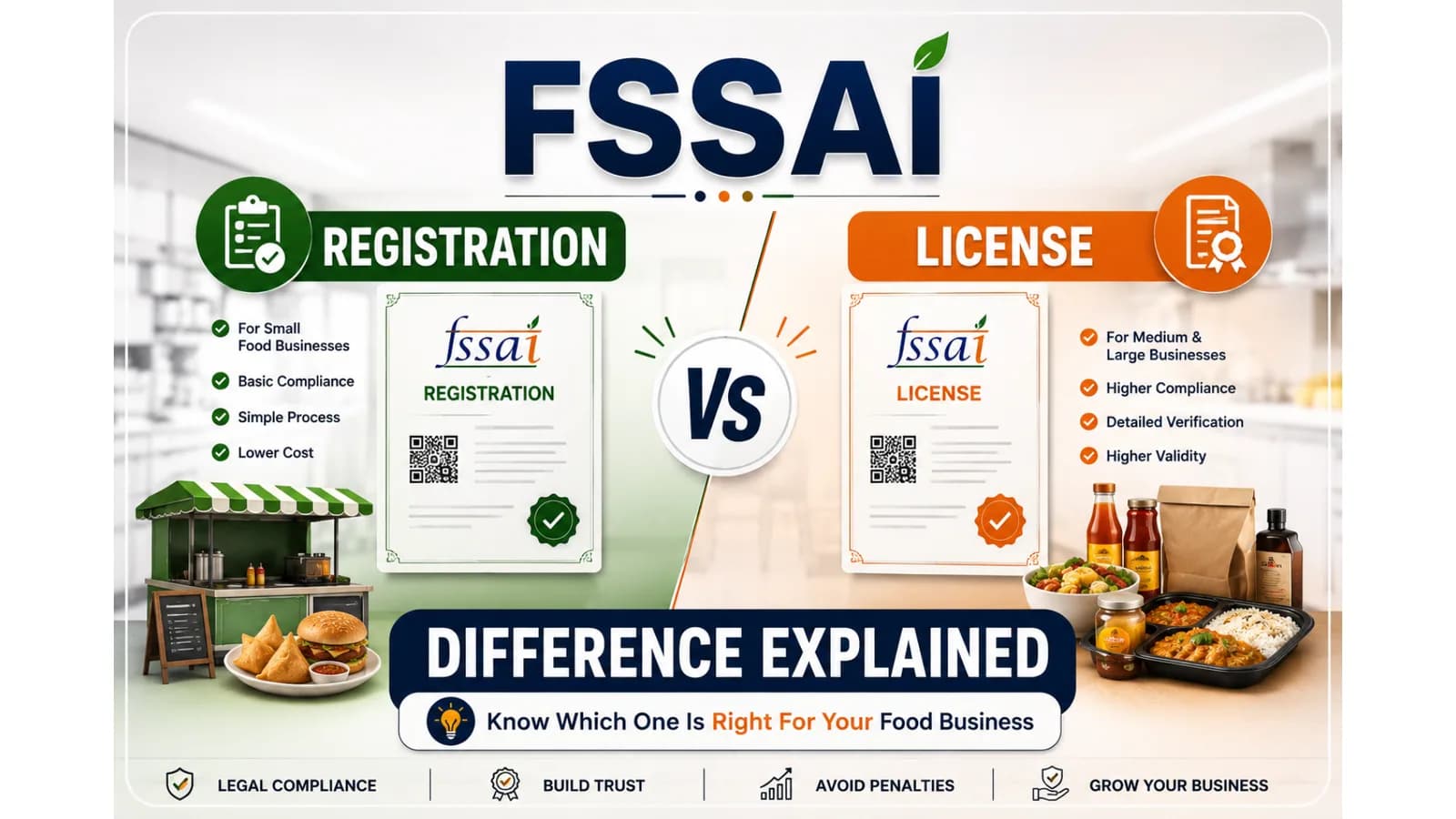
Section 31(2) is the registration route. It is the provision that lets petty retailers, hawkers, itinerant vendors, temporary stall holders and small or cottage food businesses register rather than obtain a licence. A business inside the FSSAI turnover limit for basic registration is exempted from licensing by that sub-section, so Section 63 does not reach it.
This distinction has real money in it. A caterer or an online food seller under the licence-only categories is exposed to ₹10 lakh under Section 63 even at small turnover, because those categories were never eligible to register. A kirana store at ₹40 lakh is exposed to ₹2 lakh. Same revenue, different provision, five times the difference.
What the Jan Vishwas Act, 2023 changed
The Jan Vishwas (Amendment of Provisions) Act, 2023 decriminalised a set of offences across 42 central laws, and the amendments to the Food Safety and Standards Act, 2006 came into force on 8 November 2023. Three sections that food businesses care about moved.
Section | Before | After the Jan Vishwas Act, 2023 |
|---|---|---|
63, carrying on business without a licence | Imprisonment up to 6 months and fine up to ₹5 lakh | Penalty up to ₹10 lakh, no imprisonment |
61, false or misleading information | Imprisonment up to 3 months and fine up to ₹2 lakh | Penalty up to ₹10 lakh |
59, unsafe food not resulting in injury | Imprisonment up to 6 months and fine up to ₹1 lakh | Imprisonment up to 3 months and fine up to ₹3 lakh |
Read the first row carefully, because it cuts both ways. The prison term went, and the money went up by ₹5 lakh. Coverage that still quotes six months and ₹5 lakh is describing the law as it stood before 8 November 2023.
The Act also built in escalation. Penalties rise by ten per cent of the minimum amount every three years, so the figures above are not fixed. Counting from commencement, the first revision for these provisions falls due around November 2026.
[VERIFY: confirm whether the first 10% escalation has been notified for the FSS Act provisions, and the revised figures if so, before this article passes its next refresh.]
The penalty that arrives before any officer does
Enforcement is not what catches most small operators. Distribution is. Swiggy, Zomato, Amazon and Flipkart all require a valid FSSAI number at onboarding, and an existing listing gets pulled when the number lapses or fails verification. There is no notice period and no adjudication, because it is a contract term rather than a statute.
Landlords in food courts, aggregator kitchens and corporate canteen contracts ask for the certificate as a precondition too. A registration that costs ₹100 a year is not a compliance expense at that point. It is the thing that lets you sell at all.
Suspension for non-payment under the 2026 rules
Since the 2026 Amendment Regulations, a registration granted on or after 1 April 2026 is perpetual, but perpetual is conditional. Fail to pay the annual fee, or fail to file a return that applies to you, and the registration is suspended. You may not operate during suspension, and it is revoked only once the dues and any penalty are cleared. Where FSSAI annual return filing applies to your category, treat it as part of keeping the registration alive rather than a separate formality.
This is a regulatory consequence, not a statutory penalty, and it bites faster than either. No inspection is needed for it to take effect.
What to do if you are already operating without registration
Register now rather than waiting to be found. There is no amnesty scheme, but an operator who has voluntarily regularised is in a materially different position at adjudication from one caught mid-inspection, and the adjudicating officer works within a ceiling rather than to a fixed amount.
Confirm your correct tier first, because registering in the wrong category leaves you non-compliant anyway.
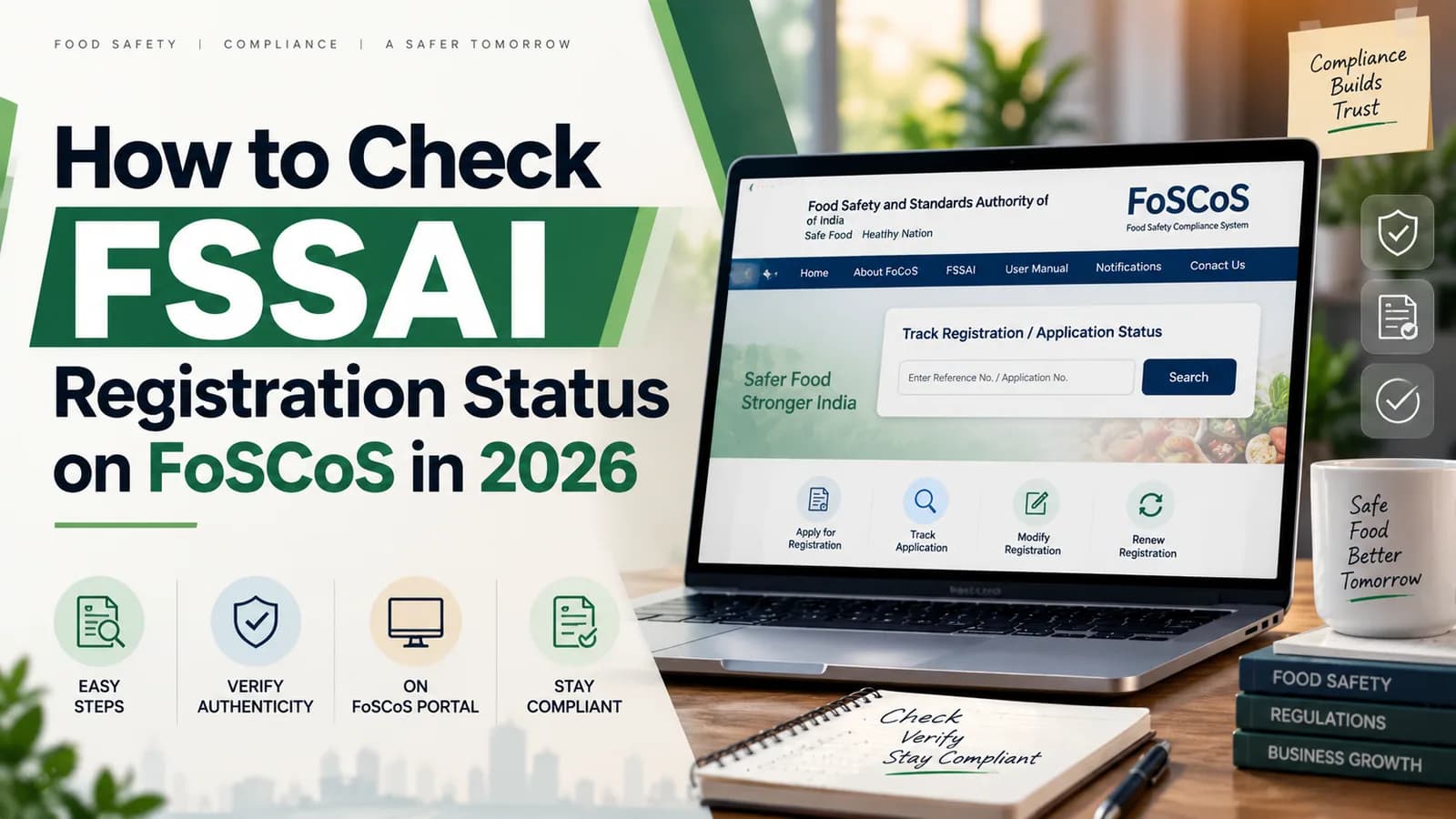
File Form A on FoSCoS with the three required documents and pay the ₹100 annual fee.
Print the 14-digit number on packaging and display the certificate at your premises once granted.
Update every marketplace and aggregator listing with the number so verification does not fail later.
Diarise the annual fee, since non-payment now suspends the registration automatically.
If your kind of business sits in a licence-only category, registering will not fix the exposure. Caterers and hotel food services need a State FSSAI Licence, and importers and online food platforms need a Central FSSAI Licence, whatever their turnover.
What we see on these filings at Complylocal
[EXPERT INPUT NEEDED: Keshav Sehgal to add one real, anonymised observation from Complylocal work. Strongest options: (a) a client delisted by a marketplace over an unverifiable or lapsed FSSAI number and how long reinstatement took; (b) an operator who assumed basic registration covered them when their kind of business was licence-only, and the exposure that created; (c) how often we find businesses running on a registration that was suspended for an unpaid annual fee without them knowing. One real number required.]
Operating without registration, or not sure which tier you need? Talk to Keshav’s team at Complylocal about FSSAI registration for your food business.
Related reading
Ready to file? Start with the documents required for FSSAI basic registration, which is a shorter list than most checklists claim.
Official sources
Food Safety and Standards Act, 2006, Section 31 (licensing and registration), Section 55, Section 58, Section 59, Section 61 and Section 63.
Jan Vishwas (Amendment of Provisions) Act, 2023, which amended Sections 59, 61 and 63 of the FSS Act; the FSS Act provisions came into force on 8 November 2023.
FSS (Licensing and Registration of Food Businesses) Amendment Regulations, 2026, Gazette CG-DL-E-12032026-270872, notified 10 March 2026, on perpetual validity and suspension.
FSSAI order dated 13 March 2026, F. No. RCD-01002/1/2021-Regulatory-FSSAI-Part(1), revised turnover thresholds effective 1 April 2026.
FoSCoS, foscos.fssai.gov.in, Kind of Business eligibility matrix.