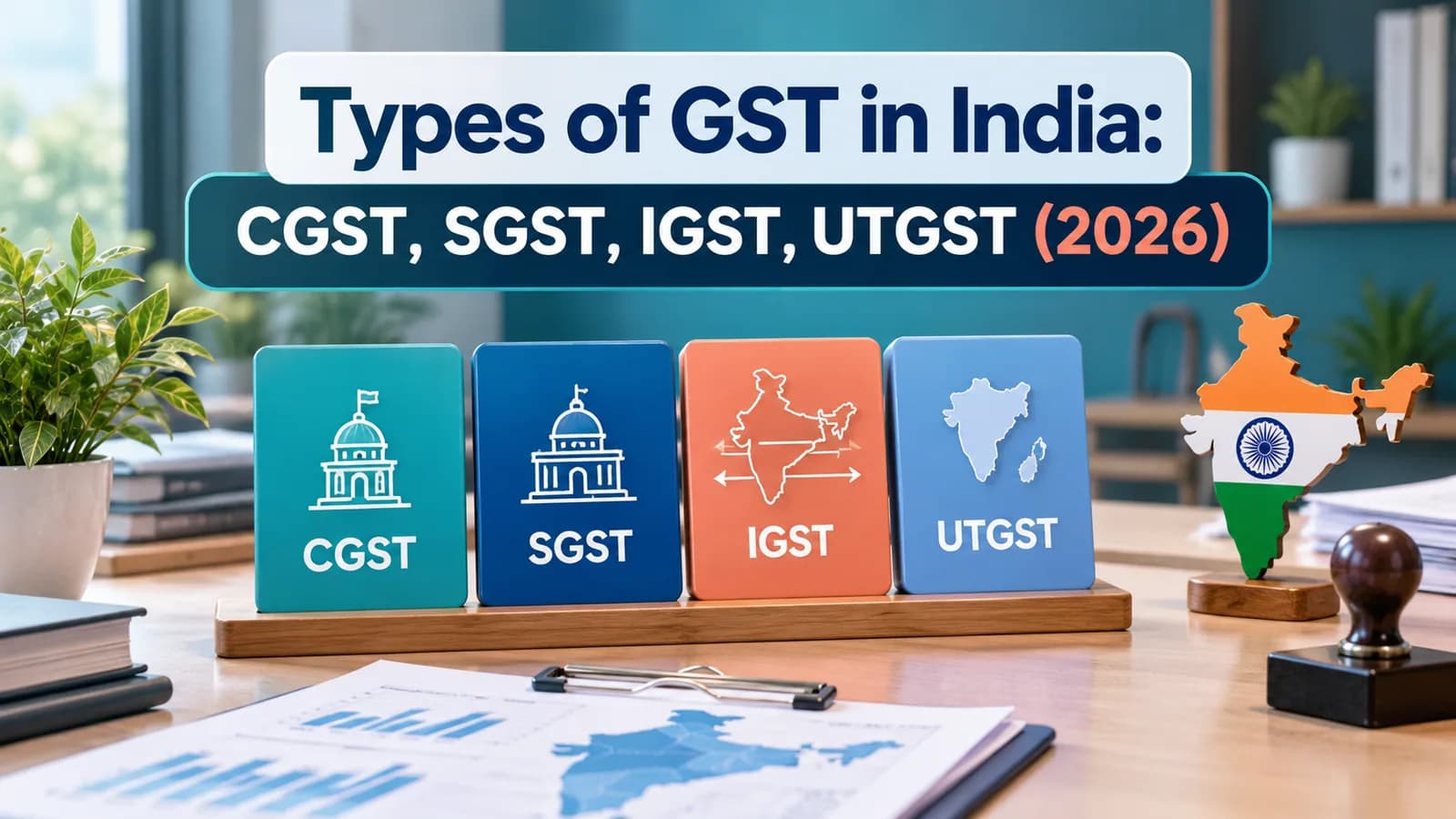
There are four types of GST in India: CGST (Central GST), SGST (State GST), IGST (Integrated GST) and UTGST (Union Territory GST). A sale within one state carries CGST plus SGST, or CGST plus UTGST in certain union territories. A sale from one state to another, an import, or a supply to an SEZ carries IGST alone.
The type of GST decides who receives the tax and which credits can pay it. The rate is a separate question: since 22 September 2025 most goods and services fall in the 5% or 18% slab, with 40% reserved for a short list of luxury and sin goods.
The four types of GST at a glance
Type | Charged on | Law | Tax goes to |
|---|---|---|---|
CGST | Sales within a state or UT | CGST Act, 2017 | Central Government |
SGST | Sales within a state, and within Delhi, Puducherry and Jammu & Kashmir | Each state's GST Act | That state |
UTGST | Sales within a UT without its own legislature | UTGST Act, 2017 | That union territory |
IGST | Sales between states, imports, exports and supplies to SEZs | IGST Act, 2017 | Collected by the Centre, then settled with the consuming state |
A single invoice never mixes IGST with CGST and SGST for the same item. Either the supply is intra-state and splits into two equal halves, or it is inter-state and carries one IGST line at the full rate.
CGST and SGST: sales within one state
CGST and SGST apply together whenever the supplier and the place of supply are in the same state. The rate is split equally: an 18% supply is billed as 9% CGST and 9% SGST, and a 5% supply as 2.5% of each.
Example: a trader in Rohtak sells goods worth ₹10,000 at 18% to a buyer in Gurugram. Both are in Haryana, so the invoice shows CGST ₹900 and SGST ₹900, a total of ₹1,800. The ₹900 of CGST goes to the Centre and the ₹900 of SGST to Haryana.
Delhi, Puducherry and Jammu & Kashmir are union territories with their own legislatures, and they use SGST under their own GST Acts, not UTGST.
UTGST: sales within certain union territories
UTGST replaces SGST in union territories that have no legislature of their own: Chandigarh, Ladakh, Lakshadweep, Andaman and Nicobar Islands, and Dadra and Nagar Haveli and Daman and Diu. A sale within one of them is billed as CGST plus UTGST, again split equally.
Example: a café supplier in Chandigarh selling to a restaurant in Chandigarh charges CGST and UTGST. If the same supplier sells to a buyer in Mohali, Punjab, the supply crosses a boundary and becomes IGST.
IGST: sales between states, imports and SEZ supplies
IGST applies to every inter-state supply under the IGST Act, 2017. That covers a sale from one state to another, goods imported into India, exports, and any supply to a Special Economic Zone (SEZ) unit or developer, even when the SEZ is in the supplier's own state.
Example: the Rohtak trader sells the same ₹10,000 of goods to a buyer in Delhi. Haryana to Delhi is inter-state, so the invoice carries a single IGST line of ₹1,800. The Centre collects it and, under Section 17 of the IGST Act, settles the state share with Delhi, where the goods are consumed.
Exports are zero-rated: the exporter either pays IGST and claims a refund, or exports under a Letter of Undertaking without paying it. Imports of goods carry IGST at the customs stage, alongside customs duty.
How to tell which type of GST applies
Compare two locations: where the supplier is registered, and the place of supply under the IGST Act. For goods, the place of supply is usually where delivery ends; for most services to a registered business, it is the customer's location. Same state or UT means CGST with SGST or UTGST; different states, or anything involving an SEZ or a foreign country, means IGST.
Situation | Type of GST | Why |
|---|---|---|
Haryana seller delivers to a Haryana buyer | CGST + SGST | Supplier and place of supply in the same state |
Haryana seller delivers to a Delhi buyer | IGST | Different states |
Chandigarh seller delivers within Chandigarh | CGST + UTGST | UT without a legislature |
Haryana seller supplies an SEZ unit in Haryana | IGST | SEZ supplies are inter-state by law |
Online seller in Haryana ships to a customer in Karnataka | IGST | Delivery ends in another state |
Business imports goods from China | IGST at customs | Imports are inter-state supplies |
For online sellers the delivery address, not the billing address, usually drives the answer. Our guide to GST rates for e-commerce sellers covers the marketplace side, and selling into other states raises separate registration questions covered in GST registration in another state.
Why the type of GST matters for input tax credit
The type of GST decides which credit can pay which liability. Under Section 49 of the CGST Act and Rule 88A of the CGST Rules, IGST credit must be used first, against IGST and then CGST and SGST or UTGST in any order. CGST credit can pay CGST and IGST but never SGST, and SGST credit can pay SGST and IGST but never CGST.
Credit available | Can be used to pay | Cannot be used to pay |
|---|---|---|
IGST | IGST first, then CGST and SGST/UTGST | Nothing; it must be exhausted first |
CGST | CGST, then IGST | SGST or UTGST |
SGST / UTGST | SGST or UTGST, then IGST | CGST |
The GST portal applies this order when you set off liability in GSTR-3B, but read your credit ledger by type anyway. A balance left in SGST credit cannot pay a CGST liability, however large it is, so that liability goes out in cash.
What happens if you charge the wrong type of GST?
Charging IGST on a local sale, or CGST and SGST on an inter-state one, does not simply cancel out. The buyer's credit lands under the wrong head, and the supplier has paid tax to the wrong government.
Section 77 of the CGST Act and Section 19 of the IGST Act provide the fix: pay the correct type of tax, without interest, and claim a refund of the tax paid under the wrong head. Rule 89(1A) of the CGST Rules requires that refund claim within two years of paying the correct tax.
Our view from the filing desk: wrong-head errors usually come from a customer's state being set up incorrectly in the billing software, not from a misunderstanding of the law. Checking the state code in every customer record once, when the customer is created, prevents months of corrections later.
Types of GST rates in 2026
Since 22 September 2025, following the 56th GST Council meeting, GST has two main slabs, a merit rate of 5% and a standard rate of 18%, plus a special de-merit rate of 40%. The earlier 12% and 28% slabs were removed, and most items moved down to 5% or 18%.
Rate | What it covers |
|---|---|
0% (nil) | Exempt and nil-rated items such as fresh produce, UHT milk and individual life and health insurance |
5% | Merit rate for daily-use items, including many packaged foods, household goods and medicines |
18% | Standard rate for most goods and services, including most professional services |
40% | De-merit rate for a short list of luxury and sin goods, such as aerated drinks, pan masala, cigarettes and larger motorcycles |
Special rates | 3% on gold, silver and jewellery; 0.25% on rough diamonds |
The GST compensation cess ended on 1 February 2026. From that date, pan masala, cigarettes and tobacco products moved to 40% GST with separate excise duty or a health cess outside GST, while biris are taxed at 18%.
The rate slab and the type of GST are independent. An 18% item is billed as 9% CGST plus 9% SGST within a state, or as 18% IGST across states. Always confirm your item's rate from its HSN or SAC code rather than a general slab list.
GST is which type of tax?
GST is an indirect tax: the supplier collects it from the customer and pays it to the government, and the final consumer bears it. It is also a destination-based, multi-stage tax, charged at every stage of supply with credit for tax paid at the previous stage, so tax revenue follows the place of consumption.
GST came into force on 1 July 2017 under the 101st Constitutional Amendment. It replaced central excise duty, service tax, additional customs duties, central sales tax, state VAT, entry tax, luxury tax and entertainment tax, among others. Petrol, diesel, aviation turbine fuel, natural gas, crude oil and alcohol for human consumption are still outside GST.
Other "types" people search for under GST
The phrase types of GST is often used for three other things, and each has its own guide. Registration categories, such as regular, composition, casual and non-resident, are covered in our guide to types of GST registration. The forms you file, such as GSTR-1, GSTR-3B and GSTR-9, are listed in types of GST returns.
Whether you need to register at all depends on turnover and the kind of supply, explained in our GST registration turnover limit guide.
Want your invoices, credit ledger and returns checked for the right GST type every month? Talk to Ankush's team about GST compliance services at ComplyLocal →