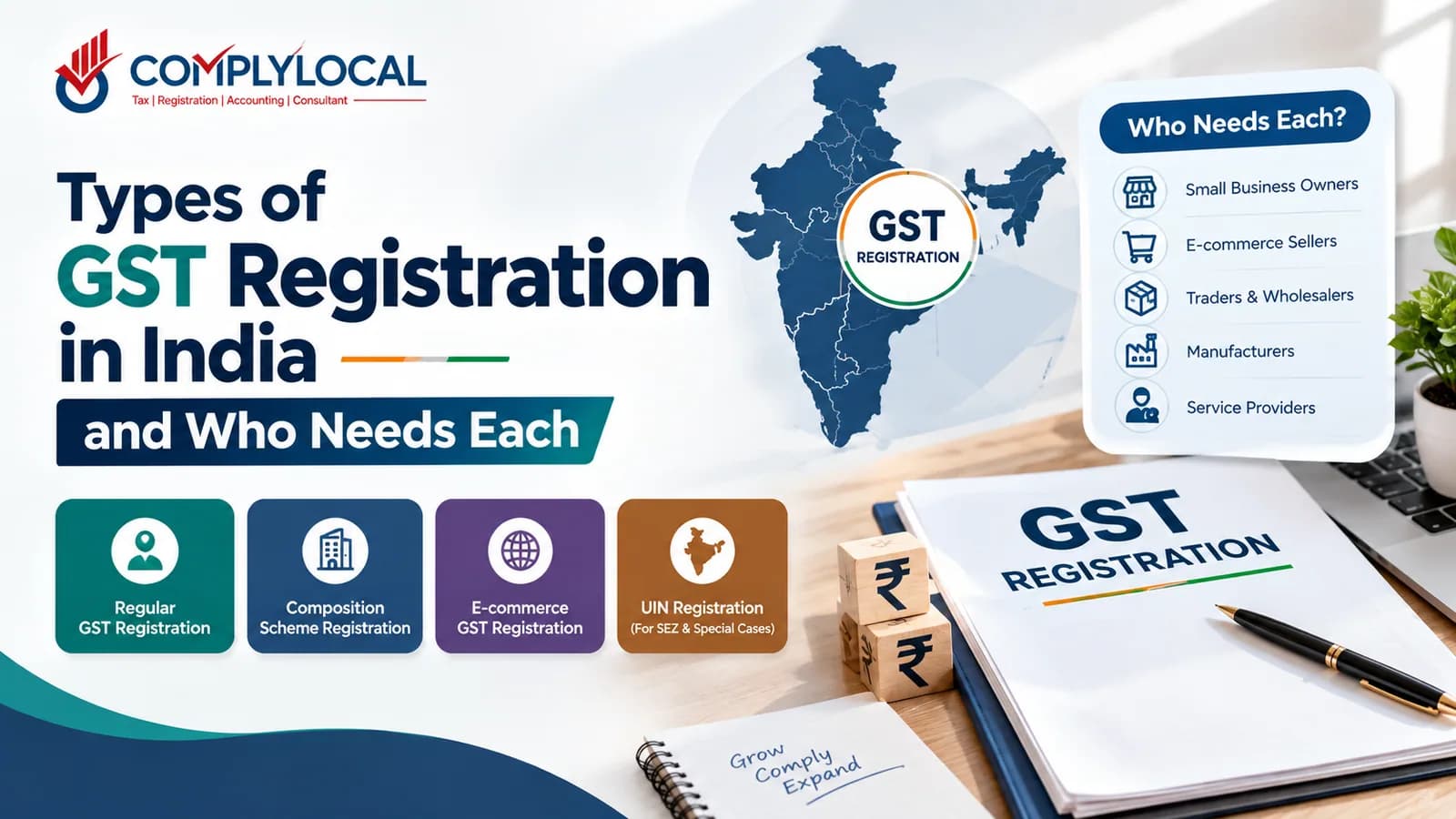
There are eleven types of GST registration in India, and the one you need depends on what you supply and how, not on your size. Most businesses take a regular registration on FORM GST REG-01. The rest are triggered by specific circumstances: occasional trade in another state, a foreign supplier, a head office distributing credit, or an obligation to deduct or collect tax.
All types of GST registration at a glance
Type | Who it applies to | Application form |
|---|---|---|
Regular taxpayer | Most businesses crossing the threshold or covered by Section 24 | REG-01 |
Composition taxpayer | Small suppliers opting into the flat-rate scheme under Section 10 | REG-01 |
Casual taxable person | Occasional supply in a state with no fixed place of business | REG-01 |
Non-resident taxable person | Foreign persons supplying in India without a place of business here | REG-09 |
Input Service Distributor | Head office distributing credit on common input services | REG-01, separate application |
TDS deductor | Government bodies and notified persons under Section 51 | REG-07 |
TCS collector | E-commerce operators collecting tax at source under Section 52 | REG-07 |
OIDAR supplier | Foreign digital service providers supplying to unregistered Indian recipients | REG-10 |
Online money gaming supplier | Foreign suppliers of online money gaming under Section 14A of the IGST Act | REG-10 |
UIN holder | Embassies, UN bodies and notified organisations claiming refunds | REG-13 |
SEZ unit or developer | Units inside a special economic zone, registered separately from other units | REG-01 |
Regular taxpayer registration
This is the default and covers the overwhelming majority of registrations. A regular taxpayer charges GST on outward supplies, claims input tax credit, and files GSTR-1 and GSTR-3B for every tax period.
You need it once aggregate turnover crosses Rs 40 lakh for goods or Rs 20 lakh for services, halved in special category states, or immediately if Section 24 applies to you. The full position is in our guide to the GST registration turnover limit.
A regular registration has no expiry date and no renewal. It stays live until it is cancelled, either voluntarily in FORM GST REG-16 or by the officer.
Composition taxpayer registration
Composition is not a separate registration so much as a way of paying tax under an existing one. You opt in inside FORM GST REG-01 at the time of registration, or later by filing FORM GST CMP-02 before the financial year begins.
Category | Turnover limit | Flat rate |
|---|---|---|
Traders and manufacturers | Rs 1.5 crore, Rs 75 lakh in specified north-eastern states | 1 per cent |
Restaurants not serving alcohol | Rs 1.5 crore | 5 per cent |
Service providers under Section 10(2A) | Rs 50 lakh | 6 per cent |
The trade-offs are real. A composition dealer cannot claim input tax credit, cannot charge tax on invoices, issues a bill of supply instead of a tax invoice, and cannot make inter-state outward supplies. Since 1 October 2023, composition dealers may sell goods through e-commerce operators, but only within their own state.
Casual taxable person
A casual taxable person supplies goods or services occasionally in a state where they have no fixed place of business. A Ludhiana garment manufacturer taking a stall at a Delhi exhibition is the classic case.
The application must be filed at least five days before commencing business in that state.
Under Section 27, an advance deposit of tax equal to the estimated liability must be paid before the certificate is issued.
The registration is valid for the period requested, up to ninety days, and can be extended once by a further ninety days.
The advance deposit is not a fee. It sits in your electronic cash ledger and is adjusted against the tax you actually report.
Non-resident taxable person
A non-resident taxable person supplies goods or services in India but has no fixed place of business or residence here. Registration is applied for in FORM GST REG-09 under Rule 13, at least five days before commencing business.
PAN is not required, which is the main structural difference from every other category. The application is made using a passport, or the tax identification number of the country of incorporation for a foreign entity, and it must be signed by an authorised signatory who is resident in India with a valid PAN. Like the casual registration, it is valid for ninety days and carries an advance tax deposit.
Input Service Distributor, now mandatory
An Input Service Distributor is an office that receives tax invoices for common input services on behalf of several GSTINs under the same PAN, and distributes the credit to them. A head office paying a single audit fee or a group software licence for branches in four states is an ISD.
This is the most consequential recent change in registration types. The Finance Act, 2024 amended Sections 2(61) and 20 of the CGST Act, and Notification No. 16/2024-Central Tax dated 6 August 2024 brought those amendments into force from 1 April 2025. ISD registration moved from optional to mandatory, and the cross-charge route can no longer be used for third-party common input services.
A separate ISD registration is required even where the same office already holds a regular GSTIN, because Rule 8 requires a separate application.
Credit is distributed by issuing an ISD invoice under Rule 54, with eligible and ineligible credit shown separately.
The ISD files FORM GSTR-6 by the thirteenth of the following month, and files no annual return.
Distributed credit appears in the recipient branch’s GSTR-2B and is claimed in its GSTR-3B.
If your group holds GSTINs in more than one state and pays for common services centrally, this now applies to you. Getting the distribution right is a reconciliation problem more than a registration one, which our GST return filing team handles alongside the monthly cycle.
TDS deductor and TCS collector
Both use FORM GST REG-07 under Rule 12, and both are registrations to collect tax on someone else’s behalf rather than to pay tax on your own supplies.
TDS deductor | TCS collector | |
|---|---|---|
Governing section | Section 51 | Section 52 |
Who it covers | Government departments, local authorities and notified persons | E-commerce operators collecting tax on supplier payments |
Return filed | FORM GSTR-7, monthly | FORM GSTR-8, monthly |
PAN requirement | TAN may be used instead of PAN | PAN required |
Marketplace sellers do not need a TCS registration. The operator holds that one. Sellers need an ordinary registration in every state where their stock sits, which is what a virtual place of business is used for.
OIDAR and online money gaming suppliers
A supplier of online information and database access or retrieval services from outside India to unregistered recipients in India must register under Section 14 of the IGST Act, using FORM GST REG-10, and files FORM GSTR-5A. Streaming platforms, cloud software sold to Indian consumers, and online course providers fall here.
Online money gaming supplied from outside India to a person in India was brought into the same framework by Section 14A of the IGST Act with effect from 1 October 2023. Where the recipient is a registered Indian business, the position changes, because reverse charge shifts the liability to the recipient.
Unique Identity Number for embassies and UN bodies
A UIN is not a taxpayer registration. Under Section 25(9) of the CGST Act read with Rule 17, specialised agencies of the United Nations, multilateral financial institutions, consulates and embassies are granted a Unique Identity Number in FORM GST REG-13.
A UIN holder does not charge GST and does not file returns in the ordinary sense. The number exists so the organisation can claim a refund of tax paid on inward supplies. Suppliers billing a UIN holder must quote the UIN on the invoice, otherwise the refund claim fails.
SEZ units and developers
A unit inside a special economic zone, or an SEZ developer, must apply for a registration separate from any other unit the same person operates outside the zone in the same state. Supplies to an SEZ unit are zero-rated, which is why the department insists on keeping the two apart in the records.
[VERIFY: confirm the exact proviso to Rule 8(1) of the CGST Rules that requires a separate SEZ registration before citing it as a rule reference.]
Can one business hold more than one registration?
Yes, and in several situations it must. Registration under GST is state-wise and PAN-based, so a business operating in four states holds four GSTINs on one PAN.
Separate registration is compulsory in every state where you have a place of business from which you make taxable supplies.
Rule 11 allows more than one registration within a single state where you have multiple places of business, though it is optional.
An ISD registration is separate from and additional to the regular registration held by the same office.
A person opting into Rule 14A may hold only one such registration on a PAN across the whole country.
That last restriction catches marketplace sellers who take the three-day route in their first state and then need a second registration elsewhere. Our guide to Rule 14A GST registration sets out when to avoid it.
Choosing the wrong type, and what it costs
The expensive mistake is not choosing a type you did not need. It is taking a regular registration where a composition or ISD registration was required, and discovering it during a reconciliation months later when credit has already been claimed the wrong way.
[EXPERT INPUT NEEDED: Keshav - one real anonymised case where a client took the wrong registration type or missed the ISD requirement after 1 April 2025. What surfaced the problem, how it was corrected, and what it cost in time or credit.]
Not sure which type your structure needs? Talk to Keshav’s team at Complylocal about GST registration services.