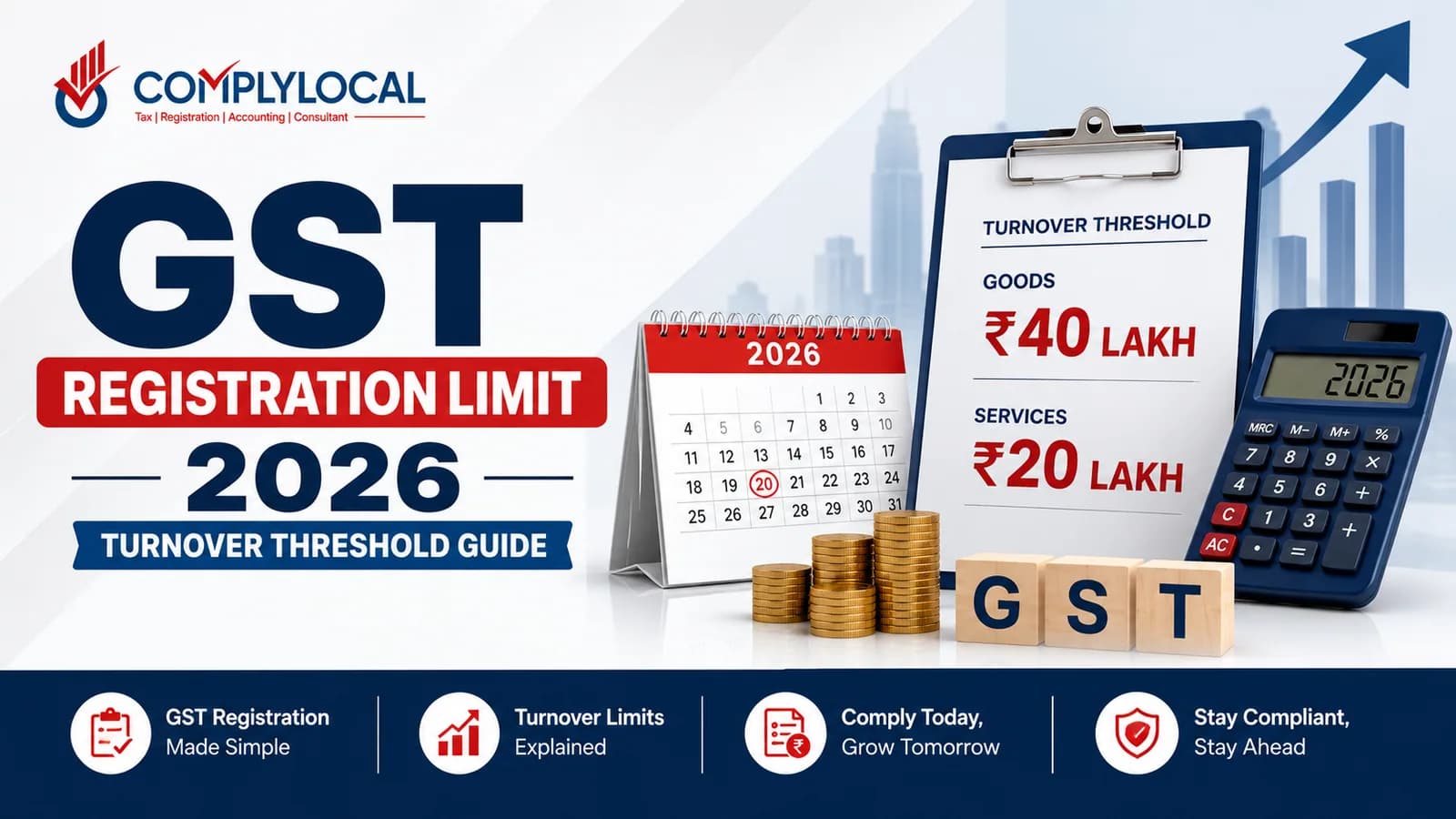
The GST registration limit is Rs 40 lakh of aggregate turnover for a business supplying only goods, and Rs 20 lakh for anyone supplying services. Both figures halve to Rs 20 lakh and Rs 10 lakh in special category states. Section 24 of the CGST Act overrides all of this for certain businesses, who must register from their first rupee.
Key facts on the GST registration limit
Item | Position as on 31 August 2026 |
|---|---|
Goods only, most states | Rs 40 lakh aggregate turnover |
Services, or goods plus services | Rs 20 lakh aggregate turnover |
Goods only, ten notified states and UTs | Rs 20 lakh |
Services in Manipur, Mizoram, Nagaland, Tripura | Rs 10 lakh |
Governing provision | Section 22, CGST Act, read with Notification No. 10/2019-Central Tax dated 07-03-2019 |
Effective from | 1 April 2019, unchanged since |
Latest confirmation | Government told Parliament in February 2026 that no revision has been recommended |
Time to apply after crossing | 30 days from the date liability arises, under Section 25(1) |
What is the turnover limit for GST registration?
A business supplying only goods must register once aggregate turnover crosses Rs 40 lakh in a financial year. A business supplying services, or a mix of goods and services, must register at Rs 20 lakh. According to CBIC, the Rs 40 lakh limit for goods was granted by Notification No. 10/2019-Central Tax dated 7 March 2019 with effect from 1 April 2019.
The higher goods limit is an exemption, not the base rule. Section 22 of the CGST Act sets Rs 20 lakh as the general threshold, and the notification lifts it to Rs 40 lakh for exclusive suppliers of goods who meet its conditions. That structure explains why the exemption falls away so easily.
In February 2026 the government confirmed in a written answer in Parliament that the GST Council has not recommended any change to these limits. Anyone quoting a new figure for 2026 is quoting a proposal, not the law.
State-wise GST registration limit
Ten states and union territories chose to stay at Rs 20 lakh for goods rather than adopt the Rs 40 lakh exemption. Four states sit at Rs 10 lakh for services.
Threshold | Applies to | States and UTs |
|---|---|---|
Rs 40 lakh (goods) | Exclusive supply of goods | All states and UTs except the ten listed below |
Rs 20 lakh (goods) | Exclusive supply of goods | Arunachal Pradesh, Manipur, Meghalaya, Mizoram, Nagaland, Puducherry, Sikkim, Telangana, Tripura, Uttarakhand |
Rs 20 lakh (services) | Services, or goods plus services | All states and UTs except the four listed below |
Rs 10 lakh (services) | Services, or goods plus services | Manipur, Mizoram, Nagaland, Tripura |
Telangana and Uttarakhand catch people out. Both are ordinary, high-activity states with no north-eastern association, and both sit at Rs 20 lakh for goods. A Hyderabad trader crossing Rs 25 lakh is liable while a Bengaluru trader at the same turnover is not.
Three situations that cancel the Rs 40 lakh limit
The Rs 40 lakh exemption is conditional, and losing it is easier than most traders expect. It does not apply if any one of the following is true.
You supply any service at all. Even a small consultancy or commission income alongside your goods business pulls you back to Rs 20 lakh.
You supply ice cream, pan masala, tobacco, or fly ash bricks and similar notified goods, which are excluded from the exemption outright.
You make intra-state supplies in one of the ten states that did not adopt the higher limit.
A hardware trader billing Rs 38 lakh of goods and Rs 3 lakh of installation charges is not at Rs 41 lakh against a Rs 40 lakh limit. That business is at Rs 41 lakh against a Rs 20 lakh limit, and has been liable since it crossed Rs 20 lakh.
What counts as aggregate turnover
Aggregate turnover is computed on the PAN, across India, not per state and not per business vertical. Under Section 2(6) of the CGST Act it covers taxable supplies, exempt supplies, exports, and inter-state supplies of persons having the same PAN.
Included in aggregate turnover | Excluded from aggregate turnover |
|---|---|
Taxable supplies of goods and services | CGST, SGST, UTGST, IGST and compensation cess charged |
Exempt and nil-rated supplies | Value of inward supplies on which you pay under reverse charge |
Exports and zero-rated supplies | |
Inter-state supplies under the same PAN |
Two consequences follow. First, a proprietor running a taxable trading business and an exempt tuition business under one PAN adds both together. Second, a company with branches in three states counts all three, so the limit is reached far earlier than a state-level view suggests.
Who must register regardless of turnover
Section 24 of the CGST Act begins by overriding Section 22 entirely. The persons listed below must register even at zero turnover.
Persons making any inter-state taxable supply of goods.
Casual taxable persons making taxable supply.
Persons liable to pay tax under reverse charge, and persons liable under Section 9(5).
Non-resident taxable persons making taxable supply.
Persons required to deduct tax at source under Section 51.
Agents making taxable supplies on behalf of other taxable persons.
Input Service Distributors.
Persons supplying goods through an e-commerce operator required to collect tax at source under Section 52.
Every e-commerce operator required to collect tax at source under Section 52.
Suppliers of online information and database access or retrieval services from outside India to unregistered recipients in India.
Note the asymmetry in the first entry. Inter-state supply of goods triggers compulsory registration; inter-state supply of services does not, because service providers were later given threshold relief. A Jaipur designer invoicing a Mumbai client for Rs 6 lakh a year does not need a GSTIN. A Jaipur trader shipping Rs 60,000 of goods to Mumbai does.
[VERIFY: confirm the notification number and date granting inter-state service providers relief up to Rs 20 lakh before publishing it as a citation.]
E-commerce sellers and the exemption most of them cannot use
Selling goods through Amazon, Flipkart or Meesho normally means compulsory registration under Section 24 regardless of turnover. According to CBIC, Notification No. 34/2023-Central Tax dated 31 July 2023, effective 1 October 2023, created a narrow exemption for small goods sellers.
The exemption applies only if every one of these holds true:
Aggregate turnover in the preceding and current financial year stays below the Section 22 threshold for that state.
You make no inter-state supply of goods at all.
You supply through an e-commerce operator in one state or union territory only.
You hold a valid PAN and declare it, along with your place of business, on the common portal.
You obtain an enrolment number on the portal before making any supply.
The inter-state condition is what disqualifies almost every real seller. National fulfilment means shipping across state lines, which ends the exemption immediately, and storing stock in another state needs a separate GSTIN there supported by a virtual place of business. Our guide to GST registration for e-commerce sellers works through the state-by-state position.
When the clock starts and how long you have
Section 25(1) of the CGST Act gives you thirty days from the date you become liable to apply for registration. Liability arises on the day turnover crosses the threshold, not at the end of the month or the quarter.
Casual and non-resident taxable persons get a tighter rule: they must apply at least five days before commencing business. A trader taking a stall at a Delhi trade fair on the 20th needs the application in by the 15th.
Applying inside the thirty-day window also protects your input tax credit on opening stock under Section 18(1)(a). The rupee cost of missing it is set out in our note on GST registration fees.
Voluntary registration below the limit
Under Section 25(3), a person not liable to register may register voluntarily, and once registered is treated exactly like any other registered person. Every obligation follows: monthly or quarterly returns, e-invoicing where applicable, and late fees for nil returns filed late.
Voluntary registration is worth taking when your buyers are registered businesses who need input tax credit, when you want to claim credit on your own input costs, or when a marketplace or corporate client will not onboard a vendor without a GSTIN. It is a poor idea for a small B2C seller with no credit to claim.
If you register voluntarily and your monthly output tax on B2B sales stays under Rs 2.5 lakh, the Rule 14A GST registration route gets you the GSTIN in three working days instead of seven.
Composition scheme limits, which are a different number
People conflate the registration threshold with the composition threshold. They measure different things. Registration limits decide whether you need a GSTIN. Composition limits decide how you pay tax once you have one.
Scheme | Turnover limit | Flat rate |
|---|---|---|
Composition, traders and manufacturers | Rs 1.5 crore, Rs 75 lakh in specified north-eastern states | 1 per cent |
Composition, restaurants without alcohol | Rs 1.5 crore | 5 per cent |
Composition for service providers, Section 10(2A) | Rs 50 lakh | 6 per cent |
Composition is governed by Section 10 of the CGST Act read with Rules 3 to 7. Existing taxpayers opt in only by filing FORM GST CMP-02 before the financial year starts. A new applicant can choose it inside FORM GST REG-01 at the time of registration.
Where turnover calculations go wrong
The errors we see are almost never arithmetic. They are scope errors: counting one state instead of the PAN, ignoring exempt income, or treating a one-off service invoice as irrelevant when it quietly moved the whole business from Rs 40 lakh to Rs 20 lakh.
[EXPERT INPUT NEEDED: Keshav - one real anonymised case where a client crossed the threshold earlier than they realised. What income was missed from the calculation, how late the registration was, and what it cost them in credit or penalty.]
Not sure which limit applies to your mix of goods and services? Talk to Keshav’s team at Complylocal about GST registration services.