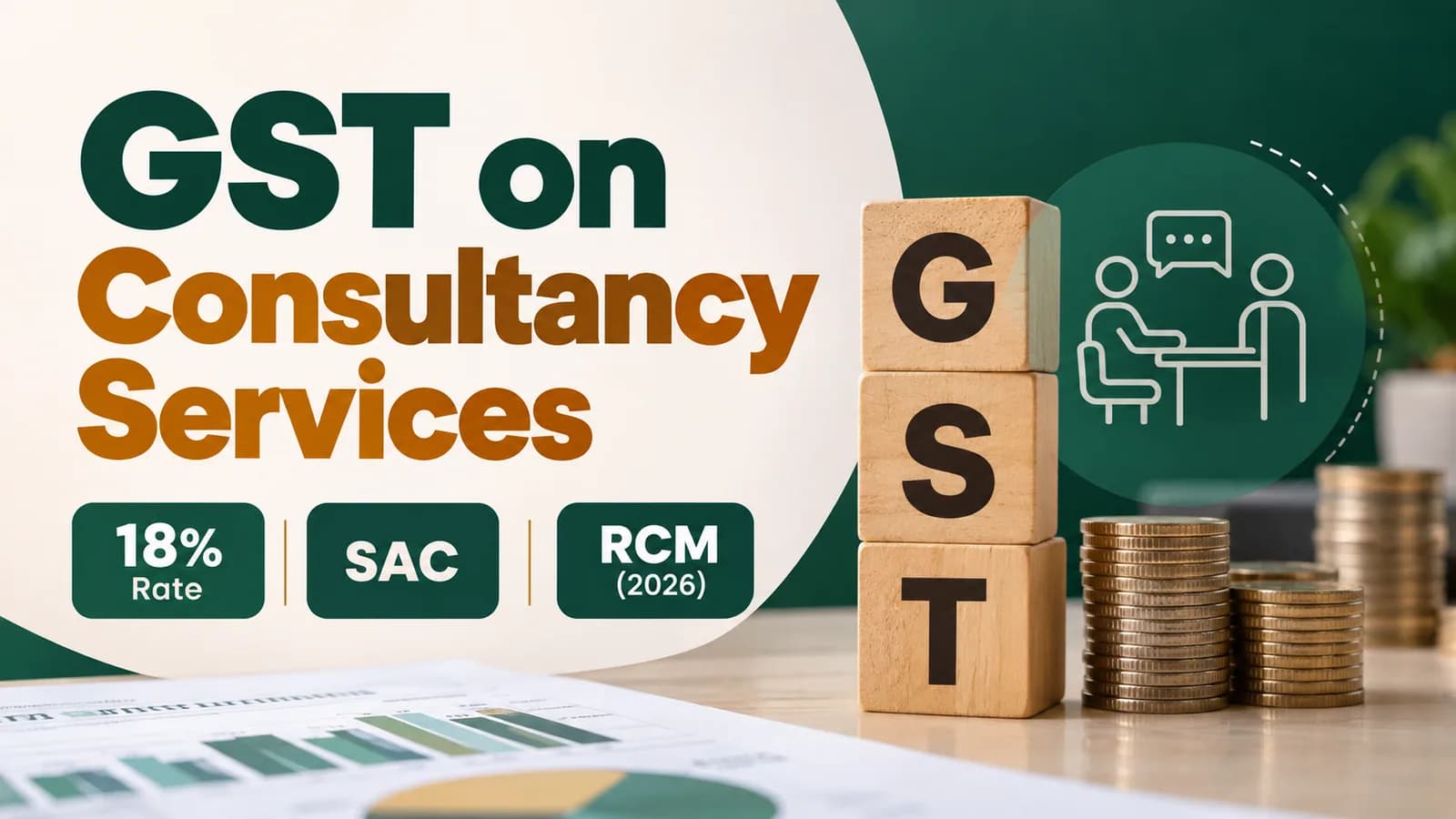
GST on consultancy services is 18% for most management, business, IT, engineering and technical consulting, billed as 9% CGST plus 9% SGST to a client in your state, or 18% IGST to a client in another state. A consultant must register once aggregate turnover crosses ₹20 lakh (₹10 lakh in some special category states). Exports of consultancy can be zero-rated.
Two exceptions change who pays: legal advice by advocates to larger businesses, and services a director provides to his own company, are taxed under reverse charge. This guide covers the rate, codes, reverse charge, place of supply, exports and invoicing.
GST rate on consultancy services
Type of consultancy | SAC heading | GST |
|---|---|---|
Management and business consulting | 9983 | 18% |
IT and software consulting | 9983 | 18% |
Engineering, architecture and technical consulting | 9983 | 18% |
Accounting, audit and tax consulting | 9982 | 18% |
Legal consulting by an advocate or law firm | 9982 | 18%, often under reverse charge (see below) |
HR, recruitment and marketing consulting | 9983 or 9985 depending on the service | 18% |
The September 2025 rate changes, which moved most goods into 5% and 18% slabs, left professional and consulting services at 18%. Use the six-digit SAC that best describes the service on each invoice; the rate for all of these is the same.
How the tax is billed: CGST and SGST or IGST
For a business client, the place of supply of consulting is the client's registered location. Same state as you means CGST and SGST in equal halves; a different state means IGST. For an individual client, it is the client's address on record.
Example: a management consultant registered in Rohtak bills ₹1,00,000 for a project. For a client in Gurugram, the invoice shows CGST ₹9,000 and SGST ₹9,000. For a client in Bengaluru, it shows IGST ₹18,000. For a client in Singapore meeting the export conditions and covered by a Letter of Undertaking, it shows no GST. How each type of GST works is explained in types of GST in India.
When the client pays GST under reverse charge
Under reverse charge, the recipient pays the GST instead of the supplier. Three situations matter for consultancy:
Situation | GST treatment |
|---|---|
Legal services by an advocate or firm of advocates to a business entity | Business entity pays GST under reverse charge; exempt for individuals and for business entities below the registration threshold |
Services by a director to the company, in the capacity of director | Company pays GST under reverse charge |
Consultancy imported from a supplier outside India | The Indian business recipient pays IGST under reverse charge and can usually claim it as credit |
A chartered accountant, company secretary or management consultant charges GST normally under forward charge; only advocates' legal services fall in the reverse-charge entry.
Registration threshold for consultants
A consultant supplying only services must register once aggregate turnover in the financial year crosses ₹20 lakh, or ₹10 lakh in Manipur, Mizoram, Nagaland and Tripura. Clients in other states do not force registration below that limit, and foreign fees count towards it. Freelance consultants will find the full registration path in our guide to GST registration for freelancers.
Composition option for small consultants
A service provider with turnover up to ₹50 lakh can opt to pay GST at a concessional 6% under Notification No. 2/2019-Central Tax (Rate), without input tax credit. It is available only if all outward supplies are within the state, and the consultant cannot charge GST on invoices, so business clients get no credit. It suits consultants whose clients are mainly individuals in the same state.
Export of consultancy services
Consultancy to a client outside India is an export when all conditions in Section 2(6) of the IGST Act are met: you are in India, the client is outside India, the place of supply is outside India, payment comes in convertible foreign exchange or RBI-permitted rupees, and the two are not branches of the same entity.
A registered consultant can export without paying IGST by filing a Letter of Undertaking in RFD-11 for each financial year; our LUT filing service handles the annual filing.
Invoicing rules consultants often miss
Issue the tax invoice within 30 days of completing the service, under Rule 47 of the CGST Rules.
Show the client's GSTIN and state on every B2B invoice so the right tax type applies.
For a retainer billed monthly, invoice each billing period as a continuous supply.
Charge GST on reimbursed expenses billed to the client unless you act purely as the client's agent.
Mark export invoices for supply under LUT without payment of integrated tax.
Our view: collect the client's GSTIN and billing state in the engagement letter, not at invoice time. The wrong state on an invoice means the wrong tax type, and correcting it later needs a credit note, a fresh invoice and an unhappy client's accounts team.
Need consultancy invoicing, returns and LUT handled together? Talk to Ankush's team about GST services at ComplyLocal →