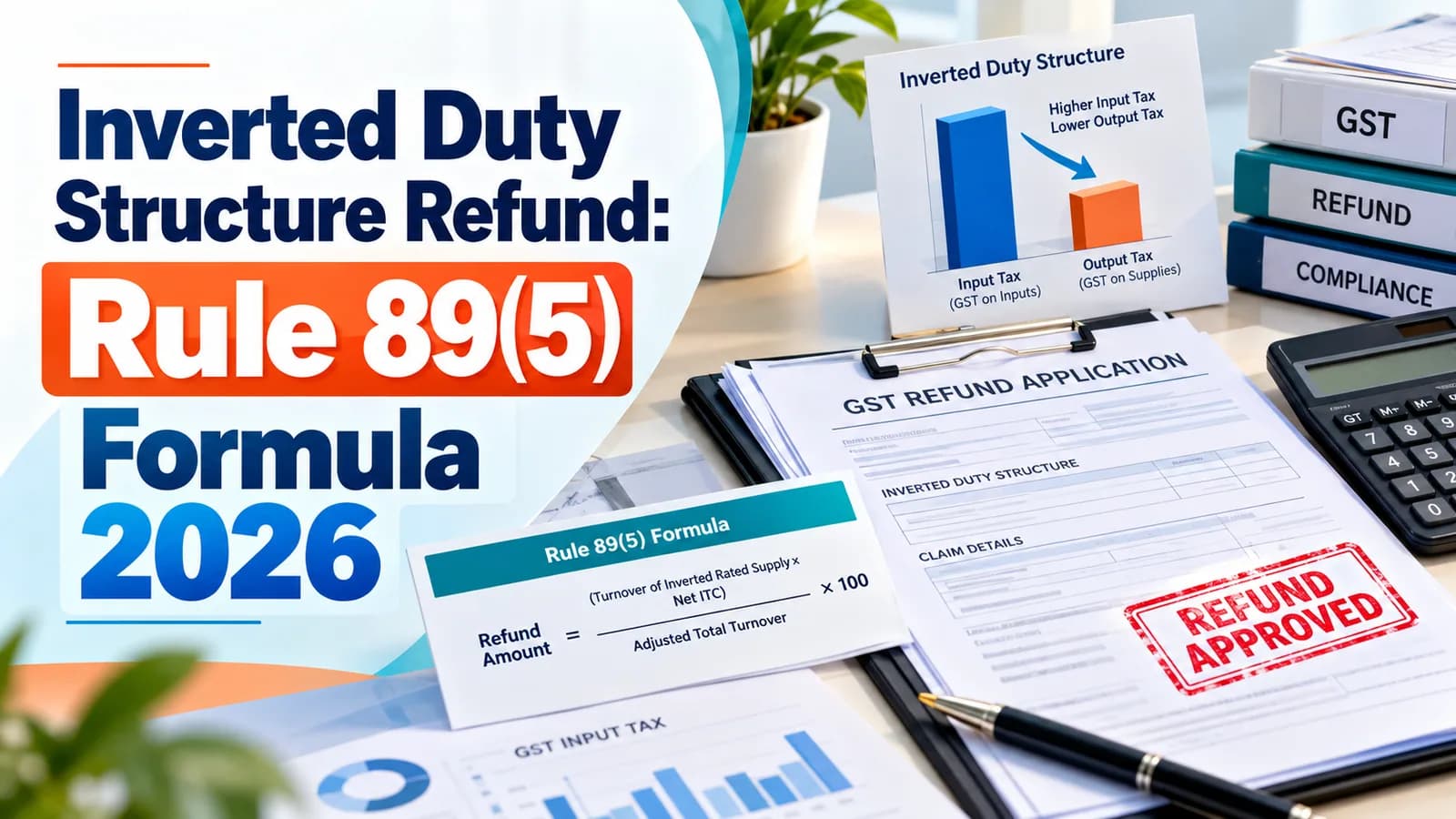
An inverted duty structure refund lets a registered person recover input tax credit (ITC) that accumulates because the GST rate on inputs is higher than on the output supply. It is allowed by Section 54(3)(ii) of the CGST Act and calculated with the formula in Rule 89(5): only credit on inputs (goods) counts, not input services or capital goods. The claim is filed in RFD-01 within two years of the relevant date.
For claims filed from 1 October 2025, low-risk inverted duty claims can also receive 90% as a provisional refund, a facility earlier limited to exporters.
Inverted duty refund at a glance
Point | Position |
|---|---|
Legal basis | Section 54(3)(ii), CGST Act; formula in Rule 89(5), CGST Rules |
Eligible credit | ITC on inputs only; input services and capital goods excluded from Net ITC |
Formula | (Inverted turnover × Net ITC ÷ Adjusted total turnover) − (Tax on inverted turnover × Net ITC ÷ ITC on inputs and input services) |
Form | RFD-01 with Statements 1 and 1A |
Time limit | Two years from the relevant date: the due date of the return for the period of the claim |
Provisional refund | 90% for low-risk claims filed from 1 October 2025 (CBIC Instruction No. 06/2025-GST) |
Not allowed | Notified goods and services; cases where input and output are the same goods |
When does an inverted duty structure arise?
Credit accumulates when you buy inputs at a higher rate than you sell your product. Example: a manufacturer buys raw materials and packing at 18% and sells finished goods taxed at 5%. Every month, credit on the inputs exceeds the tax on sales, and the unused balance grows in the credit ledger.
The GST 2.0 rate changes of 22 September 2025, which moved most goods into 5% and 18% slabs, removed inversion for some products and created it for others. Check the current rate of both your inputs and your outputs before assuming a refund position still exists, or no longer exists.
Who cannot claim an inverted duty refund
Situation | Why |
|---|---|
Output supplies are nil-rated or fully exempt | No taxable output, so there is no inverted-rated supply |
Input and output are the same goods | Rate differences on the same goods do not create an inverted structure (Circular 135/05/2020-GST) |
Goods or services notified under Section 54(3) | The government has barred refunds for specific items |
Credit arising only from input services or capital goods | Excluded from Net ITC in the formula, as upheld by the Supreme Court in VKC Footsteps (2021) |
How the Rule 89(5) formula works
Rule 89(5), as amended by Notification No. 14/2022-Central Tax dated 5 July 2022, gives the maximum refund:
Maximum refund = (Turnover of inverted-rated supply × Net ITC ÷ Adjusted total turnover) − (Tax payable on inverted-rated supply × Net ITC ÷ ITC availed on inputs and input services)
Net ITC is credit on inputs only. The second part deducts only the share of output tax treated as paid from input credit, rather than the whole output tax that the formula deducted before the 2022 amendment.
Example: a manufacturer in Bahadurgarh sells finished goods taxed at 5% during a month. Figures for the period:
Item | Amount |
|---|---|
Turnover of inverted-rated supply (all sales) | ₹1,00,00,000 |
Adjusted total turnover | ₹1,00,00,000 |
ITC on inputs (Net ITC) | ₹14,00,000 |
ITC on input services | ₹1,00,000 |
ITC on inputs and input services | ₹15,00,000 |
Tax payable on inverted-rated supply at 5% | ₹5,00,000 |
First part: ₹1 crore × ₹14 lakh ÷ ₹1 crore | ₹14,00,000 |
Second part: ₹5 lakh × ₹14 lakh ÷ ₹15 lakh | ₹4,66,667 |
Maximum refund | ₹9,33,333 |
As with export refunds, the amount claimed is limited to the lowest of the formula result, the credit ledger balance at the end of the period and the balance on the date of filing.
Time limit for filing the claim
Section 54(1) allows two years from the relevant date. For inverted duty refunds, the relevant date is the due date for furnishing the GSTR-3B for the period in which the claim arises. A claim for a month whose GSTR-3B was due on 20 June 2025 must therefore be filed by 20 June 2027.
Our view: file inverted duty claims monthly or quarterly as the credit builds, not once a year. Smaller, regular claims are easier to verify, keep each period well inside the two-year limit, and return working capital sooner.
How to file the refund in RFD-01
Reconcile the period's inward invoices with GSTR-2B and separate input, input-service and capital-goods credit.
Go to Services > Refunds > Application for Refund on the GST portal.
Select Refund of ITC accumulated due to Inverted Tax Structure and the period.
Fill Statement 1 with the formula figures and Statement 1A with invoice-wise inward and outward details.
Upload supporting documents and enter the refund amount within the permitted limit.
Submit with DSC or EVC; the claimed amount is debited from the credit ledger.
Track the ARN for RFD-02 acknowledgement, any RFD-03 deficiency memo and the orders.
The GSTN's refund user manual shows each screen of the application.
Provisional refund and processing timelines
The 56th GST Council meeting recommended extending the 90% provisional refund to inverted duty claims, and CBIC Instruction No. 06/2025-GST, dated 3 October 2025, applied it as an interim measure to claims filed on or after 1 October 2025. The system assesses risk; low-risk claims receive 90% provisionally, and the officer then completes the final order.
Stage | Timeline |
|---|---|
Acknowledgement or deficiency memo | Within 15 days of filing |
Provisional refund, where eligible | 90% of the claim, soon after acknowledgement |
Final order (RFD-06) | Within 60 days of the complete application |
Interest on delay | 6% a year beyond 60 days (Section 56) |
Records that make the claim hold up
Record | Why the officer asks for it |
|---|---|
Rate-wise sales register | Shows which supplies are inverted-rated |
Inward register split by inputs, input services and capital goods | Supports the Net ITC figure |
GSTR-2B for the period | Confirms the credit is reflected and eligible |
Bill of materials or production records | Shows the inputs are used in the inverted-rated output |
GSTR-3B and GSTR-1 for the period | Turnover and tax figures must match the claim |
A cash ledger balance follows a different route; see refund of excess cash ledger balance. Exporters should read GST refund on export of services instead.
Credit piling up month after month? Talk to Ankush's team about GST refund services at ComplyLocal →