To cancel GST registration yourself, file Form GST REG-16 on the GST portal within 30 days of the event that ends your need for it, such as closing the business. You declare closing stock and pay tax on it, the officer issues a cancellation order in REG-19, and you then file the final return, GSTR-10, within three months.
This guide covers voluntary cancellation by the taxpayer. If an officer cancelled your registration, the question is whether to restore it, which our guide to revocation of GST cancellation covers.
GST cancellation at a glance
Point | Position |
|---|---|
Form | REG-16, filed on the GST portal |
When | Within 30 days of the event warranting cancellation (Rule 20, CGST Rules) |
Registration status | Suspended from the application date or requested cancellation date, whichever is later (Rule 21A) |
Tax on exit | ITC on stock and capital goods, or output tax on them, whichever is higher (Section 29(5)) |
Order | REG-19, within 30 days of the application or of your reply to any notice |
Final return | GSTR-10, within three months of the cancellation date or order, whichever is later |
Past liability | Not wiped out; tax for earlier periods can still be assessed |
When can you cancel GST registration?
Section 29(1) of the CGST Act allows you to apply for cancellation in these situations:
Reason | Typical example |
|---|---|
Business discontinued | A shop or trading business closes permanently |
Business transferred, amalgamated or demerged | A proprietor sells the business, or a company merges into another |
Change in constitution leading to a new PAN | A partnership firm converts into an LLP or company |
No longer liable to be registered | Turnover falls below the threshold and no compulsory-registration rule applies |
Opting out of voluntary registration | A business that registered below the threshold decides it no longer benefits |
Death of a sole proprietor | The legal heir applies to cancel the registration |
A voluntary registrant can cancel at any time; the old one-year lock-in was removed in 2018. Whether registering voluntarily made sense in the first place is covered in our guide to voluntary GST registration.
Before you file: three things to settle
1. File every pending return
File all GSTR-1 and GSTR-3B returns up to the date you want the cancellation to take effect, including nil returns for months with no sales. Pending returns hold up the officer's decision and carry late fees that continue to build.
2. Choose the effective date
Pick the date the business actually stopped making taxable supplies. Any invoice issued after that date under the old GSTIN creates a problem for you and for the buyer claiming credit.
3. Work out tax on closing stock and capital goods
Section 29(5) requires you to pay back the input tax credit taken on inputs, semi-finished and finished goods held on the effective date, and on capital goods, or the output tax on them if that is higher. For capital goods, Rule 44 reduces the credit by five percentage points for every quarter since the purchase invoice.
Example: a trader in Rohtak closes on 30 November 2026 with stock bought for ₹2,00,000, on which ₹36,000 of credit was claimed at 18%. The tax payable on exit is ₹36,000, or the tax on the stock's current value if higher. A laptop bought ten quarters earlier with ₹9,000 of credit carries a reduced reversal of ₹4,500, because ten quarters take 50 percentage points off.
How to file REG-16 on the GST portal
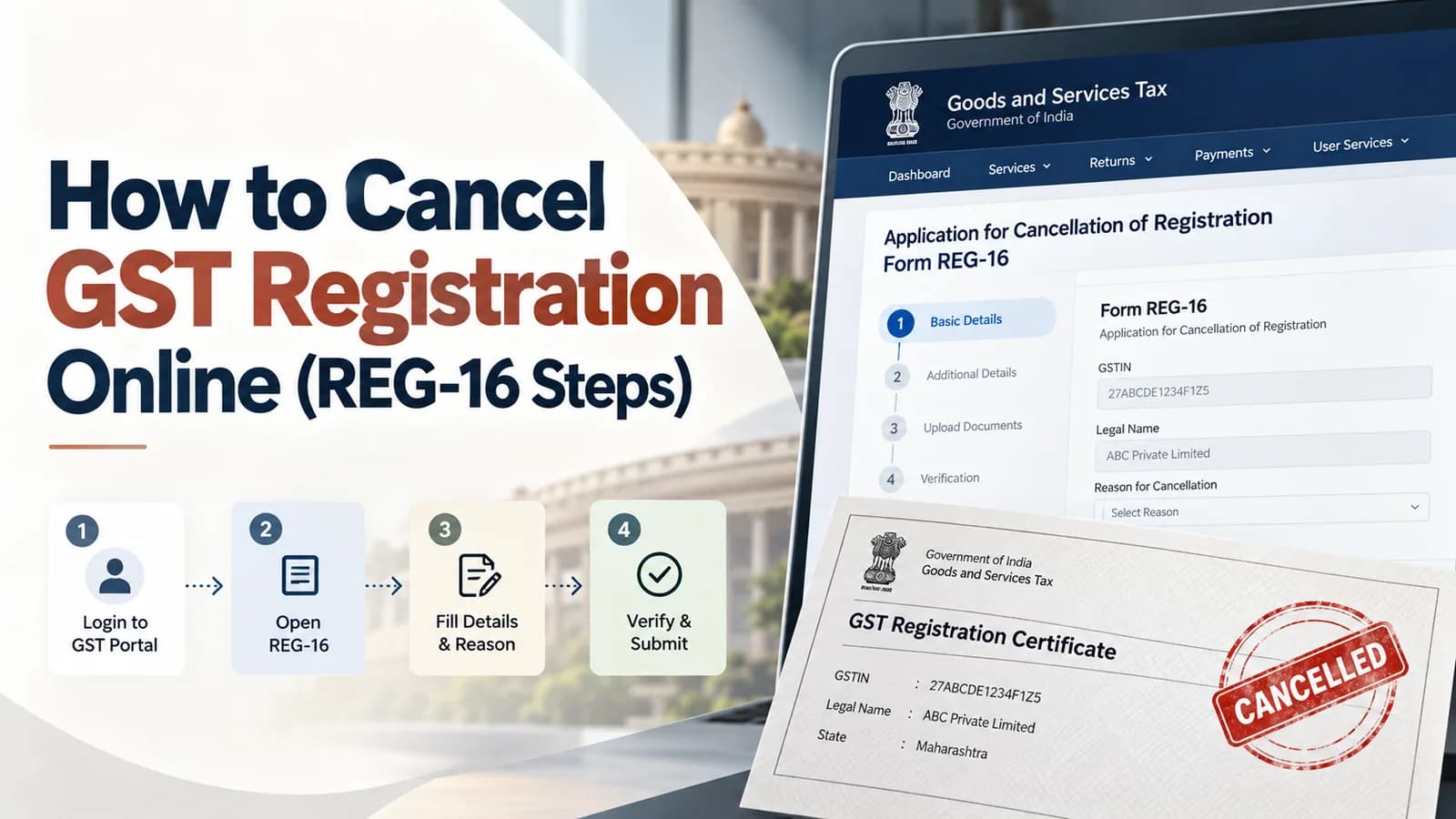
Log in to the GST portal and go to Services > Registration > Application for Cancellation of Registration.
Check the auto-filled GSTIN, legal name and address, and give an address for future communication.
Select the reason for cancellation and enter the date from which cancellation is sought.
Enter the value of stock and capital goods held, and the tax payable on them.
Add details of any transferee or merged entity where the business was transferred.
Select the authorised signatory, tick the verification and submit with DSC or EVC.
Note the ARN and track the application under Track Application Status.
Under Rule 21A, the registration is treated as suspended from the date of application or the date you asked cancellation to take effect, whichever is later. While it is suspended, you cannot issue tax invoices or collect GST.
After filing: REG-19 and GSTR-10
The officer either cancels the registration by an order in REG-19 or, if more information is needed, issues a notice to which you reply. Under Rule 22, the REG-19 order is due within 30 days of the application or of your reply.
GSTR-10, the final return, is then due within three months of the cancellation date or the cancellation order, whichever is later. It reports the closing stock and the tax paid on it. File it even if you held no stock, because the obligation depends on the cancellation, not on the stock value, and late filing attracts a late fee and a notice.
Our view: the two post-closure problems worth guarding against are an unfiled GSTR-10 and invoices raised after the effective date. Both are avoidable with a short closing checklist signed off before REG-16 goes in.
What cancellation does not do
Cancelling the registration ends future obligations, not past ones. Under Section 29(3), tax, interest and penalties for periods before cancellation can still be assessed, and records must still be kept for the statutory period. A company or LLP that is closing entirely should cancel GST before applying to strike off with the Registrar; our company strike-off service covers that sequence.
Want the returns, stock working, REG-16 and GSTR-10 handled together? Talk to Ankush's team about GST cancellation at ComplyLocal →