Last updated: 24 September 2026
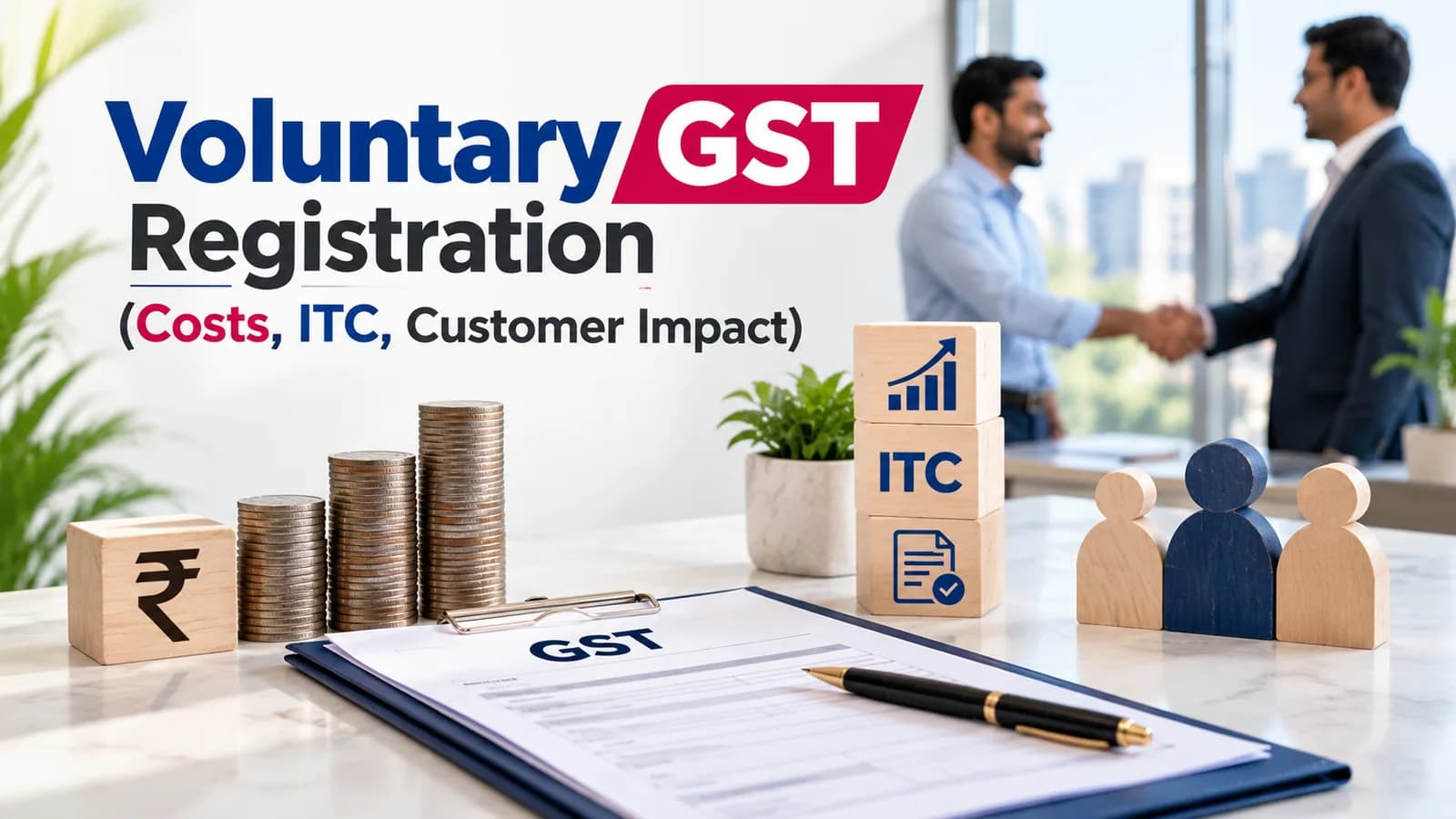
Voluntary GST registration means registering under Section 25(3) of the CGST Act although your turnover is below the threshold and no compulsory-registration rule applies. Once registered, every provision that applies to a registered person applies to you: you charge GST, file returns and can claim input tax credit (ITC). It usually pays when most buyers are GST-registered businesses.
It usually costs you when most buyers are consumers. This guide first checks whether registration is really voluntary in your case, then gives a worksheet for the decision and explains how to exit later.
Key facts on voluntary GST registration
Point | Current position |
|---|---|
Legal basis | Section 25(3), CGST Act; all provisions for registered persons then apply |
Effective date | Date of grant of registration; the portal disables the liability-date field for Voluntary Basis |
ITC on opening stock | Inputs held in stock on the day before registration is granted (Section 18(1)(b)); claim in ITC-01 within 30 days |
Returns | GSTR-1 and GSTR-3B, monthly or quarterly under QRMP; GSTR-9 only above ₹2 crore turnover |
Exit | Cancellation can be applied for at any time; an officer can cancel if business does not start within six months (Section 29(2)(d)) |
First check: is registration really voluntary for you?
Registration is voluntary only if you are below the threshold and outside every compulsory category. Under Section 22, the general threshold is ₹20 lakh of aggregate turnover (₹10 lakh in Manipur, Mizoram, Nagaland and Tripura), with a higher ₹40 lakh limit for eligible goods-only suppliers in most states. Our guide to the GST registration turnover limit covers the state-by-state detail.
Section 24 then makes registration compulsory regardless of turnover for, among others, inter-state suppliers of goods, casual taxable persons, persons liable under reverse charge, and many e-commerce sellers. Two exemptions narrow that list: small inter-state service suppliers under Notification No. 10/2017-Integrated Tax, and goods sellers meeting the conditions of Notification No. 34/2023-Central Tax on e-commerce. If you sell online, check GST registration for e-commerce sellers before assuming you have a choice.
What changes the day you register
The registration is effective from the date it is granted. According to the GST portal's registration manual, the date-of-liability field is disabled when you choose Voluntary Basis as the reason for registration, so you cannot backdate it.
From that date you must charge GST on every taxable supply, issue tax invoices, file returns and keep records, whether or not your turnover ever reaches the threshold. In return you can claim ITC on business purchases, subject to the conditions of Sections 16 and 17.
ITC on stock you already hold
Section 18(1)(b) lets a voluntary registrant claim ITC on inputs held in stock, and inputs in semi-finished or finished goods, on the day immediately before registration is granted. Declare it in Form ITC-01 within 30 days under Rule 40. The credit is not available for invoices more than one year old (Section 18(2)), and it does not cover capital goods or services already consumed.
B2B or B2C: how your customers are affected
The GST you charge is a cost only to buyers who cannot claim it back. A GST-registered business buyer usually claims your GST as ITC, so its net cost stays the same; a consumer cannot, so your price effectively rises by the tax.
Point | Mostly business buyers (B2B) | Mostly consumers (B2C) |
|---|---|---|
Effect of charging GST | Buyer claims it as ITC if eligible; net price unchanged | Buyer bears it; you raise prices or absorb it |
Effect of your ITC | Your costs fall by the GST on eligible purchases | Same benefit, often outweighed by the tax on sales |
Commercial effect | Some buyers prefer or require a registered supplier | Price-sensitive customers may notice the increase |
Usual verdict | Often worth it | Often not worth it below the threshold |
Not every business buyer can claim your GST. Credit is blocked on some purchases under Section 17(5), and a buyer under the composition scheme cannot claim ITC at all. Ask your two or three largest customers whether they will claim it before you decide.
Decision worksheet: does voluntary registration pay?
Fill in your own annual figures. Nothing here is a projection; the worksheet only tells you what to compare.
Line | What to enter |
|---|---|
A. Sales to GST-registered buyers who can claim ITC | Annual value, excluding GST |
B. Sales to consumers and other buyers who cannot claim ITC | Annual value, excluding GST |
C. GST rate on your supplies | The rate for your goods or services |
D. Eligible GST on your purchases | GST on business inputs and capital goods you could claim, excluding blocked credit |
E. Tax cost on consumer sales | B × C, if you cannot raise prices |
F. Annual compliance cost | Accounting and filing cost for 12 months, or four quarters under QRMP |
Net position | D minus E minus F; if positive, voluntary registration pays on these numbers |
Hypothetical example, with an assumed 18% rate for the arithmetic only: a designer earns ₹12,00,000 a year entirely from registered business clients (A) and nothing from consumers (B). Eligible GST on a laptop, software and co-working rent is ₹40,000 (D), so E is nil. The registration pays if the annual compliance cost (F) is below ₹40,000, and the clients' net cost does not change.
Reverse the mix, with the same ₹12,00,000 all sold to consumers, and E becomes ₹2,16,000 unless prices rise. Against ₹40,000 of ITC, that business is better off unregistered until the threshold forces the decision.
Ongoing obligations after voluntary registration
A voluntary registrant files the same returns as any regular taxpayer: GSTR-1 and GSTR-3B, monthly, or quarterly under the QRMP scheme if aggregate turnover is up to ₹5 crore. GSTR-9 is not required up to ₹2 crore turnover from FY 2024-25 (Notification No. 15/2025-Central Tax). Our guide to types of GST returns lists the forms and due dates.
Nil returns are still due in months with no sales, and late fees apply to them. Budget for that before registering; many small businesses outsource it to a GST return filing service rather than tracking every due date themselves.
Can you cancel voluntary registration later?
Yes. Since Notification No. 3/2018-Central Tax removed the old one-year lock-in from Rule 20, a voluntary registrant can apply for cancellation at any time. Section 29(1)(c), as substituted by the Finance Act, 2020, allows cancellation where a person intends to opt out of voluntary registration.
Exit has a cost. On cancellation, Section 29(5) requires you to pay back ITC on inputs held in stock and capital goods, or the output tax on them if higher, and to file the final return in GSTR-10. Separately, Section 29(2)(d) allows an officer to cancel a voluntary registration if business does not start within six months.
Want to compare expected ITC with filing obligations before opting in? Talk to Keshav's team about GST registration services at ComplyLocal →