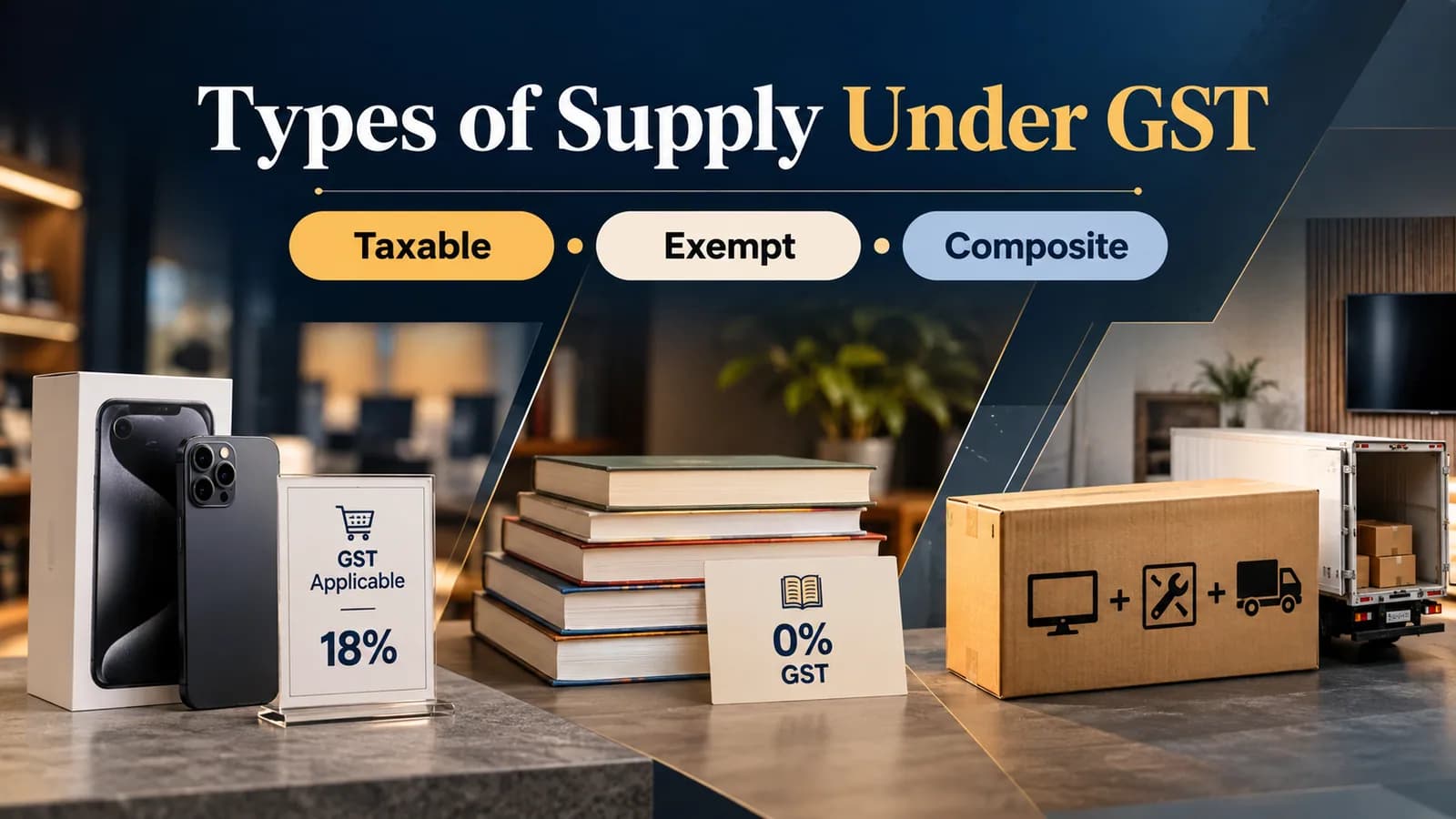
Supplies under GST are classified in five ways: by taxability (taxable, exempt, nil-rated, non-GST, zero-rated), by location (intra-state or inter-state), by bundling (composite or mixed), by consideration (with or without payment), and by who pays the tax (forward or reverse charge). Section 7 of the CGST Act defines supply, and Schedule III lists activities that are not supply at all.
Classifying a transaction correctly is the first decision on every invoice, because it fixes the rate, the tax head, whether you can claim input tax credit, and which table of your return it goes in.
Types of supply at a glance
Classification | Types | What it decides |
|---|---|---|
Taxability | Taxable, exempt, nil-rated, non-GST, zero-rated | Whether GST is charged and credit is allowed |
Location | Intra-state, inter-state | CGST and SGST, or IGST |
Bundling | Composite, mixed | Which rate applies to a bundle |
Consideration | With consideration; without, under Schedule I | Whether a free or internal transfer is taxable |
Liability | Forward charge, reverse charge | Whether supplier or recipient pays |
Timing | One-time, continuous | When the invoice is due |
What counts as a supply under GST?
Under Section 7 of the CGST Act, supply covers sale, transfer, barter, exchange, licence, rental, lease or disposal of goods or services for consideration in the course or furtherance of business. It also includes import of services for consideration, and the activities in Schedule I even without consideration.
Schedule II then decides whether certain activities are goods or services, for example treating the lease of a building as a supply of services.
Taxable, exempt, nil-rated, non-GST and zero-rated supplies
Type | Meaning | Example |
|---|---|---|
Taxable | GST charged at a notified rate | A laptop at 18% |
Nil-rated | Taxable, but at a 0% rate | Fresh vegetables |
Exempt | Wholly exempted by notification | Healthcare services by a clinical establishment |
Non-GST | Outside the levy of GST altogether | Petrol, diesel and alcohol for human consumption |
Zero-rated | Exports and supplies to SEZs; credit still allowed | Software exported to a US client under LUT |
The difference between these is not academic. Credit used for exempt, nil-rated or non-GST supplies must be reversed under Rules 42 and 43, while zero-rated supplies keep full credit and can generate a refund. In GSTR-3B, taxable supplies go in Table 3.1(a), zero-rated in 3.1(b), nil-rated and exempt in 3.1(c), and non-GST in 3.1(e).
Intra-state and inter-state supplies
A supply is intra-state when the supplier and the place of supply are in the same state, and carries CGST plus SGST (or UTGST). It is inter-state when they are in different states, and carries IGST. Imports, exports and supplies to SEZ units are always inter-state, even when the SEZ is in the supplier's own state.
Example: a Rohtak manufacturer delivering to a buyer in Karnal charges CGST and SGST; delivering to a buyer in Delhi, it charges IGST. The detail of each tax head is in our guide to types of GST in India.
Composite supply and mixed supply
When goods or services are sold together, Section 8 of the CGST Act decides the rate. The test is whether the items are naturally bundled.
Type | Rule | Example |
|---|---|---|
Composite supply | Naturally bundled, with one principal supply; the whole bundle takes the principal supply's rate | Goods sold with packing, transport and insurance to the buyer's door; taxed at the goods' rate |
Mixed supply | Items that could be sold separately, sold for one price; the whole bundle takes the highest rate among the items | A festive hamper of sweets, dry fruits, chocolates and a drink for one price |
Our view: price items separately on the invoice whenever they are genuinely separate. A mixed supply charges everything at the highest rate in the bundle, so a hamper with one 40% item can pull the whole box to 40%, while itemised pricing taxes each item at its own rate.
Supply without consideration: Schedule I
Schedule I makes some transactions taxable even when nothing is paid:
Activity | Example |
|---|---|
Permanent transfer of business assets where credit was claimed | A company gives away a used laptop on which it took credit |
Supplies between related persons or distinct persons in the course of business | Stock sent from a Haryana warehouse to the same company's Delhi branch |
Supplies between principal and agent | A principal sends goods to an agent who sells them on its behalf |
Import of services from a related person abroad | An Indian subsidiary receives free services from its foreign parent |
Gifts by an employer to an employee up to ₹50,000 in a year are not treated as supply under the Schedule I proviso.
Activities that are not supply: Schedule III
Schedule III lists activities treated as neither goods nor services, so no GST applies. These include services by an employee to the employer, sale of land, sale of a completed building after the completion certificate, actionable claims other than specified ones such as lottery, betting and gambling, and high-sea sales and merchant trade where goods never enter India.
Forward charge and reverse charge supplies
In most supplies, the supplier charges and pays GST (forward charge). For notified supplies, the recipient pays instead (reverse charge): for example goods transport agency services to specified business recipients where the agency has not opted to pay tax itself, legal services by advocates to business entities, rent paid to an unregistered landlord for commercial property, and services imported from abroad.
Continuous supply
A continuous supply is one provided under a contract over a period with periodic payments, such as an annual maintenance contract billed monthly or a leased machine billed each quarter. The invoice is due on or before each payment due date, or on completion of each milestone, rather than once at the end of the contract.
Classifying supplies correctly is the base of accurate returns; see types of GST returns for where each type is reported. Want a review of how your invoices classify supplies? Talk to Ankush's team about GST services at ComplyLocal →