There is no separate GST rate for ecommerce. The rate follows the product’s HSN code, exactly as it would in a shop, and selling online changes who collects tax at source rather than what rate applies.
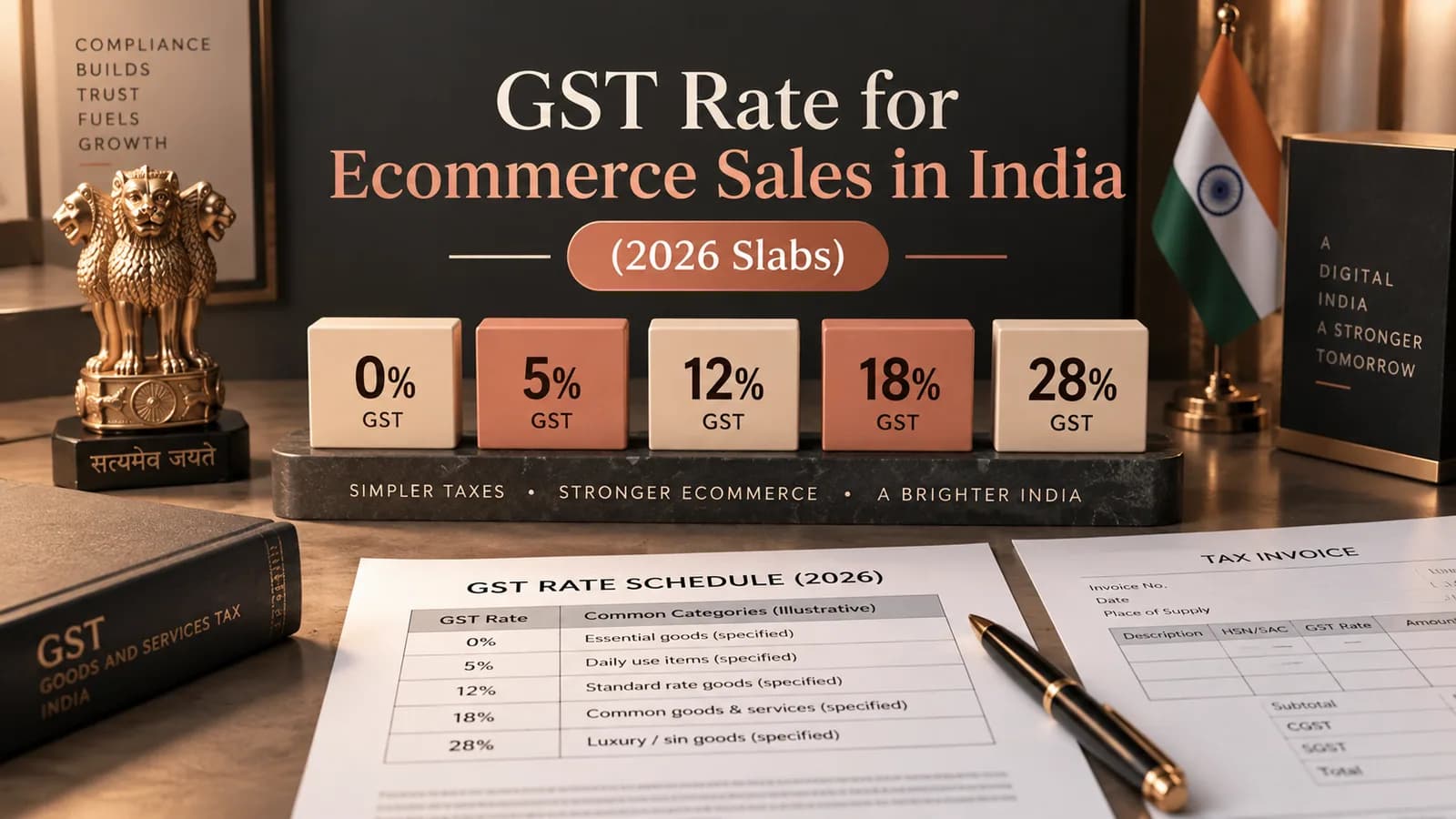
What did change is the slab structure. Since 22 September 2025 the 12% and 28% slabs are gone, leaving nil, 5% and 18% as the working rates with 40% on specified luxury and demerit goods.
Is there a special GST rate for ecommerce sellers?
No. GST is levied on the supply of goods or services at the rate notified for that item, and the sales channel is not a factor in rate determination.
An online seller of packaged snacks charges the same rate as a kirana store selling the same packet. What differs is compliance: the marketplace collects 0.5% TCS under Section 52(1) of the CGST Act at the rate set by Notification No. 15/2024-Central Tax dated 10 July 2024, and the seller reports the supply again in Table 14 of GSTR-1.
TCS is not a rate. It is an advance collection of the seller’s own tax, and treating it as an extra 0.5% of cost is one of the more common pricing errors we correct.
The GST slabs that apply since September 2025
The 56th GST Council meeting on 3 September 2025 approved the rate rationalisation, effective from 22 September 2025.
Slab | What it broadly covers |
|---|---|
Nil | Unbranded fresh staples, most healthcare and education, specified life-saving drugs, individual life and health insurance |
5% | Most items that previously sat at 12%, including dairy, packaged foods, personal care, many medical devices |
18% | The standard rate, including most items that previously sat at 28% such as consumer durables and small vehicles |
40% | Specified luxury and demerit goods, including pan masala, aerated and caffeinated drinks, large vehicles, high-capacity motorcycles, casinos and betting |
Special rates continue outside this structure, notably 3% on gold and jewellery and 0.25% on rough diamonds. Tobacco and pan masala containing tobacco were dealt with separately, moving to the new rate through a later notification once compensation cess obligations were discharged.
Rates attach to HSN codes and several categories split by price, packaging or branding. Confirm the exact rate for your own SKUs against the current CBIC schedule before you change a single price, because a category-level summary is not a substitute for the notification.
What the slab change meant for online catalogues
A rate change is an inventory problem before it is a tax problem.
Stock bought at the old rate carries input tax credit at the old rate while it sells at the new one. That is not a loss, because credit is not restricted by a subsequent rate reduction, but it does distort margin reporting for a quarter unless the two are tracked separately.
Three practical steps follow any rate revision for an ecommerce catalogue. Re-map every HSN to its current rate in your item master and on each marketplace listing, since the platform charges tax on the rate you declared. Test a handful of live invoices before switching the full catalogue. And reconcile stock bought at old rates against sales at new rates so the margin variance has an explanation.
Listings are the step sellers skip. A platform issues the invoice using the tax rate configured against your listing. Leaving an outdated rate there means you either collect too little tax and pay the shortfall yourself, or collect too much and carry a refund problem.
GST on shipping charged to the customer
Shipping charged on an invoice takes the rate of the goods, not a separate rate of its own.
Section 15(2)(c) of the CGST Act includes incidental expenses such as packing and freight charged by the supplier in the value of supply. Where the delivery is naturally bundled with the sale and supplied together in the ordinary course of business, it is a composite supply under Section 2(30), and Section 8(a) taxes a composite supply at the rate of the principal supply.
So a ₹60 shipping charge on a 5% product is taxed at 5%, and on an 18% product at 18%. Charging 18% on shipping across the board because logistics services are taxed at 18% is wrong, and it is a recurring error in D2C invoice templates.
GST on marketplace commission and platform fees
Commission, fulfilment, storage and advertising charged by a marketplace are services supplied to you and are taxed at 18%.
That GST is input tax credit, provided the invoice appears in your GSTR-2B. For most marketplace sellers this is the single largest credit in the return, and it is claimed on the platform’s invoice rather than against the sale itself. The reason to care about the rate here is reconciliation: a fee invoice that carries a different rate than expected usually signals a wrongly categorised charge.
Combo packs, hampers and mixed-rate bundles
A bundle of items at different rates is either a composite supply or a mixed supply, and the difference changes the tax substantially.
A composite supply under Section 2(30) is two or more supplies naturally bundled and supplied together in the ordinary course of business, with one principal supply. It is taxed at the principal supply’s rate. A mixed supply under Section 2(74) is two or more supplies made together for a single price that are not naturally bundled. Section 8(b) taxes a mixed supply at the highest rate applicable to any item in it.
A shampoo sold with a free sachet of the same brand is composite. A festive hamper of chocolates, a mug and a scented candle sold for one price is mixed, and the whole hamper takes the highest rate among the three. Sellers who price festive bundles on a blended rate assumption discover this at assessment.
What happens to GST when a customer returns an order
The tax follows the goods back through a credit note, and there is a deadline on it.
Issue a credit note under Section 34 for the returned supply, dated when the goods come back rather than when the refund is processed. Section 34(2) requires the credit note to be declared by 30 November following the end of the financial year in which the original supply was made, or the date of the annual return, whichever is earlier. A March return cleaned up the following December is outside the window, so the stock returns but the output tax does not.
Where the rate changed between the original sale and the return, the credit note carries the rate that applied to the original supply. It is a reversal of that transaction, not a fresh one.
Expert view: price on the rate, not on the payout
The mistake we correct most often is a seller who built a price from the marketplace payout figure and then treated GST as something that happens afterwards.
Work in the other direction. Fix the taxable value you need, apply the correct rate for that HSN, and let the listed price fall out of it. Then check the rate configured on every platform listing against your item master, every time the Council revises rates, because the platform bills on its own configured rate and any gap between the two is your money.
One more habit worth building. Keep a dated record of which rate applied to which SKU from which date. When a notice arrives two years later asking why the same product carried two different rates in one financial year, a rate-change log answers it in an afternoon instead of a fortnight.
Getting the rate right is only useful if it flows through to the return, which is covered in our guide to GST returns for online sellers. Broader year-round support sits with ecommerce tax and compliance support.
Need your catalogue rate-mapped and your returns to match it? Talk to Ankush’s team at Complylocal Consultants about GST services for ecommerce businesses.