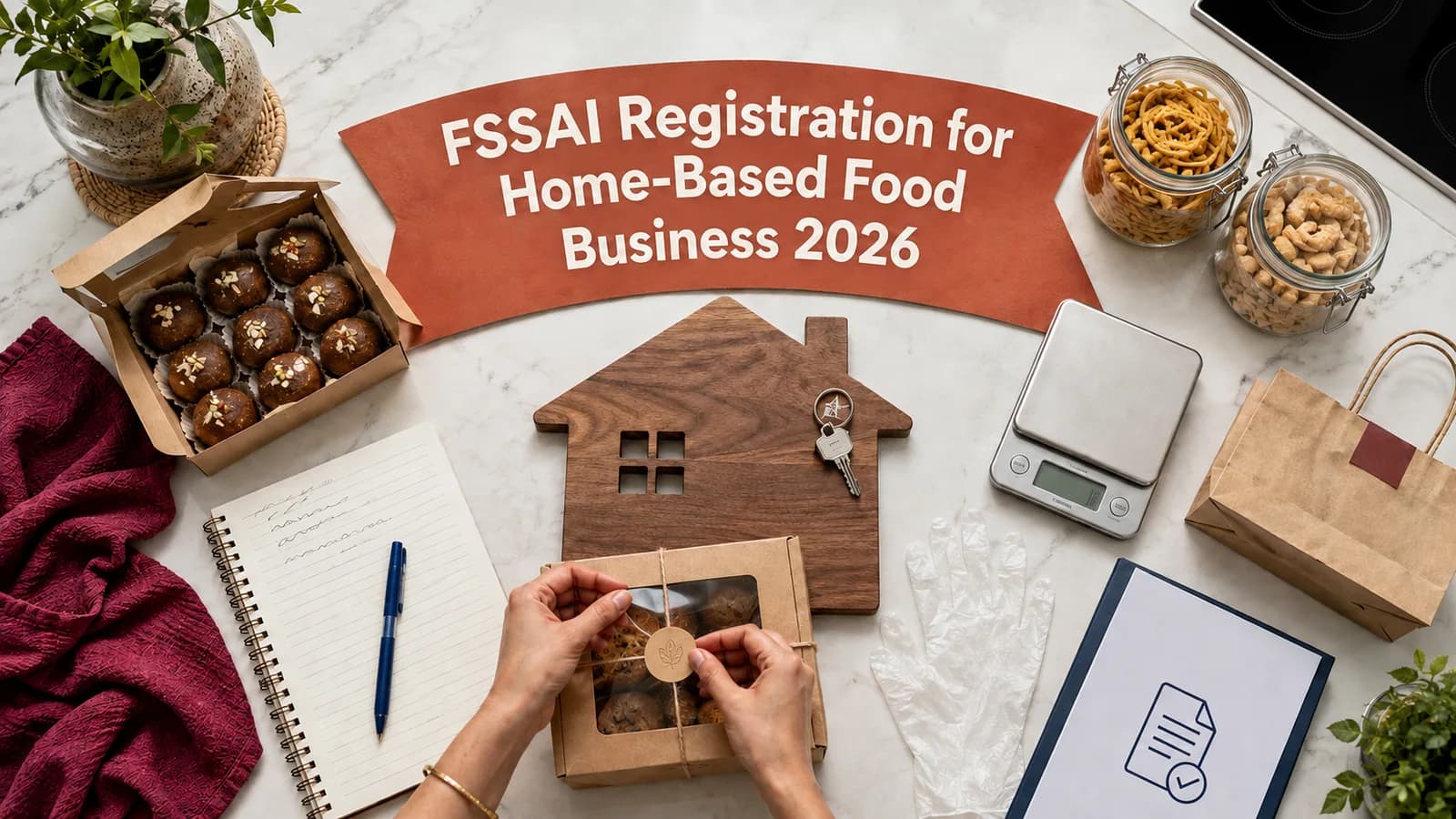
A home-based food business needs FSSAI basic registration if annual turnover is up to ₹1.5 crore. Home bakers, tiffin services and home cloud kitchens all qualify, and you can use your home address as the business premises. Catering is the exception: a caterer cannot use basic registration at any turnover.
There is no small-scale exemption. Selling ten jars of pickle a month from your kitchen makes you a Food Business Operator under the Food Safety and Standards Act, 2006, in exactly the way a factory is. Compliance costs ₹100 a year. Skipping it costs you every platform you sell on.
Home food business FSSAI rules at a glance
Item | Position as on 27 August 2026 |
|---|---|
Is registration required | Yes, for every home food business. No turnover floor exempts you |
Category up to ₹1.5 crore | Basic registration, filed in Form A |
Premises | Your home address, with address proof needed only if it differs from your photo ID |
Who this route excludes | Caterers, at any turnover |
Governing definition | Petty Food Business Operator, substituted by the FSS (Licensing and Registration of Food Businesses) Amendment Regulations, 2026 |
Government fee | ₹100 per year |
Validity | Perpetual for registrations granted on or after 1 April 2026 |
Where you apply | FoSCoS, foscos.fssai.gov.in |
Do you need FSSAI registration for a home-based food business?
Yes. Every person who manufactures, processes, stores, distributes or sells food commercially is a Food Business Operator under the FSS Act, 2006, and must hold either a registration or a licence before starting. Cooking from a domestic kitchen changes nothing about that duty.
Scale decides which tier you fall into, not whether you fall in at all. Selling to neighbours over WhatsApp counts. So does an Instagram bakery, a weekend pickle order book, and a single-person tiffin round.
Which FSSAI category does a home food business need?
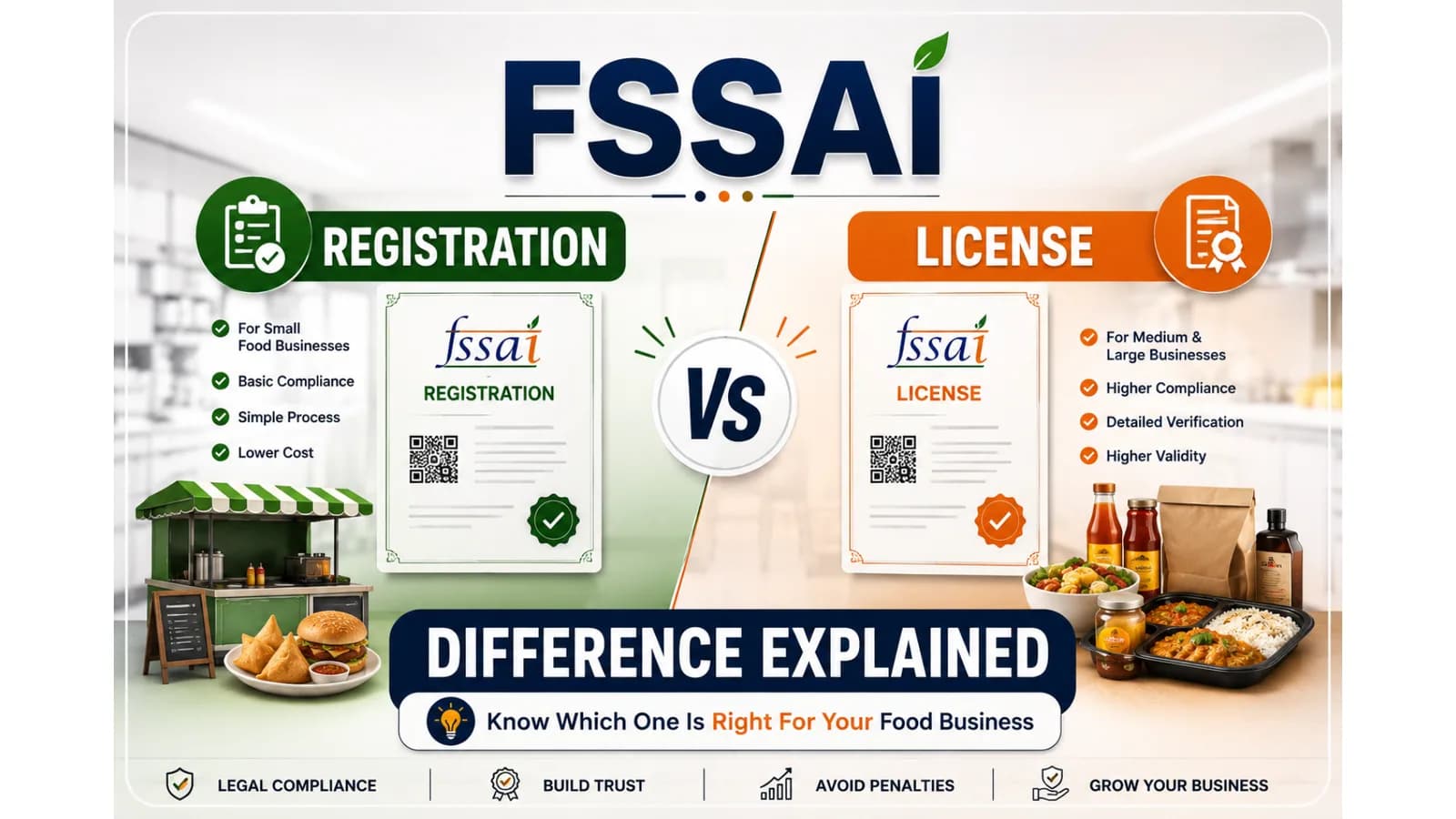
Basic registration, for any home food business with annual turnover up to ₹1.5 crore. FSSAI raised that ceiling from ₹12 lakh by order dated 13 March 2026, effective 1 April 2026, which put almost every home operation comfortably inside the registration tier. Our guide to the FSSAI turnover thresholds sets out all three bands.
Home food business | Typical category | Form |
|---|---|---|
Home baker selling cakes and cookies to order | Basic registration | Form A |
Tiffin or dabba service | Basic registration | Form A |
Home cloud kitchen delivering locally | Basic registration | Form A |
Pickle, masala or snack maker selling online | Basic registration | Form A |
Home cook taking party and event catering orders | State Licence, at any turnover | Form B |
The catering exception that disqualifies home cooks
A caterer cannot register under the basic tier however small the business is. The 2026 amendment replaced the old term Petty Food Manufacturer with Petty Food Business Operator and rewrote the definition. It now covers an operator who makes or sells food personally, a petty retailer, a street food vendor, a hawker, an itinerant vendor, a temporary stall holder, a food truck, and anyone distributing food at religious or social gatherings. It then carves out caterers, in the words "except a caterer".
This matters because home cooks drift into catering without noticing. Taking a birthday order for forty people, supplying a housing society event, or handling a wedding function is catering activity, not petty retail. Once that becomes part of what you do, basic registration is the wrong category and the application is liable to be rejected on kind of business rather than on turnover.
If catering is your model, or you expect it to become part of it, file a State FSSAI Licence application from the start rather than registering first and correcting later.
[VERIFY: confirm the exact substituted text of the Petty Food Business Operator definition against the Gazette copy of the Amendment Regulations, 2026, and confirm on the FoSCoS Kind of Business matrix that no catering KoB permits registration.]
Can you use your home address for FSSAI registration?
Yes. FSSAI registers the premises from which the food business operates, and a domestic kitchen is a valid premises. The address in Form A must be where the food is actually prepared, not a correspondence address.
If your Aadhaar or other photo ID already shows that address, you need no separate premises proof. If it does not, upload an electricity or utility bill, a rent agreement, or a property document for the home.
Renting the home: keep a signed no-objection letter from the owner. Officers ask for it often enough that having it ready is cheaper than a query.
Living with family: a no-objection letter from the family member whose name is on the bill works the same way.
Housing society rules: FSSAI does not check your society bye-laws, but your society might. Registration does not override a residential-use restriction in your lease or society rules.
The document set itself is short. Three items cover most home applicants, and we have set them out in the FSSAI document checklist.
Selling on Swiggy, Zomato, Amazon and Instagram
Every one of these routes requires a valid 14-digit FSSAI number before you can list, and platforms verify it against FoSCoS at onboarding and again in periodic checks. An account can be deactivated when the number stops returning as active.
Two things separate the legal minimum from what a platform will accept. The FSS Act sets your category by turnover and kind of business. A platform is then free to demand more than that statutory minimum as a commercial condition of partnership, and reporting on whether the delivery aggregators accept basic registration from cloud kitchen partners is inconsistent. Check the current onboarding requirement with the platform before you choose a tier, because filing the wrong one costs weeks.
[VERIFY: current Swiggy and Zomato partner onboarding requirements for home kitchens and cloud kitchens, specifically whether basic registration is accepted or a State Licence is mandated. Sources conflict. Confirm from the platforms own partner terms before publishing this section.]
Shipping packaged food across state borders is a different question from cooking and delivering locally. Once your goods move interstate, or sit in a marketplace fulfilment warehouse in another state, you are into Central FSSAI Licence for e-commerce territory rather than home registration. A home baker delivering within one city stays in the registration tier.
What you must display and print once registered
Display the registration certificate at the premises where you cook, and print the 14-digit FSSAI number on the label of anything you sell packaged. For a home business that means cake boxes, pickle jars, masala pouches and tiffin containers.
Both are routine inspection points, and both are visible to customers. A printed FSSAI number is the cheapest trust signal a home kitchen can put on a box.
How to register a home food business on FoSCoS
Confirm your kind of business is not catering, and that turnover is within ₹1.5 crore.
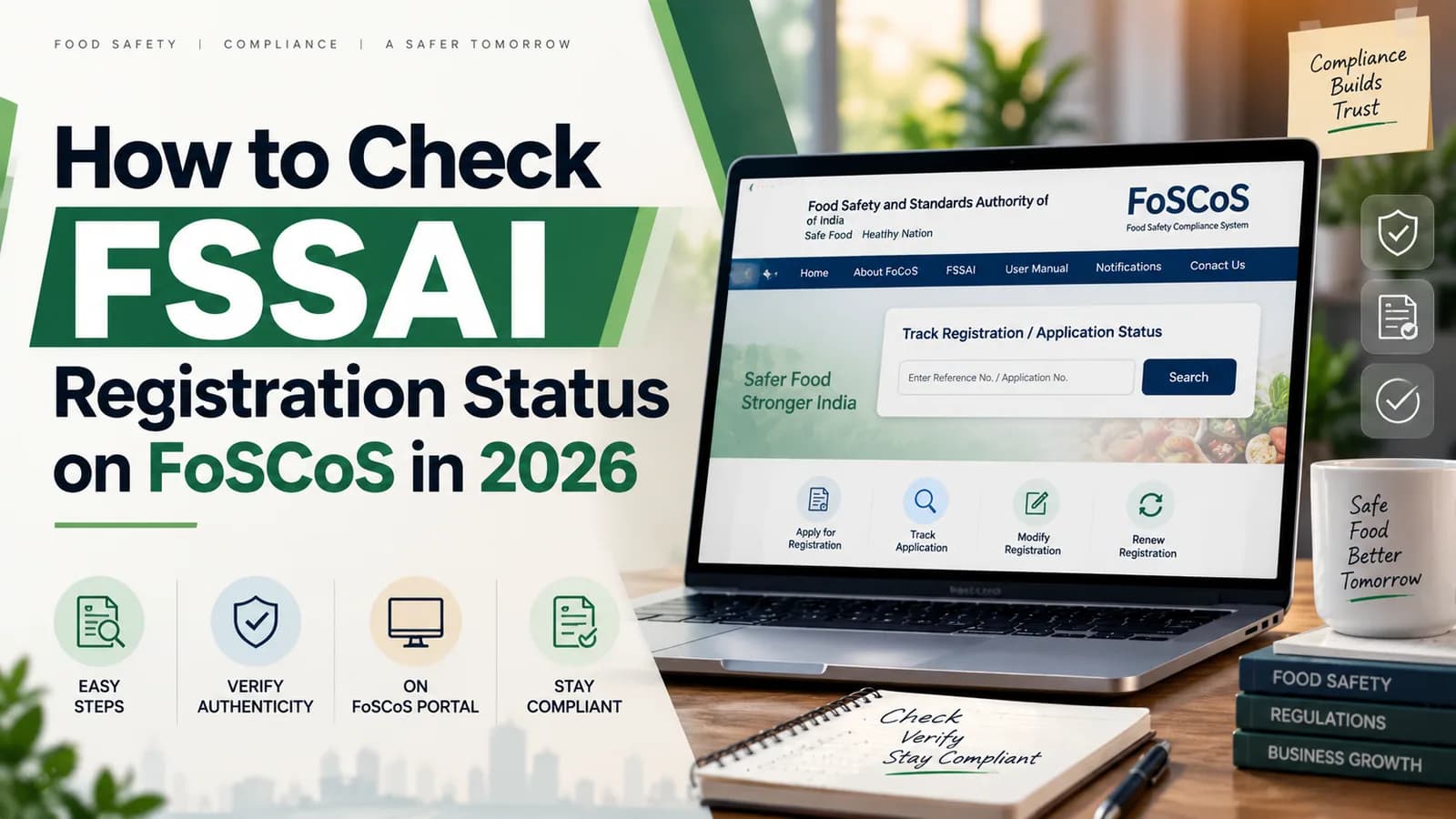
Create a login on FoSCoS at foscos.fssai.gov.in and start a new application.
Select Registration and open Form A.
Enter your home address as the premises, with your kind of business and the food items you make.
Upload your photograph, photo ID, and premises proof if the address differs from the ID.
Pay ₹100 for each year you want to prepay, then submit.
Save the reference number and download the certificate from the same login once granted.
Registrations granted on or after 1 April 2026 do not expire. You keep them alive by paying the annual fee and filing any return that applies to your category.
Mistakes home food businesses make
Assuming a hobby-scale kitchen is exempt. No turnover floor exists. The duty starts at the first commercial sale.
Registering as a petty operator while taking catering orders. Kind of business decides this, and turnover cannot rescue it.
Entering a correspondence address instead of the kitchen address. FSSAI registers the premises where food is made.
Filing without an owner no-objection letter on a rented home, then losing days to a query.
Leaving the 14-digit number off packaging while showing it on the platform listing. Both are required.
Letting turnover cross ₹1.5 crore without upgrading. Growth is where a home kitchen quietly becomes non-compliant.
What we see on home kitchen filings at Complylocal
[EXPERT INPUT NEEDED: Keshav Sehgal to add one real, anonymised observation from Complylocal home food business filings. Strongest options: (a) a home cook who registered under the basic tier, began accepting catering orders, and what the correction to a State Licence cost in time and fee; (b) how often the owner no-objection letter is asked for on rented-home applications across our filings, as a proportion; (c) a home baker whose platform onboarding was rejected on category, and the days lost. One real number required. Do not publish this section empty.]
Cooking from home and want this filed right the first time? Talk to Keshav’s team at Complylocal for home kitchen FSSAI registration.
Official sources
Food Safety and Standards Act, 2006, Section 3(1)(j) (Food Business Operator) and Section 31 (registration and licensing).
FSS (Licensing and Registration of Food Businesses) Regulations, 2011, Regulation 2.1.1 and Form A under Schedule 2, with Part I of Schedule 4 hygiene requirements.
FSS (Licensing and Registration of Food Businesses) Amendment Regulations, 2026, notified 10 March 2026 and published in the Gazette of India (CG-DL-E-12032026-270872) on 11 March 2026, substituting the Petty Food Business Operator definition.
FSSAI order dated 13 March 2026, F. No. RCD-01002/1/2021-Regulatory-FSSAI-Part(1), revised turnover thresholds effective 1 April 2026.
FoSCoS, foscos.fssai.gov.in, including the Kind of Business eligibility matrix and the registration document list.