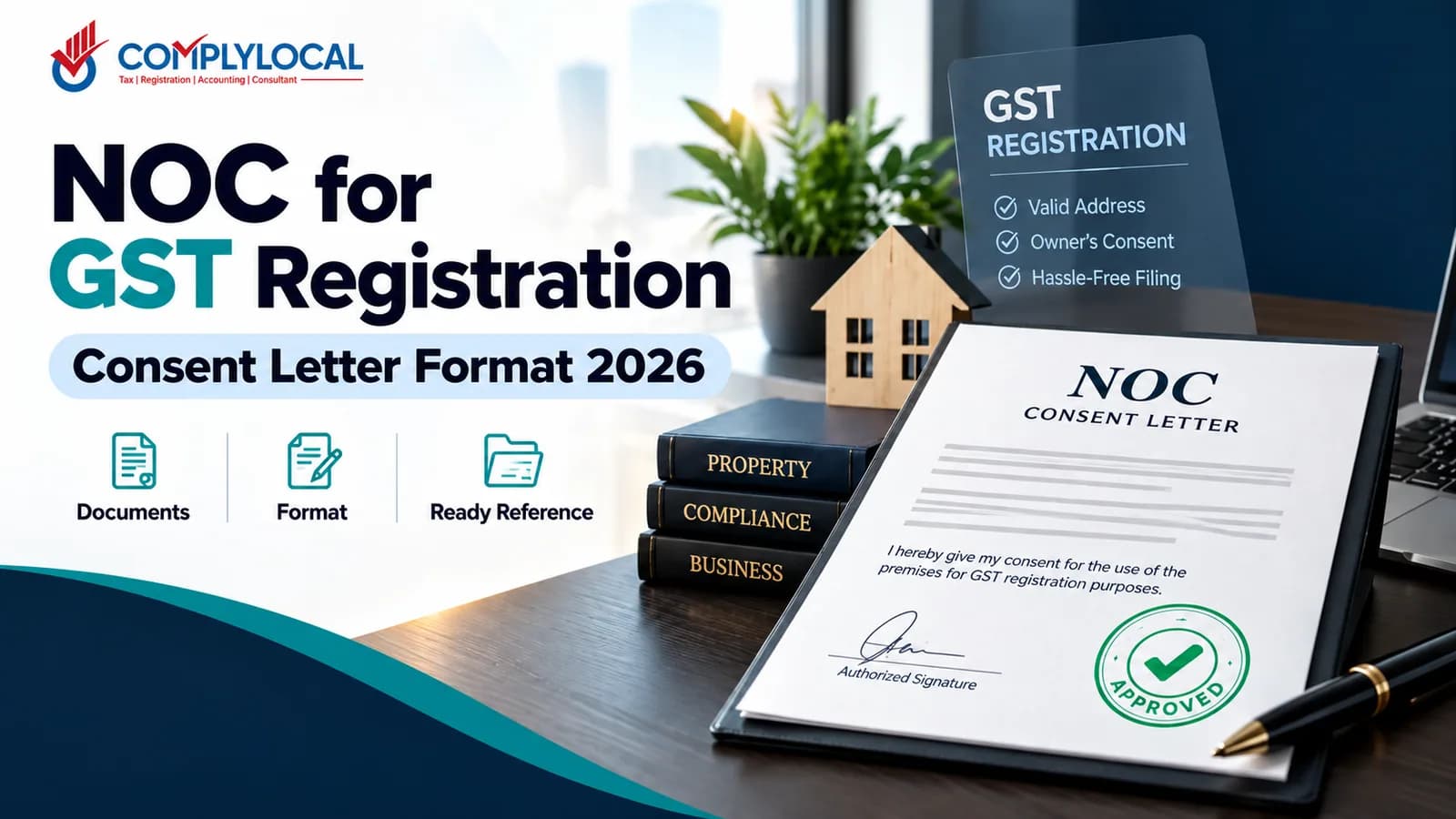
A consent letter, often called an NOC, is a signed statement from the owner of a property allowing you to use it as your place of business for GST registration. You need one whenever the premises are not in your own name and there is no rent agreement in your name. There is no prescribed form for it.
Key facts on the GST consent letter
Item | Position as on 31 August 2026 |
|---|---|
Prescribed statutory format | None. FORM GST REG-01 requires proof of the place of business, not a specific letter |
When required | Premises owned by someone else and no rent agreement in the applicant’s name |
Who signs | The legal owner of the property, or the lessor in a sub-let |
Must attach | Owner’s address proof, typically the latest electricity bill or property tax receipt |
Stamp paper | Not required by the CGST Rules. Plain paper is accepted |
Notarisation | Not mandated by rule. Some officers ask for it in flagged cases |
Upload field in REG-01 | Consent letter uploaded under proof of principal place of business |
What is a consent letter or NOC for GST registration?
A consent letter is a no-objection statement from a property owner confirming that the applicant may operate a business from that address. It exists to close the gap between the applicant named on FORM GST REG-01 and the name printed on the address proof.
The CGST Rules do not name the document. Rule 8 requires the applicant to declare the principal place of business and upload proof of it, and the portal offers Consent as one of the ownership options in the drop-down. The letter is what makes that declaration credible.
When you need a consent letter, and when you do not
Situation | Consent letter needed? | What to upload instead or in addition |
|---|---|---|
Property owned by the applicant | No | Electricity bill, municipal khata or property tax receipt |
Registered rent or lease agreement in the applicant’s name | No | Rent agreement plus owner’s electricity bill |
Property owned by a parent, spouse or relative | Yes | Consent letter plus owner’s address proof |
Property owned by a partner or director | Yes | Consent letter plus owner’s address proof |
Coworking desk or shared office | Yes, from the operator | Operator agreement plus their address proof |
Premises taken from a virtual office provider | Yes, from the provider | Agreement, NOC and utility bill from the provider |
The rule of thumb is simple. If your name appears on either the ownership document or a valid agreement over it, you do not need a consent letter. If it appears on neither, you do.
Consent letter format for GST registration
Keep it to one page and make every fact match the application. The version below covers what officers actually look for.
NO OBJECTION CERTIFICATE
I, [Owner’s full name], son/daughter of [Father’s name], residing at [Owner’s residential address], am the lawful owner of the premises situated at [complete address of the place of business, including floor, building, street, city, state and PIN code].
I hereby give my no objection and consent to [Applicant’s full name / entity name], PAN [PAN of the applicant], to use the said premises as its [principal place of business / additional place of business] for the purpose of registration under the Goods and Services Tax Act, 2017.
I confirm that I have no objection to the said premises being declared to the GST department and to any verification being carried out at the address.
Signature: ____________ Name: [Owner’s name] Date: [DD-MM-YYYY] Place: [City]
Enclosure: copy of electricity bill / property tax receipt in the owner’s name.
Two details decide whether this letter works. The address must be written character for character as it appears on the electricity bill, and the owner’s name must be spelled exactly as it appears there too. An officer comparing the two documents side by side is looking for that match and nothing else.
Does the consent letter need to be notarised?
No rule in the CGST Rules requires notarisation or stamp paper for a consent letter. A signed letter on plain paper with the owner’s address proof attached is legally sufficient, and most applications are approved on exactly that.
In practice, officers in some jurisdictions ask for notarisation when the file is already flagged, when the applicant and owner share a surname, or when the address has been used for a registration that was cancelled before. If you are in one of those situations, notarising upfront costs a few hundred rupees and removes a week of query correspondence.
Our position for clients: plain paper for a straightforward home or family-owned premises, notarised for anything involving a third party, a coworking space, or a previously flagged address.
Rent agreement or consent letter, which one applies
A rent agreement and a consent letter answer different questions. The agreement proves a commercial arrangement exists. The consent letter proves the owner does not object. Where a valid registered rent agreement names the applicant as tenant, that alone satisfies the address-proof requirement.
Where things go wrong is the expired agreement. An eleven-month agreement signed two years ago is not a live document, and uploading it invites a query. Renew it, or ask the owner for a fresh consent letter that covers the current period.
Where the applicant is a company and the premises belong to a director, upload both: a consent letter from the director as owner, and a board resolution recording that the company will use the premises. The two documents together answer the officer’s only real question, which is who controls the address.
Consent letter for a coworking space or virtual office
A coworking or virtual office provider issues a standard package: a service agreement, an NOC on their letterhead, and a copy of a utility bill for the building. These files draw closer scrutiny than home addresses, because the same building hosts many GSTINs. Choosing a virtual place of business provider that has handled departmental verification before matters more than the monthly price.
Check that the NOC names your entity exactly as it appears on your PAN, not a trading name.
Confirm the provider will accept a physical verification visit and can produce a signboard with your name.
Ask how many active GSTINs are registered at that address, because clusters attract Rule 25 verification.
Keep the agreement period longer than your expected approval time, so it does not lapse mid-application.
Consent letter for an additional place of business
Every warehouse or branch declared as an additional place of business needs its own address proof to the same standard as the principal place. A separate consent letter is required for each address not held in your name, and the letter should say additional place of business rather than principal place.
Sellers storing stock in another state need a fresh registration in that state, not an additional place. Our explainer on VPOB, PPOB and APOB sets out which structure fits which situation.
Why consent letters get rejected
Officers reject the letter, not the concept. Almost every rejection traces to one of five errors, and all five are fixable before filing.
The owner’s address proof is not attached, so the letter proves nothing about who owns the premises.
The address on the letter is written differently from the address on the electricity bill, even by a house number or a locality spelling.
The letter is signed by someone who is not the owner on record, such as a family member or a building manager.
The electricity bill is stale, or belongs to a previous owner after a property sale.
The letter says principal place of business when the application declares an additional place, or the other way round.
When a query does arrive, it comes as FORM GST REG-03 and the reply in FORM GST REG-04 is due within seven working days. Missing that deadline means rejection in FORM GST REG-05 and a fresh application from the start.
You can watch for the query on the portal rather than in your inbox. Our note on GST registration status explains what each status on the ARN screen actually means.
What we check before a consent letter goes in
Address proof is where our rework happens, so the file gets a three-point check before submission: name match between the letter and the bill, address match character for character, and bill date within the last two months.
[EXPERT INPUT NEEDED: Keshav - one real anonymised case where a consent letter caused a rejection or a physical verification. What the mismatch was, how long the fix took, and what we changed in our checklist afterwards.]
Want the address documents reviewed before the application goes in? Talk to Keshav’s team at Complylocal about GST registration services.