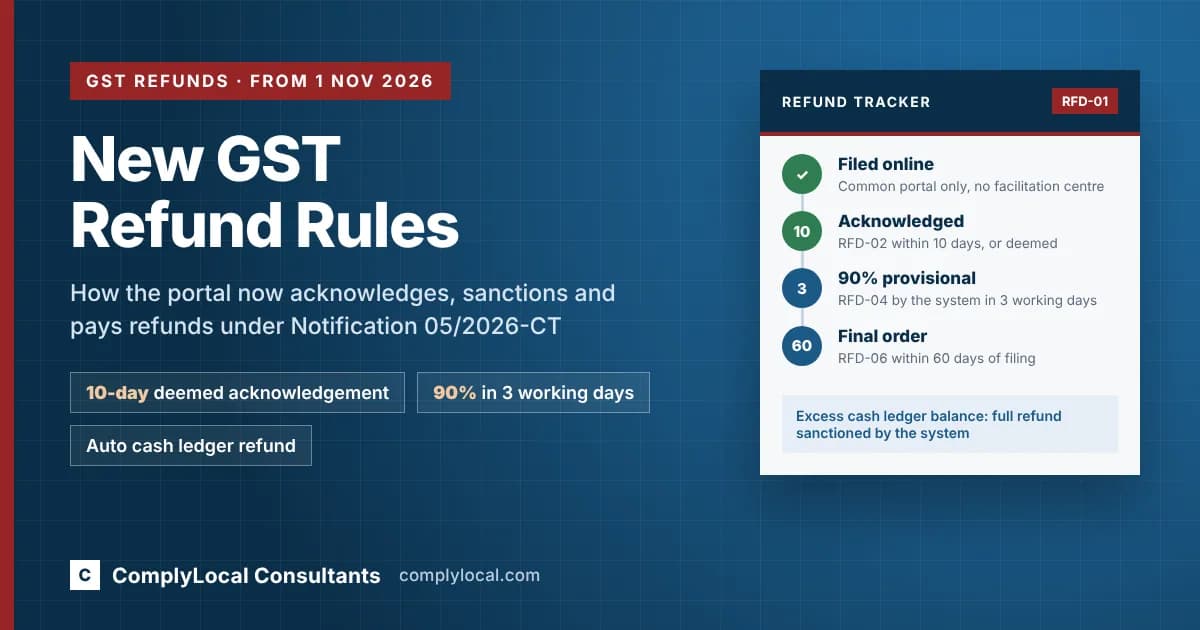
From 1 November 2026, the GST portal itself decides parts of your refund. An application that is not acknowledged within 10 days is now deemed acknowledged, low-risk export and inverted duty claims get a system-generated 90% provisional refund within three working days, and excess cash ledger balances are sanctioned in full without an officer. The changes come from Notification No. 05/2026-Central Tax, dated 26 October 2026.
No rule promises a next-day refund. What has gone is the officer queue at the two steps where most claims used to wait. This explainer covers what changed, who gains, the new filing sequence, and the RFD-01 format that applies from 1 December 2026.
Point | Position from 1 November 2026 |
|---|---|
Legal basis | CGST (Amendment) Rules, 2026, Notification No. 05/2026-Central Tax, dated 26-10-2026 (G.S.R. 919(E)), read with corrigendum G.S.R. 1001(E), dated 18-11-2026 |
Acknowledgement or deficiency memo | Within 10 days of filing, down from 15 (Rule 90) |
No response in 10 days | Application deemed acknowledged (Rule 90(3A)) |
Provisional refund | 90%, in RFD-04 generated by the portal within 3 working days of acknowledgement, for low-risk claims (Rule 91(2)) |
Excess cash ledger balance | Full refund sanctioned by the portal in RFD-06, after adjusting outstanding demands (Rule 92(1B)) |
Filing route | Online on the common portal only |
New RFD-01 format | Applies from 1 December 2026 |
What changed in GST refunds on 1 November 2026
Eight refund provisions changed on 1 November 2026, all through the CGST (Amendment) Rules, 2026. The 57th GST Council recommended system-based refund processing at its meeting on 8 October 2026, and this notification is Phase 1 of it.
Area | Up to 31 October 2026 | From 1 November 2026 |
|---|---|---|
Acknowledgement or deficiency memo | Within 15 days of filing | Within 10 days of filing (Rule 90(2) and 90(3)) |
No response from the officer | Application kept waiting | Deemed acknowledged; the portal makes RFD-02 available showing the filing date (Rule 90(3A)) |
Start of the 60-day sanction period | Receipt of a complete application | For a deemed acknowledgement, the date of filing |
Provisional refund, exports and inverted duty | 90%, sanctioned by the officer | 90% in RFD-04, generated by the portal within 3 working days for low-risk claims, with no officer revalidation (Rule 91(2)) |
Excess cash ledger balance | Sanctioned by the officer in RFD-06 | Full amount sanctioned by the portal in RFD-06, net of outstanding demands (Rule 92(1B)) |
Filing route | Online, or through a facilitation centre | Online on the common portal only (Rule 89(1)) |
Zero-rated refund formula | Turnover of goods capped at 1.5 times the domestic value of like goods | Cap removed (Rule 89(4)) |
Inverted duty refund formula | Net ITC on inputs only | Inputs plus eligible input services, for ITC availed on or after 1 November 2026 (Rule 89(5)) |
Two more changes are staged. From 1 December 2026, a substituted Form GST RFD-01 captures invoice details in a system-readable format and drops scanned uploads. From 1 April 2027, ITC on capital goods enters both refund formulas. Phase 2, described by the Council as system-based acknowledgement and fully automated sanction of zero-rated refunds, has no notified date yet.
Who benefits from the new GST refund rules
Three groups gain straight away: businesses with surplus cash in the electronic cash ledger, exporters claiming unutilised ITC, and manufacturers with an inverted duty structure. Their gains differ in size and speed.
Businesses with excess balance in the electronic cash ledger
This is now the fastest refund route. Where a refund of excess cash ledger balance under Section 49(6) is due, the portal issues the RFD-06 sanction without an officer, after adjusting any outstanding demand under GST or any other law.
Typical balances come from a challan paid twice, tax deposited under the wrong head, or marketplace TCS that builds up faster than your cash tax. Our guide to the electronic cash ledger shows how TCS lands there, and there is no two-year time limit on this refund, according to CBIC Circular No. 166/22/2021-GST, dated 17-11-2021.
Exporters and SEZ suppliers under LUT
Exporters of goods or services under a Letter of Undertaking (LUT), and suppliers to SEZ units or developers, who claim refund of unutilised ITC get the 90% provisional refund from the system when the claim is assessed as low-risk. Goods exporters whose export prices sit well above domestic prices also gain from the removal of the 1.5-times cap in Rule 89(4).
Exports of goods on payment of IGST are not part of this change. The shipping bill is still treated as the refund application under Rule 96, and those refunds run through the customs system. For services, see our walkthrough of the GST refund on export of services.
Manufacturers with an inverted duty structure
An inverted duty structure means the GST rate on your inputs is higher than the rate on your output. Low-risk claims get the same system-generated 90% provisional refund within three working days of acknowledgement.
The bigger gain is in the formula. From 1 November 2026, Net ITC under Rule 89(5) also counts ITC on eligible input services, for credit availed on or after that date, so service-heavy cost structures recover more than before. Rework your inverted duty structure refund working for every period after October 2026 rather than reusing the old template.
How fast a GST refund arrives under the new rules
A clean, low-risk provisional claim can now reach an RFD-04 order within about two weeks of filing: up to 10 days for acknowledgement, then up to three working days for the system order. The final order in RFD-06 for the balance must follow within 60 days of filing, under Section 54(7).
For excess cash ledger refunds the officer step is gone, and the 60-day outer limit still applies. Interest at 6% a year under Section 56 remains payable if the refund comes later than that.
GST refund process step by step from 1 November 2026
The refund process now has six steps, and the portal performs three of them for low-risk claims:
File RFD-01 on the common portal with the statements for your refund category; from 1 December 2026, use the substituted form with invoice-level details.
Wait up to 10 days for an acknowledgement in RFD-02 or a deficiency memo in RFD-03; if neither issues, the portal makes a deemed RFD-02 available.
Let the portal run its risk evaluation on export and inverted duty claims.
Receive RFD-04 for 90% within three working days of acknowledgement, if the claim is assessed as low-risk.
Receive the payment order in RFD-05 and the credit in your bank account validated on the portal.
Receive the final order in RFD-06 for the balance within 60 days of the filing date.
For excess cash ledger refunds, steps 3 to 6 collapse into one: the portal issues RFD-06 for the full amount, net of any outstanding demand.
Watch claims sanctioned near the end of March. Under the corrigendum dated 18 November 2026, an RFD-05 payment order must be revalidated if the refund is not disbursed in the same financial year, while an RFD-06 order needs no revalidation.
How to get your GST refund faster
Faster refunds now depend on landing in the low-risk bucket and leaving the system nothing to adjust. The risk parameters are not published, so treat return consistency as the first test:
Match GSTR-1, GSTR-3B and GSTR-2B for the refund period before you file; if they disagree, fix the GSTR-1 vs GSTR-3B mismatch first.
Clear or contest outstanding demands, because the system adjusts them against your refund before paying.
Validate your bank account on the portal in the GSTIN holder's name.
Build invoice-level data from your books for the substituted RFD-01, which applies to claims filed from 1 December 2026.
Review the cash ledger every month and claim surplus TCS instead of letting it pile up.
Recompute inverted duty claims for periods with input-service ITC availed on or after 1 November 2026.
At Complylocal, we now sequence refund claims for clients with more than one refund type: the cash ledger refund goes first, because it no longer waits for an officer, and the export or inverted duty claim follows once the month's GSTR-1, GSTR-3B and GSTR-2B agree line by line. A claim filed a week later with clean data is worth more than a fast claim that drops into manual review.
Refund due or stuck in review? Talk to Ankush's team about GST refund filing and follow-up.
This article reflects the CGST Rules as amended up to 28 November 2026 and is general information, not advice on your specific facts.