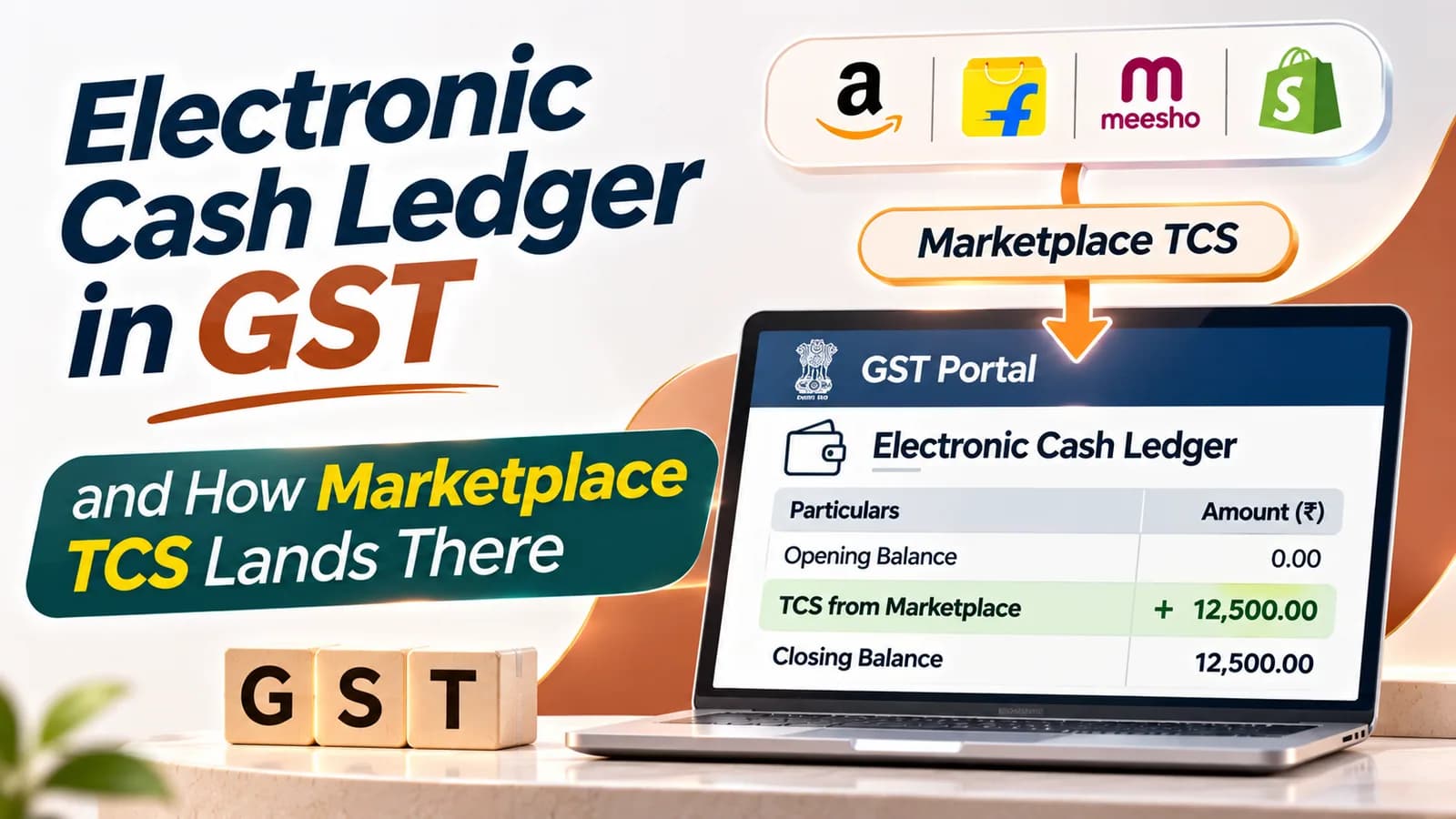
The electronic cash ledger is the GST account, maintained in Form GST PMT-05 on the portal, that holds every rupee you deposit in cash through a challan and every rupee of TDS or TCS credited to you, under Section 49(1) of the CGST Act. For marketplace sellers, it is where the 0.5% TCS collected by Amazon, Flipkart or Meesho lands once you accept it.
The balance works like money in a bank account for GST: it can pay tax, interest, late fees and penalties, it can be moved between tax heads, and any excess can be refunded. Sellers who never look at it often have lakhs sitting idle, built up from TCS that was accepted month after month but never used.
Point | Position |
|---|---|
Legal basis | Section 49(1), CGST Act, read with Rule 87, CGST Rules |
Form | GST PMT-05 (electronic cash ledger) |
Credited by | Challan payments (GST PMT-06), GST TDS and TCS accepted on the portal |
Can pay | Tax, interest, late fee, penalty and other amounts |
Transfer between heads or to a distinct person | Form GST PMT-09 under Section 49(10), as substituted by the Finance Act, 2022 |
Refund of excess balance | Under the proviso to Section 54(1); the two-year limit does not apply, per CBIC Circular No. 166/22/2021-GST, dated 17-11-2021 |
What the electronic cash ledger is
The electronic cash ledger is one of three ledgers every GST registration has, alongside the electronic credit ledger for input tax credit and the electronic liability register for what you owe. The cash ledger records deposits; the credit ledger records ITC; the liability register records dues.
Every GSTIN has its own cash ledger, split into major heads (IGST, CGST, SGST or UTGST, cess) and minor heads (tax, interest, penalty, fee, others). Money deposited under CGST tax sits in that head until you use it, transfer it or claim it back.
How marketplace TCS reaches the electronic cash ledger
TCS reaches the cash ledger in three steps, and only the last one is yours. The operator collects 0.5% of your net taxable sales, files GSTR-8 by the 10th of the next month, and the TCS appears in your "TDS and TCS Credit Received" form.
When you accept the rows and file that form, the TCS is credited to your electronic cash ledger under the same tax heads the operator used: IGST for inter-State sales, CGST and SGST for intra-State sales. Until you file the form, the money is reported against your GSTIN but cannot be used. Our guide to TCS under GST for online sellers walks through the acceptance screen.
What you can pay from the electronic cash ledger
The cash ledger can pay anything you owe under GST: output tax, interest, late fees, penalties and amounts demanded. That is wider than the credit ledger, because input tax credit can pay only output tax, never interest, late fee or penalty.
Payment | Electronic cash ledger | Electronic credit ledger |
|---|---|---|
Output tax in GSTR-3B | Yes | Yes, subject to set-off order |
Interest under Section 50 | Yes | No |
Late fee | Yes | No |
Penalty and demands | Yes | No, except tax portion where allowed |
Reverse-charge tax | Yes | No; must be paid in cash |
Reverse-charge tax is the easiest place to use TCS. Tax on imported advertising services or on purchases from unregistered suppliers under reverse charge must be paid through the cash ledger, so accumulated TCS can settle it directly. Our guide on filing GSTR-3B shows where cash and credit are applied in the return.
Moving balances between heads with PMT-09
A balance stuck under the wrong head can be moved with Form GST PMT-09. Under Section 49(10), as substituted by the Finance Act, 2022 with effect from 5 July 2022, you can transfer cash ledger balances between IGST, CGST, SGST or UTGST and cess, and between minor heads.
The same provision allows a transfer to the IGST or CGST cash ledger of a distinct person, meaning another GSTIN under the same PAN in a different State. That transfer is not allowed if you have any unpaid liability in your electronic liability register, and it is treated as a refund from the cash ledger.
For a seller with TCS piling up in one State and cash tax due in another, this is the cleanest fix. Our guide to multi-State GST registration explains how distinct persons arise.
Refund of the excess balance in the electronic cash ledger
Any balance you do not need can be refunded under the proviso to Section 54(1), through a refund application for excess balance in the electronic cash ledger. According to CBIC Circular No. 166/22/2021-GST, dated 17-11-2021, the two-year time limit in Section 54(1) does not apply to this kind of refund.
The circular also addressed refunds of TDS and TCS balances credited to the cash ledger, which makes this route available to sellers whose TCS exceeds their cash tax. Our step-by-step guide to refunding the excess cash ledger balance covers the application.
When to use TCS, transfer it or claim a refund
The right move depends on where your GST cash need sits, and the order of preference is simple:
Use the TCS against this month's output tax, reverse-charge tax and any interest or late fee in the same GSTIN.
If the balance sits in the wrong head of the same GSTIN, move it with PMT-09.
If another GSTIN of the same PAN needs cash for tax, transfer it there with PMT-09, provided there are no unpaid liabilities.
If no GSTIN needs it in the coming months, file a refund of the excess balance.
Keep a working of each step, so the cash ledger balance in your books agrees with the portal.
At Complylocal, the cash ledger problem we see most in marketplace sellers is the opposite of a shortage: TCS accepted every month, input tax credit covering all output tax, and a cash balance growing quietly for two or three years. A seller with ₹40 lakh of monthly marketplace sales accepts about ₹2 lakh of TCS a month; left untouched, that is ₹24 lakh a year of working capital parked with the government.
How to read your electronic cash ledger
Open Services, Ledgers, Electronic Cash Ledger on the GST portal and select the period. The ledger shows each deposit and debit with its date, reference number, tax head and running balance.
Three entries tell you most of what you need. Deposits described as TCS credits show which operators' TCS you accepted and when. Debits against returns show what GSTR-3B used. Refunds and PMT-09 transfers show balances that left the ledger. If the balance in your books differs from the portal, one of these three is missing from your records.
Recording the electronic cash ledger in your books
Keep a ledger in your books called "GST electronic cash ledger", grouped under current assets, and mirror every movement on the portal. Debit it when a challan is paid or TCS is accepted, and credit it when GSTR-3B uses the balance, when a PMT-09 transfer goes out or when a refund is received in the bank.
At month end, the book balance should equal the portal balance head by head. A seller whose books show TCS receivable but no cash ledger balance has usually forgotten the acceptance entry; one whose books show a cash ledger balance larger than the portal's has usually missed a debit for interest or late fee.
Interest and the electronic cash ledger
Interest under Section 50 runs on tax paid after the due date, and since the Finance Act, 2021 amendment it is charged on the net tax paid in cash rather than on tax set off from ITC. That makes the cash ledger the part of your GST position where a late filing costs money.
Keep TCS accepted before the due date, so the cash is in the ledger when the tax falls due, and file GSTR-3B on time so it is actually debited. Our guide to GST late fee and interest explains how interest is worked out.
Want TCS, cash ledger balances and refunds managed across every GSTIN you hold? Talk to Ankush's team about e-commerce GST return filing and compliance.