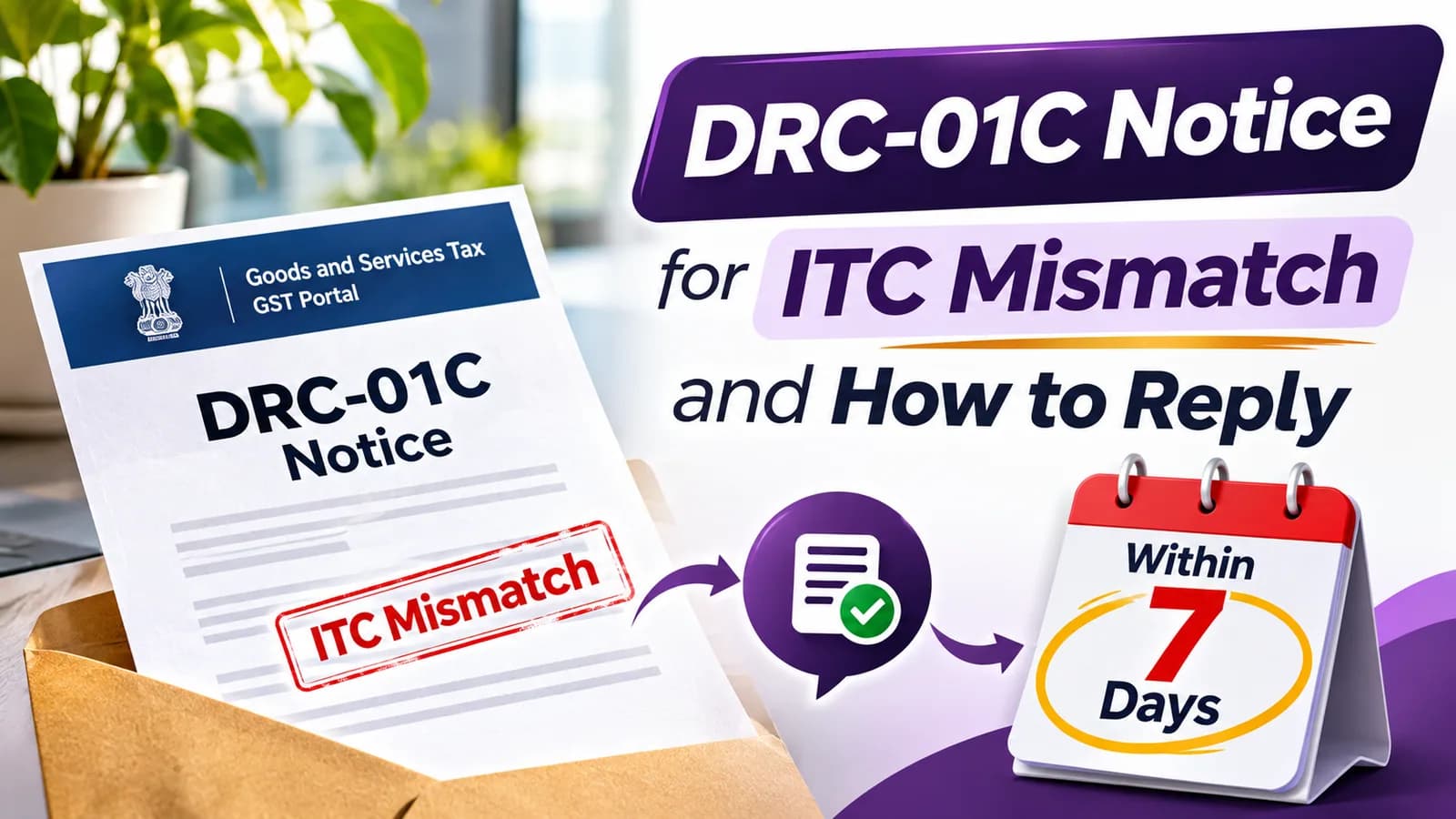
DRC-01C is an automated intimation from the GST portal telling you that the input tax credit (ITC) you claimed in GSTR-3B is higher than the ITC available in your GSTR-2B for the same period, beyond the portal's threshold. It is issued under Rule 88D of the CGST Rules, and you have 7 days to either pay the excess with interest through DRC-03 or explain the difference in Part B.
A DRC-01C is not a demand notice. It is a chance to settle or explain the gap before an officer opens proceedings. Ignore it and Rule 59(6) blocks your next GSTR-1, which in turn stops GSTR-3B, so a seller who leaves it unanswered can lose a whole filing cycle over a difference that was perfectly legal.
Point | Position |
|---|---|
Legal basis | Rule 88D, CGST Rules, inserted by Notification No. 38/2023-Central Tax, dated 04-08-2023 |
Portal functionality | Live from the GSTN advisory dated 06-10-2023 |
Trigger | ITC in GSTR-3B exceeds ITC in GSTR-2B beyond a configured amount and percentage |
Threshold recorded by the Council | Difference above both 20% and ₹25 lakh, per the minutes of the 50th GST Council meeting |
Time to respond | 7 days from the intimation |
Options | Pay through DRC-03 with interest, explain in Part B, or both |
If you do nothing | GSTR-1 for later periods blocked (Rule 59(6)); amount recoverable under Section 73 or 74 |
What a DRC-01C intimation means
DRC-01C comes in two parts. Part A is system-generated: it states the ITC available in GSTR-2B, the ITC you claimed in GSTR-3B and the excess, for the period named. Part B is your response.
The portal compares the totals, not individual invoices, so a DRC-01C tells you that the gap exists, not where it came from. Finding the cause is your reconciliation work, and the reply is only as good as that work. The official GSTN guide to DRC-01C shows the screens.
Why ITC in GSTR-3B can exceed GSTR-2B legitimately
Several kinds of credit never appear in GSTR-2B, or appear in a different month, so a higher GSTR-3B figure is often lawful. These are the reasons that explain most genuine gaps:
Reason | Why it is not in GSTR-2B for the month |
|---|---|
Reverse charge on purchases from unregistered persons and import of services | You pay the tax yourself; no supplier reports it |
ITC reclaimed after an earlier reversal under Rule 37 or 37A | The original invoice sits in an earlier GSTR-2B |
Invoice of an earlier period, reported late by the supplier and claimed now | Shows in the GSTR-2B of the month the supplier filed |
Import IGST where the bill of entry data has not yet reached GSTR-2B | Customs data reaches GSTR-2B separately |
Input Service Distributor credit | Flows through the ISD's return |
If your gap is made up of these items, explain it in Part B with the amounts; no payment is due. If it is not, the excess was claimed without a matching GSTR-2B entry, and Section 16(2)(aa) makes it ineligible until it appears.
How to reply to DRC-01C on the GST portal
Reply in Part B within 7 days, after you have reconciled the period:
Open the GST portal and go to Services, User Services, View Additional Notices/Orders, or use the DRC-01C link in the intimation email.
Open Part B for the period named in Part A.
If part of the excess is ineligible, pay it with interest through DRC-03 and note the ARN.
Enter the DRC-03 ARN in Part B for the amount paid.
For the rest, select the reason from the list and add a clear explanation with amounts.
Attach nothing you cannot defend; the explanation goes on record.
File Part B with DSC or EVC and save the acknowledgement.
A good explanation names the reason, the amount and the invoice or period: "₹3,42,000 is reverse-charge ITC on import of advertising services for October 2026, paid in Table 3.1(d) of the same GSTR-3B." A vague line such as "reconciliation in progress" invites the next notice.
When paying through DRC-03 is the right answer
Pay when the excess was claimed on invoices that never reached your GSTR-2B and are not in the lawful list above. Paying through DRC-03 stops further interest and closes the item; explaining an ineligible claim only delays a demand.
Interest under Section 50 applies at 18% a year on ITC wrongly availed and utilised, from the date of utilisation. Our guide to GST late fee and interest explains how that is computed. You can pay part and explain the rest in the same Part B response.
What happens if you ignore DRC-01C
Silence has two consequences, one immediate and one delayed. Rule 59(6) bars you from filing GSTR-1 for later periods until you file Part B, and since Section 39(10) does not allow GSTR-3B without GSTR-1, your returns stop.
Later, Rule 88D(3) allows the unexplained or unpaid amount to be demanded through proceedings under Section 73 or Section 74, or Section 74A for periods from FY 2024-25. At that stage you face tax, interest and a penalty instead of a 7-day reply. If an officer has already issued a show cause notice, reply with the period's working papers, not a fresh explanation.
DRC-01C versus DRC-01B
The two intimations look alike but test opposite sides of your returns:
Point | DRC-01B | DRC-01C |
|---|---|---|
Rule | 88C | 88D |
Compares | Tax liability in GSTR-1 with tax paid in GSTR-3B | ITC in GSTR-2B with ITC claimed in GSTR-3B |
Problem it flags | Tax under-paid on sales | Credit over-claimed on purchases |
Reply | Pay through DRC-03 or explain, within 7 days | Pay through DRC-03 or explain, within 7 days |
If ignored | GSTR-1 blocked | GSTR-1 blocked |
Since outward liability in GSTR-3B was hard-locked from July 2025, new DRC-01B cases are rarer; our guide to the GSTR-1 vs GSTR-3B mismatch explains why. DRC-01C remains live, because ITC in GSTR-3B can still differ from GSTR-2B for the reasons above.
Where DRC-01C gaps start for e-commerce sellers
For online sellers, most ITC sits on a handful of large monthly invoices: marketplace fees, advertising, logistics and payment gateways. One supplier filing late, or billing the wrong GSTIN, moves a big share of the month's credit out of GSTR-2B.
At Complylocal, the DRC-01C cases we see in seller accounts usually trace to ITC claimed from the books in the month of the invoice, while the supplier reported it a month later. The fix is a process change: claim from GSTR-2B, carry the rest as open items, and claim them in the month they appear.
Imported advertising services are the other recurring cause. Where your business pays GST on imported ad services under reverse charge, that ITC is lawful but never appears in GSTR-2B, so keep its working ready for every Part B reply.
Records to keep ready for a DRC-01C reply
A Part B reply is only as strong as the working behind it. Keep these for every month, so you can answer within the 7 days:
Record | What it proves |
|---|---|
Final GSTR-2B and the recomputed version, if any | The ITC the portal made available |
GSTR-3B Table 4 working | How you arrived at the ITC claimed |
Reverse-charge register with self-invoices | ITC that lawfully never appears in GSTR-2B |
Rule 37 and 37A reversal and reclaim log | Credit reclaimed in this month for an earlier period |
Open-items list from your reconciliation | Invoices claimed in the month they reached GSTR-2B |
Our guide on filing GSTR-3B shows which Table 4 rows each of these feeds.
How to prevent DRC-01C notices
Claim ITC in GSTR-3B from the final GSTR-2B, adjusted only for the lawful items listed above, and keep a working that shows each adjustment. That single habit prevents nearly every DRC-01C.
Run the purchase-side match every month before filing, using the method in our guide on how to do GST reconciliation. Keep reverse-charge ITC, reclaimed credit and late-reported invoices as separate lines in that working, so a Part B reply takes ten minutes, not a week.
Want DRC-01C and other GST intimations answered with a proper working on file? Talk to Ankush's team about GST notice and litigation support.