Food delivery is one of India's fastest-growing online businesses. But if you're building the next Zomato or Swiggy, GST works very differently for you than for a normal restaurant or seller.
As a food delivery platform, you pay GST on the food your partner restaurants sell, not just on your own commission. Get this wrong at launch and you could face tax demands on every order processed.
In this guide, the ComplyLocal team explains everything a new food delivery platform needs to know: registration, GST rates, returns, TCS and how to set up your books.
Section 9(5): why your platform pays the restaurant's GST
Normally, the person who supplies goods or services pays GST. Section 9(5) of the CGST Act is an exception: for certain notified services, the e-commerce operator (ECO) is treated as the supplier and must pay the tax.
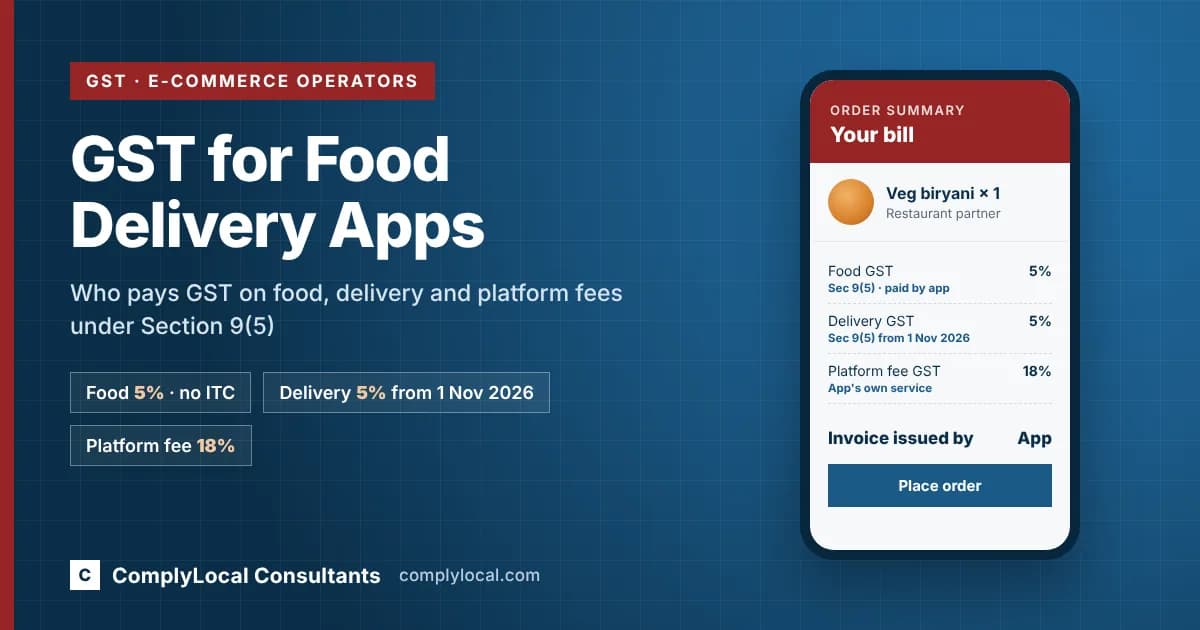
Restaurant services were added to this list from 1 January 2022. So when a customer orders a biryani on your app, you charge and pay 5% GST on the food, even though the restaurant cooked it.
From 1 November 2026, delivery services by riders who aren't registered under GST also come under Section 9(5), at 5% without input tax credit. Earlier (22 September 2025 to 31 October 2026), "local delivery" through ECOs was taxed at 18%.
GST registration and rates for a food delivery app
Registration: from day one
An e-commerce operator must register under GST before going live, whatever its turnover. The usual ₹20 lakh threshold doesn't apply. You'll need a registration in every state where you list restaurants, because food supply is intra-state.
GST rate on each charge
Every order has several charges, and each is taxed differently:
Charge | Who pays GST | Rate | ITC |
|---|---|---|---|
Food value | Platform, under Section 9(5) | 5% | Not available |
Food from hotel restaurants in "specified premises" (room tariff above ₹7,500) | Restaurant | 18% | Available |
Delivery by unregistered riders | Platform, under Section 9(5) | 5% (from 1 Nov 2026) | Not available |
Platform / convenience fee | Platform | 18% | Available |
Commission and ad fees charged to restaurants | Platform | 18% | Available |
Note: Industry bodies have asked the government to defer the new delivery rules to January 2027. Check the latest position before you finalise your billing.
TCS, returns, ITC and invoicing
No TCS on food orders
Because the platform already pays the full GST on restaurant services, no TCS is collected and no GSTR-8 is filed for them (CBIC Circular 167/23/2021). If you also sell packaged food, groceries or merchandise from registered sellers, TCS at 0.5% and monthly GSTR-8 still apply to those sales.
Monthly returns
GSTR-1: report Section 9(5) supplies in Table 15, and your own fees and commission in the regular tables.
GSTR-3B: pay Section 9(5) tax in Table 3.1.1(i), and tax on your own services in Table 3.1(a).
Partner restaurants report sales through your app in their returns, with no tax payable by them.
Input tax credit
Section 9(5) tax must be paid in cash. You can't use your ITC balance for it.
Good news: you don't need to reverse ITC on your technology, marketing or office costs. Use that ITC against the 18% GST on your fees and commission.
Invoicing
Show food, delivery and platform fee as separate tax lines on the customer invoice. Issue it in your platform's name and GSTIN, with the restaurant named as the actual supplier. E-invoicing applies to B2B bills once turnover crosses ₹5 crore.
Setting up your accounts the right way
GST treats you as the supplier, but in your books you are usually an agent. Your revenue is your commission, platform fee and delivery charges. The food value belongs to the restaurant and sits as a payable until you settle it.
A simple flow for every order:
Customer pays the full amount online or by COD.
Payment gateway settles to your bank, net of its charges.
Food value is credited to the restaurant's account, and 5% GST to a separate Section 9(5) output ledger.
Your commission is invoiced to the restaurant and deducted from its payable.
Restaurant is paid weekly, net of commission, GST and TDS.
Reconcile regularly: match order reports with gateway settlements and bank daily, and match GST in your books with GSTR-1/3B every month. Refunds, cancellations and discounts cause most mismatches.
Other compliances to plan for
Income-tax TDS of 0.1% on gross sales facilitated for each restaurant (the e-commerce TDS provision).
FSSAI central licence as an e-commerce food business; list only FSSAI-licensed restaurants.
Consumer Protection (E-Commerce) Rules, 2020: grievance officer, seller details, refund policy.
Gig worker social security contributions under the Social Security Code.
Frequently asked questions
Does a food delivery app need GST registration even with low turnover? Yes. E-commerce operators must register from the start, with no turnover threshold.
What GST rate applies to food ordered through an app? 5% without input tax credit, paid by the platform under Section 9(5). Hotel restaurants in specified premises charge 18% themselves.
Does the platform collect TCS on restaurant orders? No. TCS doesn't apply where the platform pays GST under Section 9(5).
Can the platform use ITC to pay Section 9(5) GST? No, it must be paid in cash. ITC can be used against GST on the platform's own fees and commission.
What GST applies to delivery charges? From 1 November 2026, 5% without ITC, paid by the platform where riders aren't registered.
Launching a food delivery platform? Talk to ComplyLocal
At ComplyLocal, we specialise in e-commerce accounting and compliance for B2C and D2C businesses across India. We can handle your GST registrations in every state, invoice setup, monthly GST and TDS returns, restaurant settlements and MIS, end to end.
Get in touch at complylocal.com to get your platform compliant from day one.
This article reflects GST provisions as of 27 November 2026 and is for general information. Please consult a professional before acting on it.