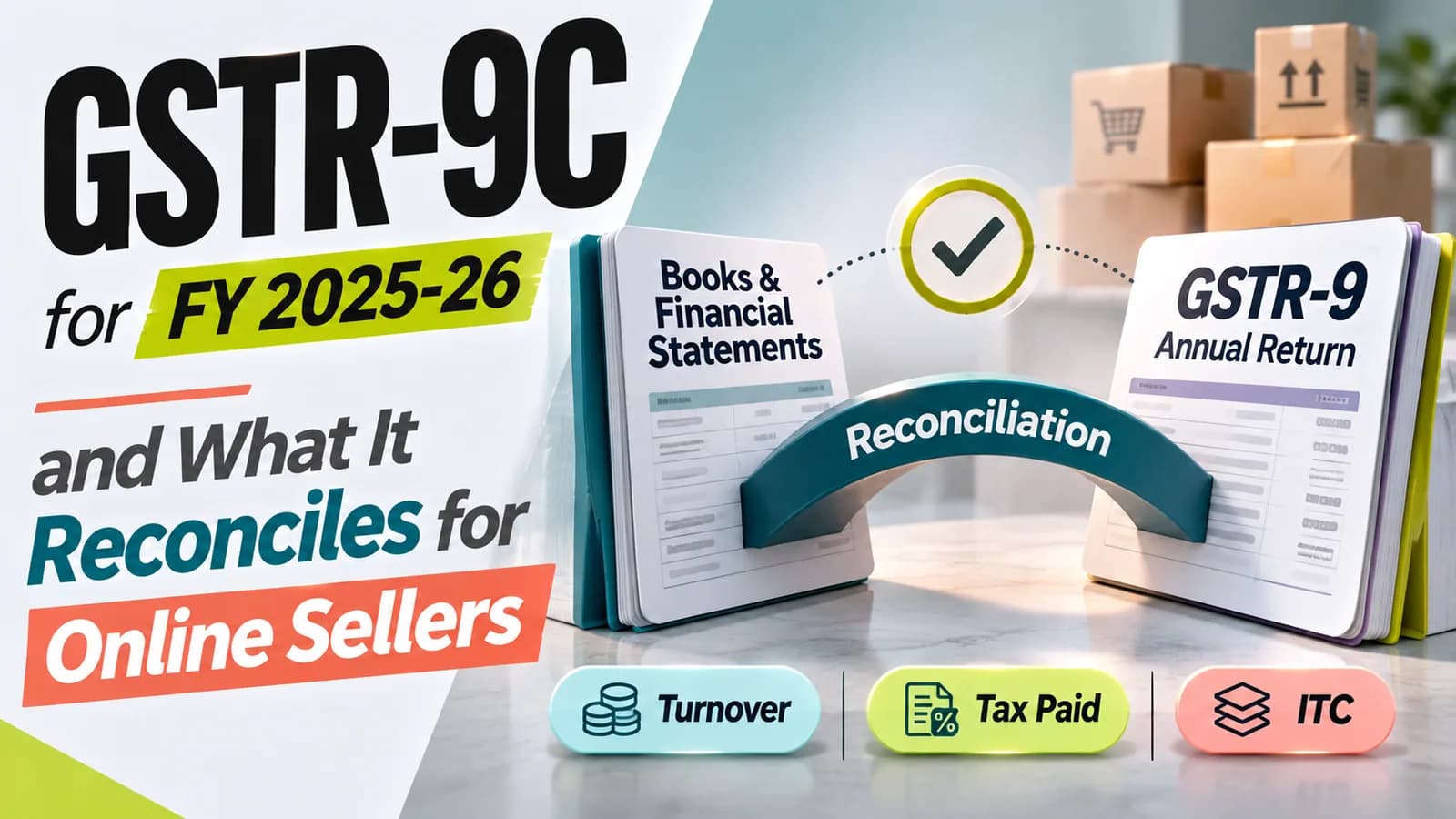
GSTR-9C is the reconciliation statement that compares the turnover, tax and input tax credit (ITC) in your audited financial statements with what you reported in GSTR-9, GSTIN by GSTIN. For FY 2025-26, it is required where aggregate turnover exceeds ₹5 crore, and it is due on 31 December 2026 along with GSTR-9. Since FY 2020-21, it is self-certified by the taxpayer, not certified by a chartered accountant.
Self-certification did not make it lighter. GSTR-9C is where the company's books, prepared for the whole PAN, meet GST returns filed per State. For a seller with warehouses in several States, the biggest differences are rarely errors in tax; they are items GST treats as supplies and the books do not, such as stock moved between your own registrations.
Point | Position for FY 2025-26 |
|---|---|
Form | GSTR-9C, reconciliation statement under Section 44, CGST Act, read with Rule 80(3) |
Who files | Registered persons with aggregate turnover above ₹5 crore |
Certification | Self-certified by the taxpayer, from FY 2020-21 (Notification No. 30/2021-Central Tax, dated 30-07-2021) |
Due date | 31 December 2026, with GSTR-9 |
Filed for | Each GSTIN separately |
Basis | Audited financial statements for the year |
Late fee | Applies to the complete annual return, which includes GSTR-9C, according to GSTN's FAQs |
Who must file GSTR-9C for FY 2025-26
GSTR-9C applies when the aggregate turnover of all GSTINs under your PAN exceeds ₹5 crore in FY 2025-26. Once that limit is crossed, each GSTIN files its own GSTR-9C, even a small registration in a second State.
Aggregate turnover in FY 2025-26 | GSTR-9 | GSTR-9C |
|---|---|---|
Up to ₹2 crore | Exempt | Not required |
Above ₹2 crore up to ₹5 crore | Required | Not required |
Above ₹5 crore | Required | Required, self-certified |
A D2C brand with ₹4.2 crore of sales in one State and ₹1.1 crore in another files GSTR-9C for both, because the ₹5 crore test is on aggregate turnover, not on each State.
What GSTR-9C reconciles
GSTR-9C works through three comparisons, each starting from the audited books and ending at the figure reported in GSTR-9:
Comparison | Starts from | Ends at | Typical adjustments |
|---|---|---|---|
Turnover | Turnover in audited financial statements for the GSTIN | Turnover reported in GSTR-9 | Unbilled revenue, credit notes after year end, stock transfers, discounts |
Tax paid | Tax on reconciled taxable turnover | Tax paid as declared in GSTR-9 | Rate differences, unpaid tax found during reconciliation |
Input tax credit | ITC as per audited books | ITC claimed in GSTR-9 | Credit of other years, blocked credit, ITC on capital goods |
Any tax found short at the end is shown as additional liability and paid through DRC-03 with interest. The reconciliation is not a place to argue the difference away; it is where it gets paid.
Why marketplace sellers see large GSTR-9C differences
Four items explain most GSTR-9C gaps for online sellers, and none of them is a mistake in the monthly returns:
Stock transfers between your own GSTINs, which are supplies under GST but not sales in the books.
Books prepared for the whole company, while GSTR-9C needs turnover for each GSTIN.
March-end orders invoiced in GST but recognised as revenue only on delivery in April.
Discounts and returns that hit the books and GSTR-1 in different years.
At Complylocal, the first item is the one that surprises sellers most. A brand sending stock from its Haryana warehouse to a marketplace fulfilment centre in Karnataka raises a tax invoice between two of its own registrations, as a supply between distinct persons under Schedule I. That invoice is turnover for the Haryana GSTIN, but the company's books record it as an internal movement, so the Haryana GSTR-9C shows a gap equal to every rupee of stock sent out of the State.
Stock transfers and the GSTIN-wise turnover split
Treat GSTIN-wise turnover as a separate exercise before you open GSTR-9C. Split the books' revenue by the State of supply, then add inter-State stock transfers sent from each GSTIN and remove the transfers received, to arrive at each registration's GST turnover.
Step | Haryana GSTIN | Karnataka GSTIN |
|---|---|---|
Revenue from customers in books, by State of supply | ₹4,20,00,000 | ₹1,10,00,000 |
Add stock transferred out to the other GSTIN | ₹65,00,000 | ₹0 |
Turnover for GSTR-9C | ₹4,85,00,000 | ₹1,10,00,000 |
The figures are illustrative. The point is that the Haryana registration reports ₹65 lakh more than its share of customer sales, and the reconciliation must show it. Our guide to stock transfers between PPOB and APOB covers the invoicing and e-way bill side.
How to prepare GSTR-9C step by step
Start from finalised audited accounts and a filed or final-draft GSTR-9:
Obtain the audited financial statements and the trial balance for FY 2025-26.
Split revenue by GSTIN using the State of supply, and add stock transfers out.
Adjust for unbilled revenue, deferred revenue on undelivered orders and credit notes issued after year end.
Compare the adjusted turnover with GSTR-9, line by line, and record the reason for each difference.
Recompute tax on the reconciled taxable turnover by rate, and compare with tax paid.
Reconcile ITC in the books with ITC in GSTR-9, separating credit of other years and blocked credit.
Pay any additional liability through DRC-03 with interest before filing.
File GSTR-9C with the same GSTIN's GSTR-9 and keep the working file.
Our guide to GSTR-9 for FY 2025-26 covers the annual return that GSTR-9C sits alongside.
Revenue timing differences for e-commerce sellers
GST is triggered by the invoice, while the books usually recognise revenue when the order is delivered. A March order invoiced on 29 March and delivered on 4 April is FY 2025-26 turnover for GST and FY 2026-27 revenue in the books.
The same split happens in reverse with returns. A credit note issued in May 2026 for a March sale reduces FY 2025-26 GST turnover if declared within the Section 34 limit, but may be booked as a FY 2026-27 adjustment. Our guide on credit notes in GST explains the 30 November 2026 cut-off for those notes.
ITC reconciliation in GSTR-9C
The ITC part compares the input tax credit recorded in your audited books with the ITC claimed in GSTR-9. Differences usually come from credit belonging to another year, credit reversed under Rule 37 or 37A, blocked credit under Section 17(5) booked as an asset in the books, and ITC on capital goods.
If your monthly purchase-side reconciliation was kept with an open-items list, most of this part is already done. Our guide on how to do GST reconciliation shows the working that feeds it.
Records to keep behind your GSTR-9C
The statement itself is a summary; the working file is what you rely on if a figure is questioned. Keep these for each GSTIN:
Record | Supports |
|---|---|
GSTIN-wise revenue split with the State of supply | The starting turnover |
Register of inter-State stock transfer invoices | The transfer adjustment |
List of March invoices delivered in April, and April credit notes for March sales | Timing differences |
Purchase-side reconciliation with open items | The ITC comparison |
DRC-03 challans for tax paid during reconciliation | The additional liability |
A seller who has these ready can complete GSTR-9C in days rather than weeks, and can answer a scrutiny query from the same file a year later.
Self-certification and what it changes
Since the Finance Act, 2021 amendment to Section 44 and Notification No. 30/2021-Central Tax, GSTR-9C is self-certified, and a chartered accountant's certification is no longer required. The taxpayer, through an authorised signatory, signs the statement with DSC or EVC.
Self-certification moves the responsibility, not the work. An authorised signatory is now confirming the reconciliation personally, so the working file behind every adjustment matters more, not less. The statutory audit of the company's accounts under company law is a separate matter and still provides the audited figures GSTR-9C starts from; see our annual ROC filing service for that side.
Want GSTR-9C prepared GSTIN by GSTIN, with stock transfers and timing differences worked out? Talk to Ankush's team about GST return filing.