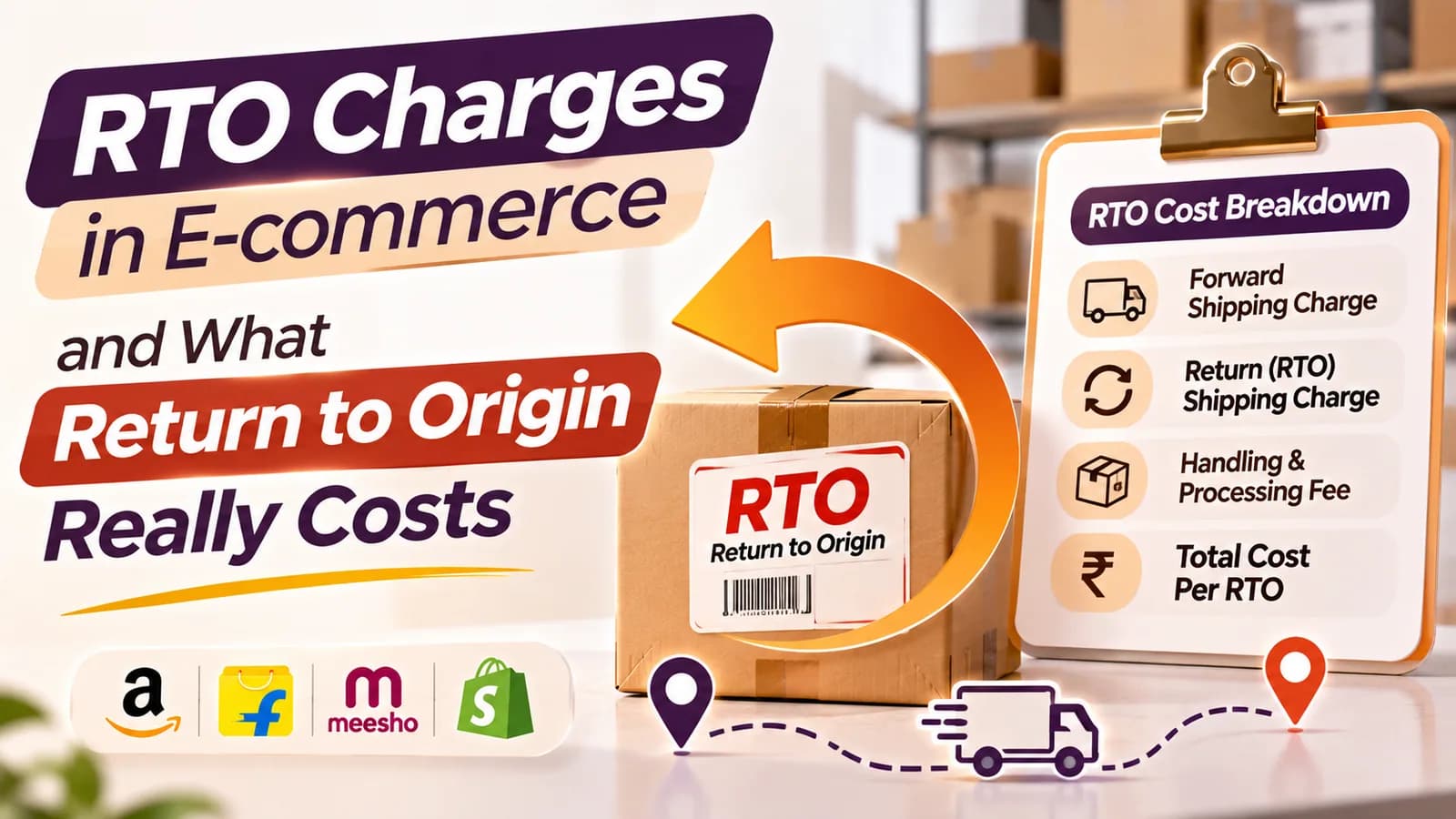
RTO in e-commerce means Return to Origin: a shipment that was dispatched but never delivered, and came back to the seller's warehouse. The buyer refused it, could not be reached, gave a wrong address or cancelled while it was in transit. RTO charges are the costs that follow, usually forward shipping already spent, reverse freight on the way back, packaging, and for cash-on-delivery (COD) orders, a sale that never produced any cash.
RTO is different from a customer return, where the buyer received the product and sent it back. That distinction drives the fee, the GST treatment and the accounting entry, and mixing the two is the reason many sellers cannot explain why a high-volume month made no money.
Point | RTO (Return to Origin) | Customer return |
|---|---|---|
Was the order delivered? | No | Yes |
Typical causes | COD refusal, buyer unreachable, wrong address, fake order | Size, quality, "not as described", change of mind |
Shipping cost | Forward shipping, plus reverse freight where the platform or courier charges it | Forward shipping, plus reverse pickup fee |
GST position | No supply completed; reverse the invoice through a credit note if already reported | Supply made, then reversed through a credit note |
Cash | No payment received on COD | Refund paid to the buyer |
Common causes of RTO and what each one tells you
Each RTO reason points to a different fix, so read the courier's reason code before treating all RTOs alike:
RTO reason | What it usually means | Where the fix sits |
|---|---|---|
Customer refused | Impulse COD order, or a cheaper offer found | Prepaid incentive, COD confirmation |
Customer not reachable | Wrong or inactive phone number | Checkout validation |
Incomplete or wrong address | Missing landmark, wrong pin code | Address checks at checkout |
Cancelled in transit | Long delivery promise, buyer moved on | Faster dispatch, honest delivery dates |
Repeat refusals from one buyer or area | Fake or abusive orders | COD limits for that buyer or pin code |
What RTO charges include
The RTO charge on a courier or platform invoice is only one part of the cost. The full cost of an RTO has five components, and three of them never appear as a line item:
Cost component | Where you see it |
|---|---|
Forward shipping already paid | Shipping invoice or settlement deduction |
Reverse or RTO freight | Courier or platform invoice, where charged |
Packaging and dispatch labour | Your own costs, rarely tracked per order |
Stock blocked in transit | Days of inventory unavailable to sell |
Damage or unsellable returns | Write-off at stock check |
Platforms treat RTO freight differently. Meesho, for example, states on its pricing page that it charges no return shipping fee for RTOs. Brands shipping through their own courier aggregators usually pay RTO freight under their rate card, so check yours line by line.
How to calculate the real cost of RTO
Measure RTO cost per kept order, not per RTO. The orders that are delivered and kept are the ones that must pay for the ones that came back.
Count orders shipped, delivered and kept, customer returns and RTOs for the last 90 days.
Work out the RTO rate: RTO orders divided by orders shipped.
Total forward shipping on RTO orders, RTO freight, and packaging per RTO.
Add an allowance for damaged RTO units at your actual write-off rate.
Divide the total RTO cost by the number of kept orders.
Add that figure to the cost of every kept order when you price.
An illustrative month for a D2C brand selling through its own website shows the effect. All charges are assumed for the arithmetic.
Line | Value |
|---|---|
Orders shipped | 1,000 |
RTO orders at 18% | 180 |
Forward shipping on RTOs, assumed ₹70 each | ₹12,600 |
RTO freight, assumed ₹60 each | ₹10,800 |
Packaging, assumed ₹15 each | ₹2,700 |
Damaged units, 5% of RTOs at ₹400 cost | ₹3,600 |
Total RTO cost | ₹29,700 |
Kept orders (after 70 customer returns) | 750 |
RTO cost per kept order | ₹39.60 |
On a product with ₹150 of margin per order, that ₹39.60 removes over a quarter of the profit before customer returns are counted.
Why RTO is higher on cash-on-delivery orders
COD orders carry the highest RTO because the buyer has committed no money. A buyer who changes their mind, finds a cheaper option or ordered on impulse simply refuses the parcel.
For D2C brands, the share of COD orders is the single strongest predictor of the RTO rate. A brand that moves part of its COD volume to prepaid, even through a small prepaid discount, usually lowers RTO more than any change in courier.
GST treatment of RTO orders
An RTO order never reaches the buyer, so no supply is completed. If you had not yet reported the invoice in GSTR-1, cancel it in your books; if you had, issue a credit note and report it within the Section 34 time limit, which for FY 2025-26 sales is 30 November 2026.
Most consumer RTO parcels are worth less than ₹50,000, the consignment value above which an e-way bill is generally required under Rule 138, so the return movement rarely needs one. A bulk B2B consignment that comes back is a different case and should be checked. Our guide on credit notes in GST covers the time limit and reporting.
Accounting entries for RTO
Record an RTO as a reversed sale, a stock receipt and a cost, in that order. If the sale was booked at dispatch, debit sales returns and output GST and credit the customer or marketplace account; then bring the stock back into inventory at cost.
Book forward shipping and RTO freight on RTO orders to a separate ledger, "RTO costs", not to general shipping. That one ledger makes the RTO cost per kept order visible in every monthly P&L. For brands selling through their own store, our guide to Shopify D2C accounting shows how COD remittances and RTOs sit in the courier reconciliation.
RTO on marketplaces versus your own website
On a marketplace, the platform's logistics handles the RTO and the cost appears as a settlement deduction, or not at all where the platform does not charge it. On your own website, every RTO cost lands on your courier invoice and your COD remittance report.
That makes RTO a reconciliation problem for D2C brands. The courier aggregator's COD remittance must be matched order by order with delivered orders, because an RTO wrongly marked as delivered shows up as COD cash that never arrives. Our guide to the payment reconciliation process covers that match.
At Complylocal, the RTO gap we find most often in D2C books is not the freight but the missing COD: orders marked delivered in the store's admin, while the courier's remittance report shows them as RTO. Until the two are matched by AWB number, revenue is overstated and the cash shortfall looks like a bookkeeping error.
RTO numbers to track every week
A single monthly RTO percentage hides the problem. Split it the way the fixes are organised:
Measure | Why it matters |
|---|---|
RTO rate for COD and for prepaid, separately | Shows how much of the problem is payment mode |
RTO rate by pin code or district | Finds the areas that drive most refusals |
RTO rate by SKU | Exposes products that attract impulse orders |
RTO rate by courier | Separates courier failure from buyer behaviour |
Days from order to first delivery attempt | RTO rises as this lengthens |
RTO cost per kept order | The number that belongs in pricing |
How to reduce RTO
RTO responds to a few specific changes, mostly before dispatch:
Confirm COD orders by message before dispatch, and cancel the ones that do not respond.
Validate addresses and pin codes at checkout, especially landmarks and phone numbers.
Offer a small prepaid incentive, or collect a partial advance on high-value COD orders.
Track RTO by pin code and limit COD where a handful of areas account for most refusals.
Dispatch the same day; RTO rises with every extra day between order and delivery attempt.
Measure the rate weekly by channel and pin code, and treat a rising RTO rate as a pricing problem, not just a logistics one. Marketplace sellers can compare the treatment on Meesho in our guide to Meesho seller charges.
Want RTO, returns and COD worked into a real per-order margin for each channel? Talk to Simran's team about e-commerce profitability analysis.