Most APOB applications don’t fail because the filing steps are hard. They fail on documents — a rent agreement in the wrong name, a missing NOC, an electricity bill whose address doesn’t match the portal entry, or a scan that’s over 1 MB. The officer raises a clarification, the 7-day reply window starts, and a routine amendment turns into a month-long headache.
I’m Keshav Sehgal from ComplyLocal Consultants, and after five-plus years of filing APOB amendments for e-commerce sellers and MSMEs, I can tell you the document file decides the outcome before the officer even opens it. This guide lists every document required for an additional place of business in GST — by nature of possession, by scenario (residential, co-working, marketplace fulfilment centre), with the upload rules and the mistakes that get files rejected. For what an APOB is and when it’s mandatory, start with our guide to the additional place of business under GST; for the filing sequence itself, see how to add an additional place of business on the portal.
Official APOB Document Requirements (GST Portal)
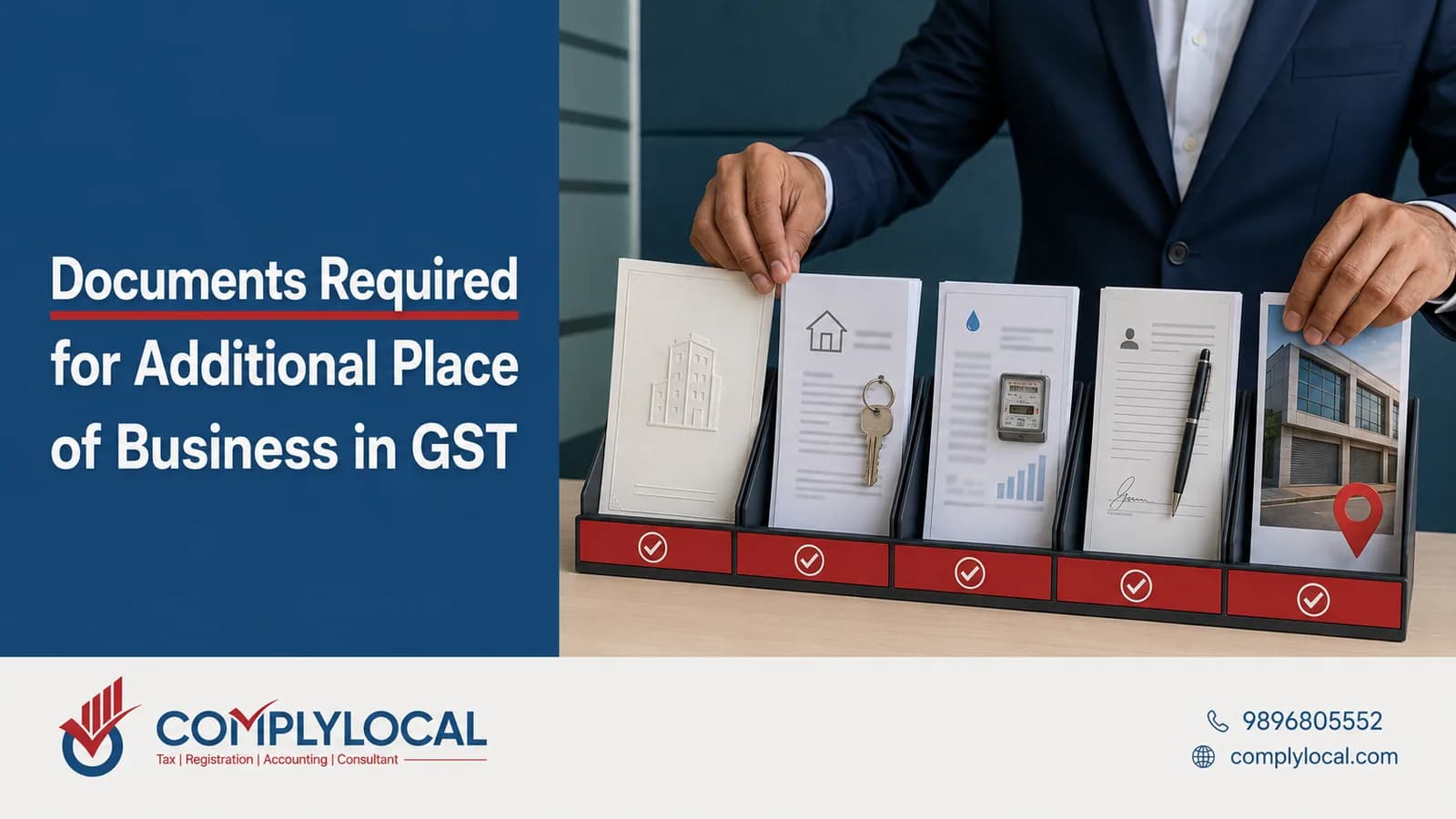
The GST portal’s official guidance for Additional Places of Business accepts the following as proof of nature of possession of premises. Everything else officers ask for builds on this base.
Nature of possession | Documents accepted as proof |
|---|---|
Owned premises | Latest property tax receipt, OR Municipal Khata copy, OR a copy of the electricity bill |
Rented / leased premises | Valid rent or lease agreement PLUS the lessor’s ownership proof (property tax receipt, khata copy, or electricity bill) |
Consented / shared premises | Consent letter or NOC from the owner PLUS the consenter’s ownership document (khata copy or electricity bill) |
Upload Rules You Must Follow
Format: PDF or JPEG only.
Size: maximum 1 MB per file.
Count: up to two documents per APOB — combine additional pages into a single merged file.
Is upload mandatory? No — documentary proof is not compulsory for every APOB. But officers can and do request it, so uploading upfront avoids a REG-03 clarification round.
Consultant’s note: “not mandatory” does not mean “not needed.” In practice, an application with clean documents attached moves faster than one that invites the officer to ask. We attach proof for every APOB, every time.
Documents by Nature of Possession — What Officers Actually Check
Owned Premises
Any one of the three works: latest property tax receipt, Municipal Khata copy, or electricity bill. Pick the document whose address reads closest to how you’ll type it on the portal — that address string is what the officer compares.
Rented or Leased Premises
Two layers of proof are needed: the rent or lease agreement, plus the lessor’s ownership proof. Practitioner experience adds three checks the portal page doesn’t spell out:
The agreement should be in your entity’s name — an agreement in a partner’s or director’s personal name for a company filing is a classic rejection reason.
Use a registered or notarized rent agreement rather than a plain print — CA guidance consistently recommends it.
The agreement must be current, not expired — outdated agreements are a documented cause of REG-03 notices.
Consented or Shared Premises
Where you use premises without a rent arrangement — a family property, a shared facility — you need a consent letter or NOC from the owner plus the consenter’s ownership document (khata copy or electricity bill). The NOC should clearly permit business use of the premises by your entity.
Special Scenarios: Residential, Co-working, and Marketplace FCs
Residential Address as APOB
A common misconception is that residential addresses can’t be an APOB. They can — with a proper NOC and supporting documents, home addresses are used as PPOB or APOB, especially by small online businesses. Treat it as a consented premises: NOC from the owner plus their ownership proof, and where the home is your own, ownership documents directly.
Co-working and Shared Spaces
For co-working or shared workspaces, CA guidance calls for separate consent letters from the space provider alongside the usual possession proof. The documentation logic is the consented-premises route — the provider consents, and their ownership/utility document backs it up.
Amazon, Flipkart, and Meesho Fulfilment Centres
Marketplace APOB files add platform-provided paperwork on top of the standard set: **VPOB agreements, NOCs, and Amazon/Flipkart FC address letters** are used in the APOB registration file. Meesho’s warehouse-based fulfilment similarly expects rent agreements, NOC, and utility proof for the aggregator-run warehouse. If you don’t yet hold a GSTIN in the FC’s State, you’ll first need a State registration — typically via a virtual place of business — and the FC then goes in as APOB. The full seller flow is in our Amazon FBA GST registration guide.
Additional Documents Officers Sometimes Ask For
Beyond the portal’s possession-proof list, practitioner guidance flags documents that officers request in clarifications:
Identity/address proof of the authorised signatory — PAN and Aadhaar.
Local trade or shop establishment licences, in some cases.
A utility bill (electricity/water) matching the exact address string entered on the portal — the single most useful supporting document you can attach.
The Address-Matching Rule (Where Most Files Fail)
The officer’s basic test is simple: does the address on the documents match the address on the application? Small mismatches — a different spelling of the locality, a missing sub-locality, the wrong PIN — trigger clarifications or rejection. The portal itself warns you when the locality or sub-locality doesn’t match the PIN code.
Open your strongest proof (utility bill or rent agreement) and read the address exactly as printed.
Type the portal address to match it word for word — same spellings, same sequence.
Resolve any locality/PIN warning the portal raises before submitting — never submit past a warning.
If two documents show slightly different address strings, follow the one you upload as primary proof.
Document Mistakes That Get APOB Applications Rejected
From documented rejection patterns and our own clean-up work, these are the recurring document failures — and the fix for each.
Document mistake | How to fix it before filing |
|---|---|
Rent/lease agreement not in the entity’s name or inconsistent with the utility bill | Redo the agreement in the registered entity’s name; align it with the utility bill |
Missing owner/consenter documents for rented or consented premises | Collect the lessor’s or consenter’s property tax receipt, khata copy, or electricity bill |
Expired or outdated rent agreement | Execute a current agreement before applying |
Blurred scans or unreadable copies | Re-scan clearly; officers reject what they cannot read |
Missing NOC for consented, shared, or residential premises | Obtain a signed NOC clearly permitting business use |
File over 1 MB or wrong format | Compress to under 1 MB; PDF/JPEG only; merge extra pages into one file |
Address on documents doesn’t match the portal entry | Match the address string word for word before submitting |
What Happens If Your Documents Are Deficient
If the officer finds the proof insufficient or inconsistent, a clarification notice in REG-03 is issued. You must reply in REG-04 within 7 working days — with the corrected or additional documents — or the application can be rejected automatically. A rejection means fixing the file and submitting a fresh core-field amendment, so it’s always cheaper to get the documents right the first time.
Master Document Checklist by Scenario
Your scenario | Documents to keep ready |
|---|---|
Own warehouse/shop/office | Property tax receipt OR khata copy OR electricity bill |
Rented warehouse/branch | Current registered/notarized rent agreement (in entity’s name) + lessor’s ownership proof |
Family or shared property | Consent letter/NOC + consenter’s khata copy or electricity bill |
Home used as APOB | NOC (if not your own) + owner’s ownership/utility proof |
Co-working space | Consent letter from provider + provider’s ownership/utility document |
Amazon/Flipkart/Meesho FC | Platform paperwork — VPOB agreement, NOC, FC address letter — plus the standard possession proof |
Every scenario, always | Utility bill matching the portal address string; signatory PAN/Aadhaar on hand; files as PDF/JPEG under 1 MB, max two per APOB |
Expert Tips from ComplyLocal Consultants
Build the document file before opening the portal — the address you type should be copied from the proof, not from memory.
Merge supporting pages into one clean PDF; two crisp files under 1 MB each beat five fragments.
For rented premises, collect the lessor’s ownership proof at the time of signing the agreement — chasing landlords later is the most common cause of missed REG-03 deadlines.
Marketplace sellers: download and file the FC address letter and NOC the day onboarding opens; the 15-day amendment window is short.
If you’d rather hand over the paperwork, our team manages the full document file and filing as part of APOB registration — including REG-03 replies.
Government References
GST Portal FAQs and User Guide — “Additional Places of Business”: accepted documents for proof of nature of possession, the two-file limit, and PDF/JPEG 1 MB rules.
GSTN Registration FAQs — confirmation that documentary proof is not mandatory for every APOB, and document handling for additional places.
GST Portal Manual — “Amendment of Registration (Core Fields)”: the amendment route through which APOB documents are submitted.
CGST Act, Section 2(85) — the definition of place of business that determines which premises need declaring (and documenting) in the first place.
Conclusion
The document requirements for an additional place of business in GST are short — one to two files, matched to how you hold the premises. What decides approval is discipline: the agreement in the right name, the NOC where consent applies, the lessor’s proof attached, and above all an address string that matches the paper exactly. Get those four things right and the documents stop being the reason your APOB waits.
— Keshav Sehgal, E-commerce GST, APOB, VPOB & PPOB Specialist, ComplyLocal Consultants