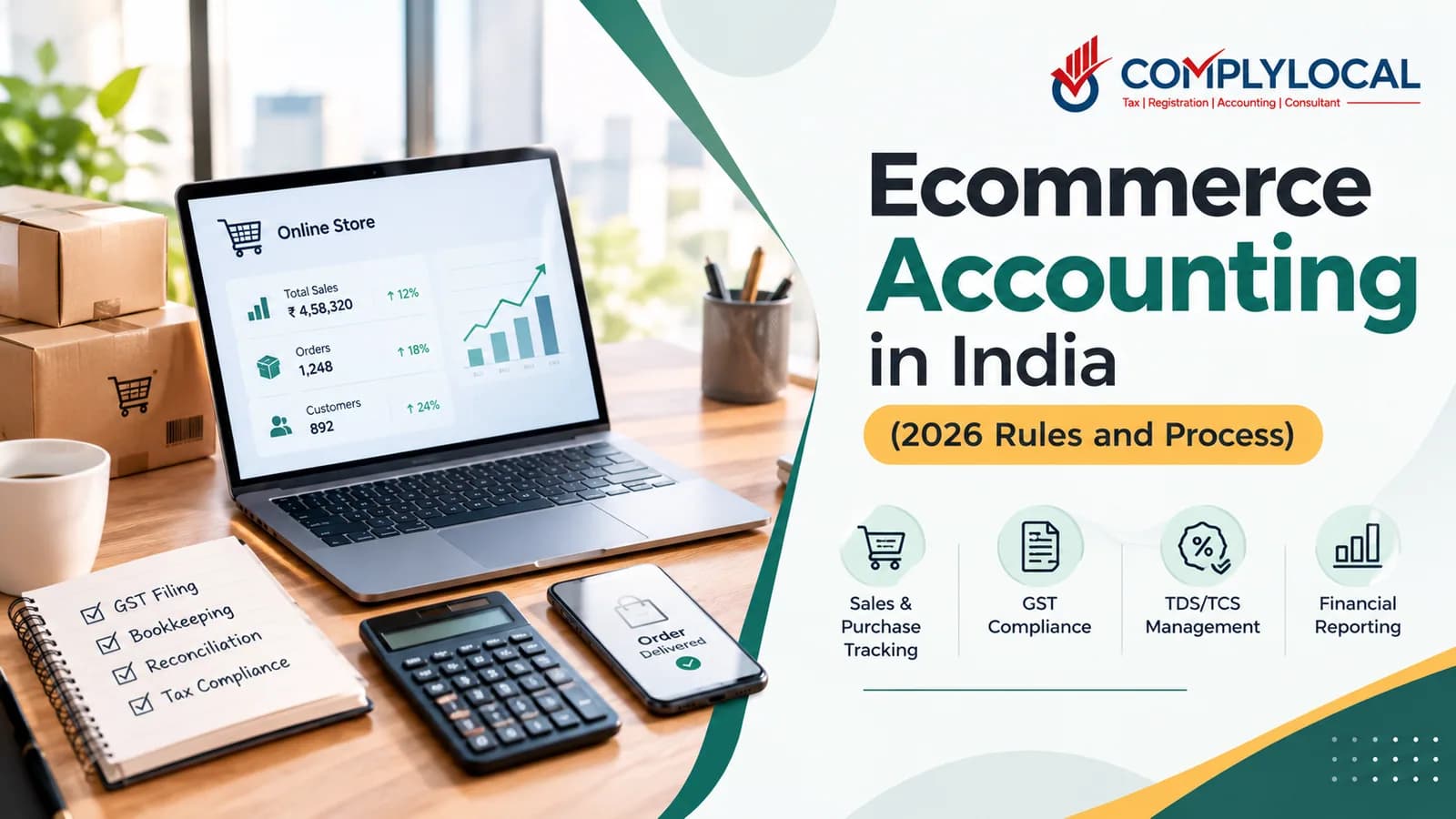
Ecommerce accounting records every marketplace sale at its gross invoice value, then books commission, fulfilment fees, returns, GST TCS and income-tax TDS as separate lines. Do it that way and your books tie to your GST returns and to your bank statement at the same time. Book the Amazon payout as your sale instead, and both reconciliations fail from the first month.
This guide covers the ledgers you need, the entries for one full order cycle, the records the law makes you keep, a twelve-step monthly close, and the change in the Income-tax Act, 2025 that pushes thin-margin sellers into a tax audit they never faced before.
What ecommerce accounting means in practice
Ecommerce accounting is ordinary double-entry bookkeeping applied to a transaction where the marketplace collects your money, deducts its charges, withholds two different taxes, and pays you the remainder two weeks later.
A shop books ₹1,180 of sale and receives ₹1,180. An Amazon seller books ₹1,180 of sale and receives about ₹985. The ₹195 difference is not a discount. It is four separate accounting events that happened inside someone else’s system.
It applies to you if you sell on Amazon, Flipkart, Meesho, Myntra or a quick-commerce platform, or run a D2C store on Shopify or WooCommerce with a payment gateway in between. Entity type does not change the bookkeeping. A proprietorship and a private limited company record the same order identically. What changes is the audit obligation and the return you file at the end of the year.
If you have not registered yet, read our guide to GST registration for online sellers first, because the accounting described below assumes a live GSTIN in every state where you hold stock.
Key facts for ecommerce sellers in 2026
Item | Current position | Source |
|---|---|---|
GST TCS on marketplace sales | 0.5% of net taxable supplies (0.25% CGST + 0.25% SGST, or 0.5% IGST) | Section 52(1), CGST Act; Notification No. 15/2024-Central Tax dated 10 July 2024 |
Income-tax TDS on ecommerce sales | 0.1% of the gross sale amount | Section 393(1), Table Sl. No. 8(v), Income-tax Act, 2025 (previously Section 194-O of the 1961 Act) |
Governing income-tax law | Income-tax Act, 2025 and Income-tax Rules, 2026, in force from 1 April 2026; “tax year” replaces “assessment year” | Income-tax Act, 2025 |
GST record retention | 72 months from the due date of the annual return | Section 36, CGST Act |
Tax audit threshold | ₹1 crore of turnover, raised to ₹10 crore where cash receipts and cash payments are each 5% or less | Section 63(1), Table Sl. No. 1, Income-tax Act, 2025 |
Tax audit report form | Form No. 26, which replaces Forms 3CA, 3CB and 3CD | Section 63 read with Rule 47, Income-tax Rules, 2026 |
GST annual return | GSTR-9 by 31 December following the financial year, so 31 December 2026 for FY 2025-26 | Section 44, CGST Act read with Rule 80, CGST Rules |
Input tax credit cut-off | 30 November following the financial year, or the date of the annual return, whichever is earlier | Section 16(4), CGST Act |
Hard stop on late returns | A GST return cannot be filed more than three years after its due date | Notification No. 28/2023-Central Tax dated 31 July 2023, enforced on the portal from the July 2025 tax period |
Why you cannot book a marketplace payout as your sale
Because the payout is what survives after the marketplace has deducted charges that are your expenses and taxes that are your assets. Booking the net figure understates turnover, deletes input tax credit you already paid for, and abandons tax credits sitting in your name on two different portals.
The table below traces one order. Figures are illustrative, built on GST at 18%, commission at 10%, a fulfilment fee of ₹60 plus GST, TCS at 0.5% of taxable value and TDS at 0.1% of gross value. Your commission rate depends on category.
Settlement line | Amount | Where it belongs in your books |
|---|---|---|
Gross invoice raised on the customer | ₹1,180.00 | Sales ₹1,000 and Output GST ₹180 |
Marketplace commission | ₹118.00 | Commission expense ₹100 and Input GST ₹18 |
Fulfilment and shipping fee | ₹70.80 | Logistics expense ₹60 and Input GST ₹10.80 |
GST TCS withheld | ₹5.00 | TCS receivable, an asset, never an expense |
Income-tax TDS withheld | ₹1.18 | TDS receivable, an asset, never an expense |
Amount credited to your bank | ₹985.02 | Bank |
Your turnover for the year is built from the ₹1,000 line. A seller doing ₹4 crore of gross sales who books payouts instead will declare roughly ₹3.3 crore, while the GSTR-8 statement the operator files under Section 52 reports the full figure to the department. That gap is what a system-generated notice is built from.
Rebuilding a year of books from settlement files is slow work. Where volumes are high across several platforms, treat marketplace reconciliation as a monthly discipline rather than a March project.
The chart of accounts an ecommerce business needs
A trading chart of accounts breaks the moment you sell online, because it carries one Sales head and one Bank head. Ecommerce needs a separate ledger for every deduction a marketplace is capable of making, created before your first import rather than after.
Under income, split sales by channel so that a Flipkart problem never hides inside an Amazon total. Keep sales returns as its own head, not as a negative sale.
Under direct expenses, the fee types that need their own ledger are commission, closing or fixed fee, pick and pack, shipping and weight handling, storage, long-term storage surcharge, sponsored advertising, and return or RTO shipping. Reimbursements for lost and damaged inventory sit here too, but as other income rather than a negative expense, because netting them off hides a warehouse problem you would otherwise notice.
Under current assets, you need four ledgers most sellers never create: TCS receivable under GST, TDS receivable under income tax, marketplace receivable for orders dispatched but not yet settled, and inventory held location-wise. The marketplace receivable ledger is the one that does the real work. It should empty itself every month, and any balance older than 30 days is a fee, a return or a lost shipment you have not recorded.
Accounting entries for a marketplace sale from order to settlement
Four entries cover one order cycle. Passing only the fourth is the single most common reason an ecommerce trial balance refuses to tie.
On dispatch, debit Marketplace receivable ₹1,180, credit Sales ₹1,000 and credit Output GST ₹180.
On the marketplace fee invoice, debit Commission ₹100, debit Logistics ₹60, debit Input GST ₹28.80, credit Marketplace receivable ₹188.80.
On withholding, debit TCS receivable ₹5.00, debit TDS receivable ₹1.18, credit Marketplace receivable ₹6.18.
On settlement, debit Bank ₹985.02 and credit Marketplace receivable ₹985.02.
The receivable closes to nil. A return reverses entry one through a credit note dated when the goods came back, not when the refund hit the customer’s card. Those two dates sit in different months often enough that a March return refunded in April will overstate your year-end turnover if you use the refund date.
Records you are required to keep, and for how long
GST requires accounts at every declared place of business, retained for 72 months from the due date of the annual return for that year (Section 36, CGST Act). Where an appeal or investigation is running, you keep them for one year after final disposal or 72 months, whichever ends later.
Income tax runs on a separate clock. Section 62 of the Income-tax Act, 2025 requires books once income from the business exceeds ₹1,20,000 or turnover exceeds ₹10 lakh in any one of the three years before the tax year. An individual or HUF gets higher limits of ₹2,50,000 and ₹25 lakh.
Record | Required by | Retention |
|---|---|---|
Invoice-wise outward supply register | Section 35(1), CGST Act read with Rule 56 | 72 months from annual return due date |
Purchase and inward supply register | Section 35(1), CGST Act read with Rule 56 | Same |
Stock account, goods-wise and location-wise | Rule 56(2), CGST Rules | Same |
Input tax credit availed and output tax paid | Section 35(1), CGST Act | Same |
Credit notes, debit notes, delivery challans, payment vouchers | Rule 56(1), CGST Rules | Same |
Cash book, ledgers, bills and vouchers | Section 62, Income-tax Act, 2025 | As prescribed by the Income-tax Rules, 2026 |
Marketplace settlement and tax reports | Evidence behind every entry above | Keep with the GST records |
Section 35(6) of the CGST Act is the provision that makes this expensive. Where goods are not accounted for, the proper officer may determine tax as though you had supplied them, with penalties under Sections 73 and 74 following. On the income-tax side, failure to keep books attracts ₹25,000 under Section 441 of the Income-tax Act, 2025.
Stock records across warehouses and fulfilment centres
Rule 56(2) of the CGST Rules requires every registered person other than a composition dealer to keep an account of goods received and supplied, and separately of goods lost, stolen, destroyed, written off or given away as free samples. The account is per place of business.
Inventory sitting in an Amazon fulfilment centre in Haryana is your stock, in Haryana, and your register must show it there. That is what the additional place of business on your registration certificate is for, which is why our note on VPOB and APOB belongs on a bookkeeper’s desk as much as a registration consultant’s.
Three practical rules follow. Reconcile the marketplace inventory ledger to your stock register every month, because adjustment entries made by the platform will not announce themselves. Record lost and damaged units as a write-off with the reimbursement as separate income, so that shrinkage stays visible. And never let stock exist in a state where you have no registration, because that is exactly the fact pattern Section 35(6) was written for.
How to close an ecommerce month in twelve steps
Download the settlement report for each marketplace for the full calendar month, not the payout cycle.
Download the tax or MTR report from each marketplace and total taxable value by state and by rate.
Post gross sales from the tax report, never from the settlement report.
Post sales returns and credit notes for the same calendar month.
Book each fee type from the settlement report to its own ledger.
Book the GST charged by the marketplace on its fees as input tax credit.
Action every invoice in the Invoice Management System before GSTR-2B is generated on the 14th.
Match input tax credit in your books against GSTR-2B and list every gap by supplier.
Accept the TCS credit on the GST portal and tie it to the TCS receivable ledger.
Reconcile TDS in Form 26AS and the Annual Information Statement to the TDS receivable ledger.
Clear the marketplace receivable ledger and investigate anything older than 30 days.
Close inventory location-wise and tie it to the marketplace stock ledger.
Step seven is the one that catches people. An invoice left unactioned in IMS is treated as accepted when GSTR-2B is generated, so a supplier’s ₹10 lakh typo becomes your input tax credit unless someone rejected it by the 14th. Since the July 2025 tax period the auto-populated liability in Table 3 of GSTR-3B has also been non-editable, which means corrections now have to go through GSTR-1A before you file. Fixing it in 3B is no longer an option.
TCS and TDS both hit your payout and neither is an expense
The marketplace deducts GST TCS at 0.5% and income-tax TDS at 0.1% from the same order. Both are advance payments of your own tax. Both belong in asset ledgers until you claim them.
GST TCS | Income-tax TDS | |
|---|---|---|
Rate | 0.5% of net taxable supplies | 0.1% of gross sale value |
Law | Section 52(1), CGST Act; rate set by Notification No. 15/2024-Central Tax dated 10 July 2024 | Section 393(1), Table Sl. No. 8(v), Income-tax Act, 2025 |
Operator’s filing | GSTR-8 by the 10th of the following month | Quarterly TDS statement, with a certificate to you |
Where you see the credit | “TDS and TCS Credit Received” on the GST portal | Form 26AS and the Annual Information Statement |
How you use it | Accept it, then set it off against GST payable in GSTR-3B | Set off against income tax payable, or claim as refund |
Net value for TCS means taxable supplies made through the operator during the month, reduced by supplies returned in the same month. Returns processed in a later month do not reduce the earlier month’s TCS, which is why the TCS receivable ledger and the settlement report drift apart in high-return categories like apparel.
One detail costs sellers real money. TCS does not reach your electronic cash ledger on its own. You have to accept it under “TDS and TCS Credit Received” on the portal. Sellers who never do that pay GST in cash every month while their own credit sits unclaimed on the same screen.
Why a low-margin seller can now be pushed into a tax audit
From tax year 2026-27, Section 63(1) of the Income-tax Act, 2025 makes a tax audit compulsory where an eligible business declares profit lower than the deemed rate in Section 58(2), whether or not it ever opted into presumptive taxation. Under the old Section 44AB that trigger fired only if you had opted in and then dropped out.
Section 58(2) sets the deemed rate at 8% of turnover, or 6% on receipts through prescribed banking and online modes, for a resident individual, HUF or firm other than an LLP. The turnover limit is ₹2 crore, rising to ₹3 crore where cash receipts do not exceed 5%.
Take an apparel seller with ₹1.6 crore of turnover, all of it digital, and net profit of ₹6 lakh. The ₹1 crore audit threshold does not catch them, because Section 63(1), Sl. No. 1(b) lifts it to ₹10 crore when cash receipts and cash payments are each 5% or less. But ₹6 lakh is 3.75% of turnover against a deemed 6%, or ₹9.6 lakh. Sl. No. 2 of the same table then makes the audit compulsory anyway.
That leaves two choices, and both cost something. Declare 6% and you pay tax on ₹3.6 lakh of income you did not earn. Declare the real 3.75% and you carry an audit, a Form No. 26, and a professional fee. Section 63(2) confirms the escape route: the section does not apply where you declare profits at the Section 58(2) rate. Run that arithmetic in January, not in September when the report is already late.
Two limits are worth knowing before you plan around this. Section 58 is not available to LLPs or companies, and it excludes agency business and income by way of commission or brokerage, so a seller of own goods is inside the scheme while a pure commission agent is not. Commentators also disagree on whether Sl. No. 2 bites where total income falls below the basic exemption limit. Ask your CA to take a written position on your numbers rather than assuming last year’s treatment carries forward.
Setting up ecommerce accounting in Tally or a cloud tool
The software matters less than the import mapping. Tally, Zoho Books and QuickBooks all handle ecommerce correctly once you accept that two different files feed the books: gross sales come from the marketplace tax report, and fees come from the settlement report.
Create every fee ledger before the first import, because retrofitting them across 4,000 vouchers is worse than the original setup. In Tally, keep each state GSTIN as its own company or branch, since a single consolidated company makes state-wise GSTR-1 reconciliation almost impossible to audit later. Map each marketplace to its own sales ledger at the same time.
Two habits keep the file clean after that. Never import a settlement CSV as a sales voucher, however convenient the column headers look. And archive the raw report files alongside the books, because they are the evidence behind every entry and they fall inside the same 72-month retention as the ledgers themselves.
The compliance calendar an ecommerce seller works to
Filing | Due date | Applies to |
|---|---|---|
GSTR-1 | 11th of the following month | Monthly filers |
IMS action on inward invoices | Before GSTR-2B is generated on the 14th | Everyone claiming input tax credit |
GSTR-3B | 20th of the following month | Monthly filers |
GSTR-1 and GSTR-3B under QRMP | Quarterly, with tax paid monthly through PMT-06 | Turnover up to ₹5 crore opting into QRMP |
Input tax credit cut-off | 30 November following the financial year, or the annual return date, whichever is earlier | Everyone, under Section 16(4) |
GSTR-9 | 31 December following the financial year | Aggregate turnover above ₹2 crore |
GSTR-9C | Same date as GSTR-9, self-certified | Aggregate turnover above ₹5 crore, under Rule 80(3) |
Form No. 26 tax audit report | One month before the income tax return due date | Businesses covered by Section 63 |
The ₹2 crore exemption from GSTR-9 is notified by CBIC each year and was notified for FY 2024-25 by Notification No. 15/2025-Central Tax. Confirm the notification for FY 2025-26 before you decide to skip the annual return.
What late filing costs
Default | Consequence |
|---|---|
GSTR-9 filed late, turnover up to ₹5 crore | ₹50 per day, capped at 0.04% of turnover in the state (Notification No. 07/2023-Central Tax dated 31 March 2023) |
GSTR-9 filed late, turnover ₹5 crore to ₹20 crore | ₹100 per day, same cap |
GSTR-9 filed late, turnover above ₹20 crore | ₹200 per day, capped at 0.5% of turnover in the state |
GST paid late | Interest at 18% per annum, Section 50, CGST Act |
Return more than three years past its due date | Cannot be filed at all, Notification No. 28/2023-Central Tax dated 31 July 2023 |
Goods not accounted for | Officer may demand tax as if supplied, with Sections 73 and 74 penalties, under Section 35(6), CGST Act |
Books not maintained | ₹25,000 under Section 441, Income-tax Act, 2025 |
Where ecommerce books break most often
Payouts booked as sales is the first and largest failure, and it is usually invisible until a GSTR-8 mismatch notice arrives two years later.
After that, the recurring problems are narrower. Returns get recognised on the refund date instead of the return date, which inflates March turnover every year. TCS and TDS get posted to expense heads, which understates profit and quietly abandons credit. Advertising spend gets netted inside the settlement file rather than booked, so the seller genuinely does not know what customer acquisition costs. Reimbursements for lost inventory get treated as negative expenses, hiding warehouse shrinkage. Stock in a second state never reaches the location-wise register. And input tax credit on commission gets claimed from the marketplace invoice without anyone checking that it appears in GSTR-2B.
[EXPERT INPUT NEEDED: one real anonymised client scenario from Simran Malhotra. Ideal shape: a seller who came to Complylocal with books built from payout figures, what the turnover gap turned out to be, how many months it took to rebuild from settlement reports, and what it cost them in unclaimed TCS or input tax credit. One specific number makes this section the reason the article gets cited.]
Need help rebuilding marketplace books? Talk to Simran’s team at Complylocal Consultants about ecommerce accounting and bookkeeping services.