
Written by Keshav Sehgal, E-commerce Filing Expert · Reviewed by Ankush Goyal, GST Services Expert · Last updated: 31 August 2026
Every GST registration needs four things regardless of who is applying: PAN, proof of the applicant’s identity, proof of the principal place of business, and proof of the entity’s constitution. Everything else on the checklist depends on whether you are a proprietor, a firm or a company, and on whether you own your premises.
Key facts on GST registration documents
Item | Position as on 31 August 2026 |
|---|---|
Application form | FORM GST REG-01, filed under Rule 8 of the CGST Rules, 2017 |
PAN | Mandatory for every applicant except a non-resident taxable person |
Aadhaar authentication | OTP based, and biometric in flagged cases under Rule 8(4A) |
Bank account proof | Not needed at application. Due under Rule 10A within 30 days of registration or before the first GSTR-1, whichever is earlier |
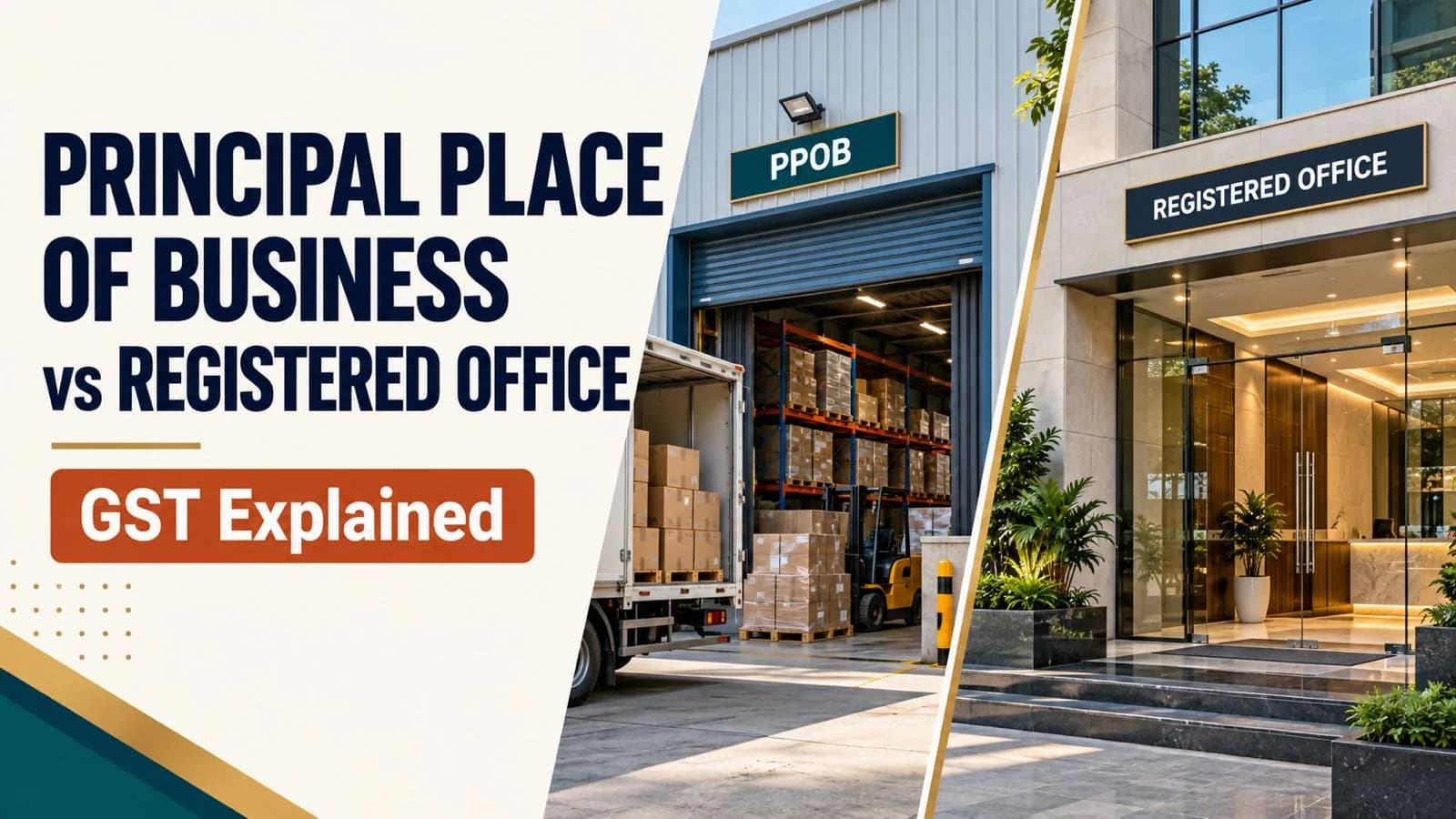
Address proof | Required for the principal place of business and every additional place |
Government fee | Nil |
Upload formats | PDF or JPEG. [VERIFY: current per-field size limits on the portal before publishing] |
What documents are required for GST registration?
The core set below applies to every applicant. Entity-specific papers sit on top of it.
PAN of the business or of the proprietor, validated online against the CBDT database under Rule 8(2).
Aadhaar of the primary authorised signatory and at least one promoter or partner, linked to a mobile number you can access.
Passport-size photograph of every promoter, partner or director listed in the application.
Proof of constitution: partnership deed, certificate of incorporation, trust deed, or registration certificate as applicable.
Proof of principal place of business, matched to the address you type into Part B.
Authorisation letter or board resolution appointing the authorised signatory.
Digital signature certificate, for companies and LLPs only.
Nothing here costs money to obtain from the department, and the application itself carries no charge. Our breakdown of GST registration fees explains where the real costs sit.
Proof of principal place of business, and why it fails most often
Address proof is the single most rejected document in a GST application, because the portal accepts the upload and the officer rejects the substance. What matters is that the name on the proof, the name on the application, and the name on the ownership trail line up.
Your situation | What to upload | The trap |
|---|---|---|
You own the premises | Latest electricity bill, municipal khata, or property tax receipt | Bill is in a parent or spouse’s name |
You rent the premises | Rent agreement plus the owner’s latest electricity bill | Agreement expired, or address written differently from the bill |
Premises belong to a relative or partner | Consent letter plus the owner’s address proof | No consent letter uploaded at all |
Shared or coworking desk | Agreement from the operator plus their address proof | Operator will not give a bill in your name |
Registered office of a company | Same proofs, matched to the MCA record | MCA address differs from the GST address |
Where the premises are not in your name, a consent letter is not optional. Our note on the consent letter for GST registration carries the wording and the notarisation rules.
Documents for a proprietorship
A proprietorship files against the individual’s PAN, because the firm has no separate PAN of its own. That single fact removes half the paperwork other entities carry.
PAN and Aadhaar of the proprietor, both in the same name spelling.
Passport-size photograph of the proprietor.
Address proof of the principal place of business, with a consent letter if the premises are not in the proprietor’s name.
Bank account proof, due under Rule 10A after registration rather than with the application.
No constitution document is required. There is no deed, no incorporation certificate, and no board resolution, because the proprietor and the business are the same person in law.
Documents for a partnership firm and an LLP
Both file against the firm’s own PAN and both need a document that proves who is authorised to act. The difference is the signing method: a partnership can use EVC, an LLP must use a Class 3 digital signature.
PAN of the firm or LLP.
Partnership deed, or the LLP agreement together with the certificate of incorporation issued by the MCA.
PAN, Aadhaar and photograph of every partner or designated partner listed.
Letter of authorisation signed by the partners appointing one of them as authorised signatory.
Address proof of the principal place of business.
Class 3 digital signature of a designated partner, for LLPs.
Documents for a private limited company and an OPC
A company needs the most paperwork and the least room for improvisation, because every detail is cross-checked against the MCA record. A mismatch between the registered office on the incorporation certificate and the address on REG-01 draws a query almost every time.
PAN of the company and its certificate of incorporation.
Memorandum and articles of association.
PAN, Aadhaar and photograph of every director named in the application.
Board resolution or authorisation letter appointing the authorised signatory, on company letterhead.
Address proof of the registered office, matched to the MCA filing.
Class 3 digital signature of the authorised director, which is mandatory and cannot be replaced by OTP.
Documents for a trust, society, club or HUF
These entities are handled less often, so applications from them tend to sit longer with the officer. Give the constitution document extra attention.
Entity | Constitution proof | Authorised signatory proof |
|---|---|---|
Trust | Registered trust deed | Resolution of trustees |
Society or club | Registration certificate and bye-laws | Managing committee resolution |
HUF | PAN of the HUF | Karta’s PAN, Aadhaar and photograph |
Government department | Notification or order constituting it | Order appointing the drawing and disbursing officer |
Bank account proof and the Rule 10A deadline people miss
You do not need a bank account to apply for GST registration. Under Rule 10A of the CGST Rules, 2017, bank account details must be furnished within thirty days from the date of grant of registration, or before filing the first FORM GSTR-1, whichever comes earlier.
That ordering matters for new businesses. Open the current account after the GSTIN arrives, using the registration certificate as proof, then update the portal. What is accepted is the first page of the passbook, a bank statement, or a cancelled cheque carrying the account holder’s name, account number and IFSC.
Miss the Rule 10A window and the registration can be suspended, which is a far harder problem to unwind than a GST amendment filed on time.
Documents for an additional place of business
Every warehouse, branch or storage point you operate in the same state has to be declared as an additional place of business, and each one needs its own address proof of the same standard as the principal place. Marketplace sellers storing stock in another state need a separate registration there, not an additional place, which is where a virtual place of business comes in.
The distinction trips up almost every new seller. Our explainer on VPOB, PPOB and APOB sets out which one applies to which situation.
File format rules that cause silent rejections
The portal enforces upload limits per field, and an oversized or wrongly formatted file is the most avoidable reason an application stalls. Photographs go up as JPEG. Most other proofs go up as PDF or JPEG.
[VERIFY: confirm the current per-field size limits on the GST portal before publishing exact KB figures. These have changed more than once.]
Scan documents rather than photographing them; a tilted phone photo of a rent agreement reads as tampering to a reviewing officer.
Upload the full document, not the first page alone, when the address appears on a later page.
Keep the name spelling identical across PAN, Aadhaar and the application, including initials and middle names.
Use an electricity bill dated within the last two months where the state discom issues them monthly.
Where document files actually get rejected
Rejections cluster around identity mismatches and address proofs that do not connect to the applicant. An officer who cannot draw a straight line from the applicant to the premises raises a query in FORM GST REG-03, and the reply in FORM GST REG-04 is due within seven working days.
[EXPERT INPUT NEEDED: Keshav - the two most common document rejections we saw in the last quarter, with the entity type, the exact mismatch, and what we now change in the file before submitting.]
Want the document set reviewed before you file, rather than after a query lands? Talk to Keshav’s team at Complylocal about GST registration services.