
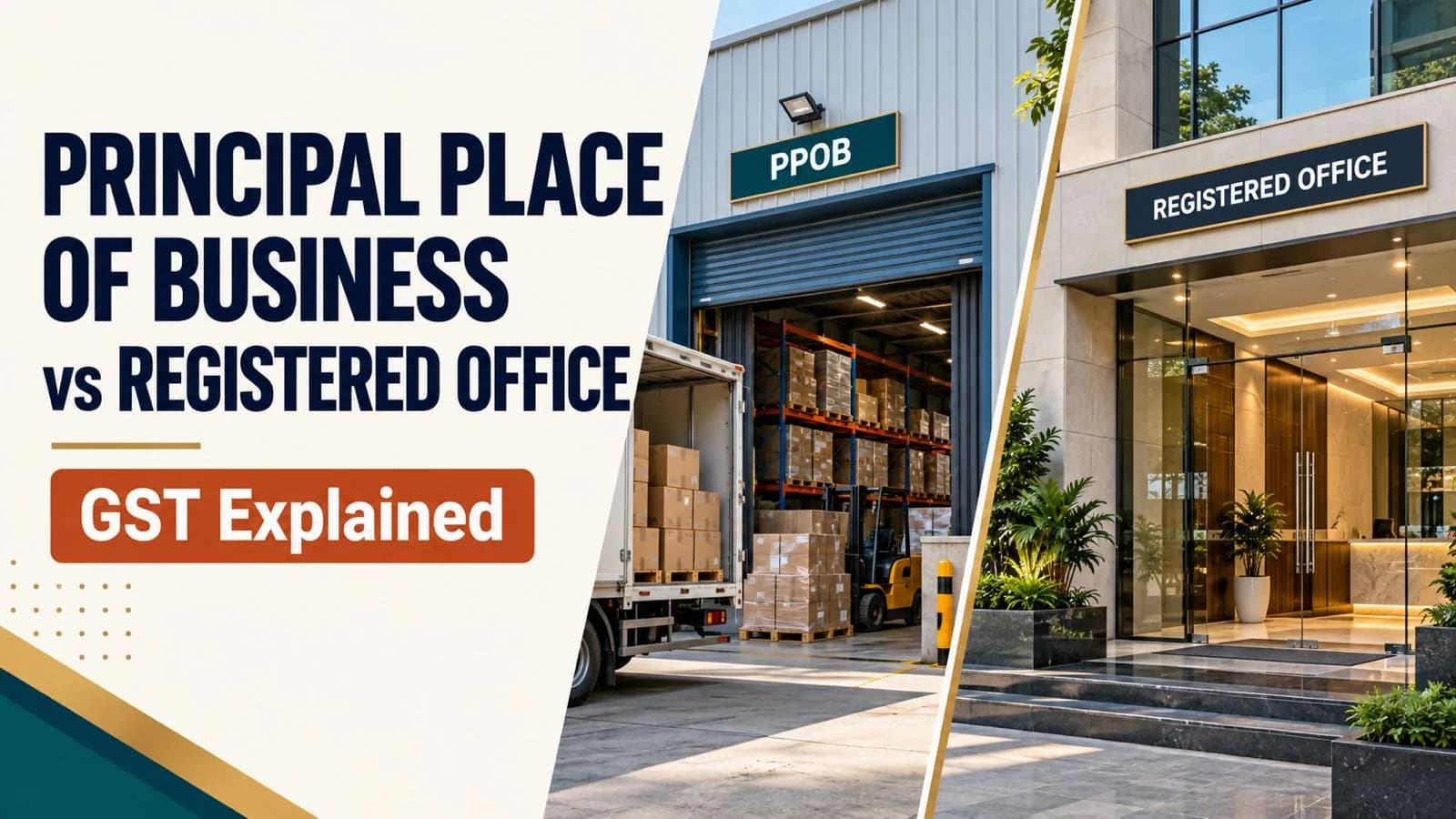
A company's registered office and its GST principal place of business (PPOB) are two different legal addresses that can, but need not, be the same. The registered office is where the company receives official communication under Section 12 of the Companies Act, 2013. The PPOB is the place of business shown as principal on your GST registration certificate under Section 2(89) of the CGST Act, which must be a place where business is actually carried on in that state.
The confusion costs founders time in both directions. Some declare a registered office at their CA's address as their GST PPOB, though no business happens there. Others assume that moving the registered office automatically updates GST.
Neither is right. Here is how the two addresses relate and what to file when one of them changes.
Key facts at a glance
Point | Registered office | GST principal place of business |
|---|---|---|
Law | Section 12, Companies Act, 2013 | Sections 2(85) and 2(89), CGST Act, 2017 |
Purpose | Receiving communications and notices for the company | The main place in a state from which business is carried on |
How many? | One per company | One per GSTIN, so one per state you are registered in |
Must business happen there? | No; it must be able to receive and acknowledge communications | Yes; Section 2(85) ties a place of business to actual activity or records |
Change filed with | Registrar of Companies, Form INC-22, within 30 days | GST officer, FORM GST REG-14 core field amendment, within 15 days |
What a registered office is
Every company must have a registered office capable of receiving and acknowledging all communications and notices. Under Section 12(2) of the Companies Act, the company furnishes verification of it to the Registrar within 30 days of incorporation.
When the registered office changes, Section 12(4) requires notice to the Registrar within 30 days of the change. That period was 15 days until the Companies (Amendment) Act, 2017 extended it, with effect from 27 July 2018.
Nothing in Section 12 requires the company to trade, store goods or keep staff at the registered office. A small company can have it at a director's home or a professional's office.
What a principal place of business is under GST
Section 2(89) of the CGST Act defines the principal place of business as the place specified as such in the certificate of registration. Section 2(85) explains what a place of business is: a place from where business is ordinarily carried on, including a place where goods are stored or books of account are kept.
So your PPOB is not a mailing address. It is the place an officer can visit and find your business, your goods or your books. Under Section 35(1), your books of account must be kept at the principal place of business named in the certificate.
When the two should be the same address
Use one address for both when the company actually works from its registered office. That is the common case for a small private limited company operating from one office.
Declaring the same premises in both places keeps your records consistent across MCA and GST. The possession documents still have to satisfy GST on their own terms. Your certificate of incorporation is proof of constitution in FORM GST REG-01, not proof of possession of premises.
Under para 6A of CBIC Instruction No. 03/2025-GST dated 17 April 2025, the PPOB needs documents that match the nature of possession: an ownership document for owned premises, a rent agreement with the owner's documents for rented premises, or a consent letter with the owner's ID and one ownership document for consented premises.
When they should be different
Keep them separate when the registered office is only an address for communications. The most common examples are a registered office at a director's flat, a family property or a professional's office, while operations run from a rented unit elsewhere.
Situation | Registered office | GST PPOB |
|---|---|---|
Company works from one rented office | That office | Same office |
Registered office at a director's home; operations from a rented godown in the same state | Director's home | The godown |
Registered office in Delhi; all operations in Haryana | Delhi address | Haryana premises, under a Haryana GSTIN |
Registered office in Delhi; operations in Delhi and Haryana | Delhi address | One PPOB under the Delhi GSTIN and one under the Haryana GSTIN |
Our position: never declare an address as your GST PPOB just because it is the registered office. If no business is carried on there and no books are kept there, it does not meet Section 2(85). Rule 21(a) of the CGST Rules lists not conducting business from the declared place of business as a ground for cancelling registration.
The registered office also does not decide which state you register in for GST. A company with its registered office in Delhi but all operations in Haryana registers in Haryana. It needs a Delhi GSTIN only if it becomes liable to register there, for example by supplying from Delhi.
What to file when either address changes
What changed | MCA filing | GST filing |
|---|---|---|
Registered office moves; it was also the PPOB | INC-22 within 30 days, plus the approvals the move needs | REG-14 core field amendment for the PPOB within 15 days |
Registered office moves; it was not a place of business | INC-22 within 30 days | None for the address, because no GST particular changed |
PPOB moves within the state; registered office unchanged | None | REG-14 core field amendment within 15 days |
Operations move to another state | INC-22 only if the registered office also moves | Fresh registration in the new state; cancel the old GSTIN if no business remains there |
Note the different clocks: 30 days for INC-22 and 15 days for REG-14. If one move triggers both filings, file the GST amendment first because its deadline is shorter. Moving the registered office outside the local limits of a city, town or village also needs a special resolution under Section 12(5), and moving it between Registrars within the same state needs Regional Director confirmation.
Our guide to changing the principal place of business covers the GST side in detail, including what the officer checks.
Unsure which address to declare as your principal place of business? Talk to Keshav's team about principal place of business documentation that matches where your company actually works.
For the company law side of a move, see our registered office change service.
Your next step: compare the address on your certificate of incorporation with the PPOB on your GST certificate, and check that business is actually carried on at the PPOB today.