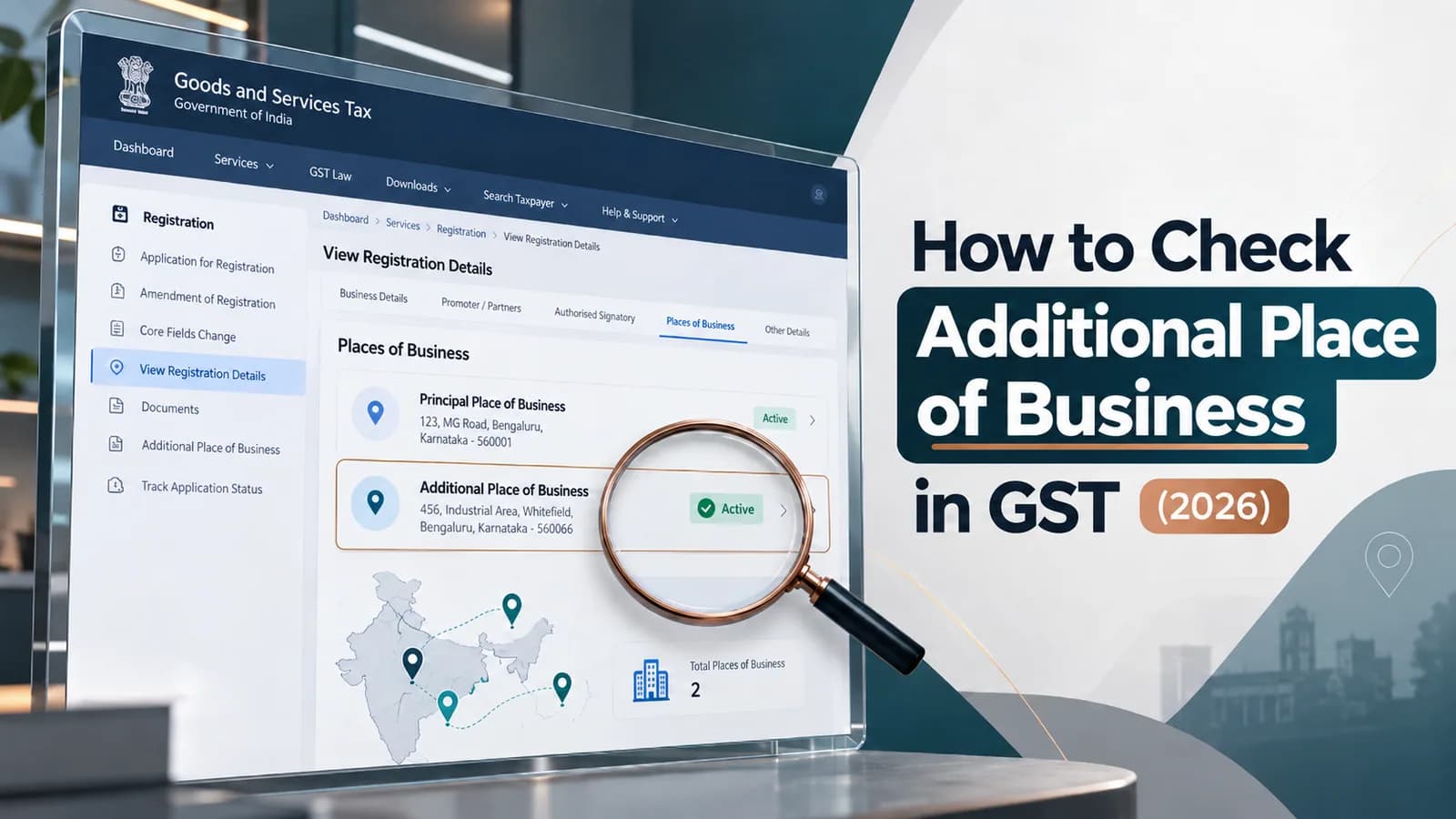

Every registered business eventually moves. The office shifts to a bigger floor, the godown lease ends, or a home-based operation finally takes commercial premises. The moment that happens, the address printed on your GST registration certificate is out of date — and GST law gives you fifteen days to correct it.
Changing the principal place of business sounds like a form-filling job. In practice it is where a lot of otherwise-compliant businesses come unstuck. They file the wrong type of amendment, upload documents whose address does not match what they typed, enter today's date instead of the date they actually moved, or try to shift the principal place of business to another State — which the portal will simply not permit.
This guide walks through a change of principal place of business under GST the way we handle it at ComplyLocal Consultants: the rule that governs it, the document set that is genuinely sufficient, the portal steps, what happens after you submit, and the escalation route CBIC created in 2025 for when an officer raises a query he should not have raised.
Section 2(89) of the CGST Act defines the principal place of business as the place of business specified as the principal place of business in the certificate of registration. That definition is narrower than most people assume. It is not "head office" in any commercial sense, and it is not wherever the owner happens to sit. It is whatever address occupies that field on your REG-06.
Sitting underneath it is section 2(85), which defines place of business inclusively: a place from where business is ordinarily carried on, including a warehouse or godown or any other place where a taxable person stores goods or provides or receives goods or services; a place where the taxable person maintains his books of account; and a place where business is carried on through an agent. Any of those limbs can make an address a place of business.
Situations that are a principal place of business change
You shift your office, shop, factory or godown to a new address within the same State.
The address on the certificate is wrong or incomplete — a missing floor or unit number, a wrong PIN code, a misspelt locality.
You close the premises currently declared as the principal place of business and start operating primarily from an existing additional place of business.
You move from a residential address to commercial premises, or the reverse.
Situations that are not a principal place of business change
You open a second premises and keep the first. That is an addition to the additional place of business record, not a change of the principal one. The procedure for adding an additional place of business on the portal is a different tab in the same amendment application.
You move to another State. This is not an amendment at all — see the dedicated section below.
Your mobile number, email or authorised signatory contact details change. Those are non-core fields.
The landlord at the same address changes, or the lease is renewed in the same premises. The address has not changed, but your possession documents have — keep the fresh set on file, because it is what you will be asked for at any future verification.
Can you change the principal place of business in GST?
Yes. Rule 19 of the CGST Rules, 2017 allows a registered person to apply for amendment of any particular furnished in the registration application. A change of address of the principal place of business is a core field amendment, which means it does not take effect on submission — a proper officer has to approve it.
The GST portal's own guidance on amendment of registration lists the core fields as follows.
Core fields (officer approval required) | Non-core fields (auto-approved on submission) |
|---|---|
Legal name of the business | Most other registration particulars |
Principal Place of Business (other than change in State) | Details of the authorised signatory's contact information, subject to online verification |
Additional Place of Business (other than change in State) | Bank account details |
Addition, deletion or retirement of partners, directors, Karta, Managing Committee, Board of Trustees, Chief Executive Officer or equivalent responsible for day-to-day affairs | Other particulars not listed as core |
Read the second row carefully. The parenthesis — "other than change in State" — is doing a great deal of work, and it is the reason a very common request cannot be granted. More on that shortly.
The practical consequence of being a core field is that your new address does not go live the moment you hit submit. You receive an ARN, the application sits with the officer, and only when it is approved does an updated REG-06 become available.
Rule 19 and the timelines that actually matter
Two numbers get mixed up constantly. You have fifteen days to file. The officer has fifteen working days to decide. They are different clocks, and only the first one is yours to control.
Stage | Position under Rule 19 |
|---|---|
Filing the amendment | Within fifteen days of the change, in FORM GST REG-14, along with the documents relating to the change |
Officer's decision | Approve the amendment within fifteen working days of receipt of the application, by an order in FORM GST REG-15 |
If the officer is not satisfied | Notice in FORM GST REG-03 within fifteen working days, requiring you to show cause why the application should not be rejected |
Your reply | FORM GST REG-04, within seven working days of service of the notice |
Rejection | Order in FORM GST REG-05, for reasons recorded in writing |
Officer takes no action | The certificate stands amended to the extent applied for, and the amended certificate is made available on the portal |
Effective date of the change | From the date of occurrence of the event warranting the amendment |
That last row is worth pausing on, because it is genuinely useful and almost nobody explains it. The amendment relates back to the date you actually moved, not the date the officer signed off. If you shifted premises on 3 March and approval lands on 2 April, the certificate reflects 3 March. Which is also why filing late is awkward: you are effectively asking the department to record a change you sat on for weeks.
What happens if you miss the fifteen days
There is no penalty provision written specifically for a late amendment of the principal place of business. Section 125 provides a general penalty of up to twenty-five thousand rupees where no separate penalty is prescribed, and that is the provision usually cited.
The fine is not the real exposure. Section 29 read with Rule 21 allows cancellation of registration where a registered person does not conduct any business from the declared place of business. If you have vacated the declared address and carried on billing from somewhere else without updating the certificate, that is precisely the fact pattern those provisions describe. A suspension or cancellation costs far more than twenty-five thousand rupees.
Documents required to change the principal place of business
What you upload depends on how you hold the new premises. The clearest statement of what is sufficient comes from CBIC Instruction No. 03/2025-GST dated 17 April 2025 (F. No. CBIC-20016/24/2025-GST), which superseded Instruction No. 03/2023-GST. It was issued because officers were routinely demanding documents outside the indicative list in FORM GST REG-01 and rejecting applications on presumptive grounds.
A scoping point, stated plainly because it matters: that Instruction is addressed to the processing of applications for GST registration, not amendments. But the possession documents you upload for a principal place of business amendment come from the same indicative REG-01 list, and REG-03, REG-04 and REG-05 are common forms used for registration and amendment alike — FORM GST REG-03 is titled as a notice seeking information relating to an application for registration, amendment, cancellation or withdrawal. So the Instruction is the correct benchmark for what should be enough, and it is worth citing if you are asked for more.
How you hold the new premises | What the Instruction treats as sufficient | What should not be demanded |
|---|---|---|
Owned | Any ONE of: latest property tax receipt, municipal khata copy, electricity bill, water bill, or a similar document prescribed under State or local law | Additional ownership documents; original physical copies |
Rented or leased, agreement registered | Registered rent or lease agreement, plus any ONE ownership document of the lessor | Identity proof of the lessor |
Rented or leased, agreement unregistered | Agreement, plus any ONE ownership document of the lessor, plus a copy of the lessor's identity proof | The lessor's PAN or Aadhaar; a photograph of the lessor in front of or inside the property |
Electricity or water connection already in your own name | That utility document, together with the rent agreement | Any further lessor documents at all |
Consent premises (spouse, relative, group entity) | Consent letter on plain paper, plus identity proof of the consenter, plus any ONE ownership document of the consenter | Additional documents from the applicant |
Shared premises, agreement available | Agreement plus any ONE ownership document; add the lessor's ID only where the agreement is unregistered | Lessor ID where the agreement is registered |
Shared premises, no agreement | Consent letter on plain paper, plus the consenter's ID, plus any ONE ownership document of the consenter | Additional documents |
Rented, but the agreement is genuinely unavailable | Affidavit on non-judicial stamp paper of minimum value, sworn before a First-Class Judicial Magistrate, Executive Magistrate or Notary Public, plus a possession document such as an electricity bill in your own name | — |
SEZ unit or developer | Government of India issued SEZ documents or certificates | — |
Queries an officer is not supposed to raise
Paragraph 7 of the Instruction lists presumptive queries officers must not raise. Three of them turn up regularly on address changes:
That the residential address of the applicant, Managing Director or authorised signatory is not in the same city or State where registration is sought.
That the HSN code of the goods mentioned is banned or prohibited for sale in that State.
That the kind of activity mentioned in the application cannot be conducted from those particular premises.
The third is the one that ambushes a principal place of business change. A trading business that moves into a modest commercial office gets asked how it can possibly "trade" from a room that size. Under paragraph 7, that is a presumptive query rather than a proper one. Say so in the reply, courteously, and cite the Instruction by number and date.
How to change the principal place of business in the GST portal
Assemble the document set before you log in, not while the application is open. Half the failures in this process are created in the ten minutes before filing.
Normalise the address string. Decide the exact wording — including floor, unit or shop number, locality and PIN — and make the rent agreement, the utility bill and what you are about to type all say the same thing.
Log in at gst.gov.in using your GSTIN credentials.
Go to Services, then Registration, then Amendment of Registration Core Fields.
Open the Principal Place of Business tab and click EDIT.
Enter the new address. Where the portal offers map-based or geocoded address selection, use it rather than typing freehand — the portal will flag where the locality or sub-locality does not sit inside the PIN code you entered.
Select the nature of possession that matches the documents you are about to upload — Own, Leased, Rented, Consent or Shared. A mismatch between this dropdown and the uploaded file is one of the most common reasons for a notice.
Confirm the nature of business activity at the new premises, and answer it truthfully. If no goods are stored there, do not tick warehouse; if it is where your books sit, say so.
Upload the documents in PDF or JPEG within the portal's prevailing size limits. Check the current limits on the portal at the time of filing rather than relying on a number from a blog, including this one — they have changed before.
Enter the reason for amendment and the date of amendment. The date of amendment is the date you actually shifted, not the date you are filing. This is what drives the effective date under Rule 19.
On the Verification tab, tick the declaration, select the authorised signatory, enter the place, and submit using DSC, e-Sign or EVC. Note the ARN.
Track it under Services, then Registration, then Track Application Status.
One sequencing tip. If you also need to add or delete an additional place of business, both tabs sit inside the same core-field amendment. Do it in one application. A pending core amendment ARN blocks the next one, so filing two back to back means waiting out the first before the second can even be submitted. The document checklist for an additional place of business is largely the same possession-document set.
The address string is where most rejections start
The single most common trigger for a REG-03 on an address amendment is three versions of the same address disagreeing with each other. It looks trivial on screen and is fatal on the file.
Where the address appears | What it says |
|---|---|
Rent agreement | Unit 4B, 2nd Floor, Sunrise Arcade, MG Road, Indiranagar — 560038 |
Electricity bill | Shop 402, Sunrise Arcade, MG Road, Bengaluru — 560038 |
What was typed in REG-14 | 402, Sunrise Complex, M.G. Road, Indiranagar, Bengaluru — 560038 |
Three documents, three buildings, as far as a verifying officer is concerned. Copy and paste; never retype. Where the documents genuinely disagree — and with older utility bills they often do — get the landlord to issue a short clarifying letter confirming that the unit described in the agreement is the same premises as the one on the bill, and upload it with the application rather than after a notice arrives.
After you submit: approval, notice or rejection
Three things can happen. The officer approves, and an order in FORM GST REG-15 is issued with an amended registration certificate made available on the portal. Or a notice in FORM GST REG-03 is issued, to which you reply in FORM GST REG-04 within seven working days. Or, if no reply is filed or the reply does not satisfy him, the application is rejected in FORM GST REG-05 with reasons recorded in writing.
There is no separate document to collect on approval. Log in and download the fresh REG-06 — the amended address will appear on it, and that certificate is what your marketplace, your bank and any customer asking for proof will want.
Physical verification can be triggered again
People assume verification is a one-time event at first registration. It is not. Under Rule 25, the proper officer may get physical verification of the business premises done where he considers it necessary, and the verification report along with other documents including photographs is uploaded in FORM GST REG-30. Instruction 03/2025-GST records that where verification is carried out, the officer must give a specific report on the existence or non-existence of the premises, record the efforts made to locate it if it is not found, and upload a GPS-enabled site photograph. If you want the detail, we have covered how physical verification and biometric authentication work separately.
What that means in practice for a change of address is simple and physical. Put the name board up at the new premises before you file, showing the entity name and the GSTIN. Rule 18 requires the registration certificate to be displayed at a prominent location at the principal place of business and the GSTIN to be displayed on the name board at the entry, at every place of business — so this is a standing obligation, not a trick for passing an inspection.
One honest wrinkle: during the pendency period your REG-06 still shows the old address. Keep the ARN acknowledgement printed and available at the new premises alongside the certificate, so anyone who visits can see immediately that an amendment is on file rather than concluding the business is operating from an undeclared location.
If the officer raises an improper query or rejects the application wrongly
This is the part almost no guide mentions, and it is the most useful thing in this article.
CBIC Instruction No. 04/2025-GST dated 2 May 2025 created a formal grievance redressal mechanism. It provides that an applicant whose Application Reference Number has been assigned to Central jurisdiction, and who has a grievance in respect of any query raised in contravention of Instruction No. 03/2025-GST or regarding the grounds of rejection of the application, may approach the jurisdictional Zonal Principal Chief Commissioner or Chief Commissioner.
How it is meant to work:
Each CGST Zone publicises an email address on which applicants can raise grievances, with wide publicity given to it.
You send the grievance containing your ARN details, jurisdiction details (Centre or State) and the issue in brief.
Where the grievance pertains to State jurisdiction, that office forwards it to the concerned State jurisdiction with a copy endorsed to the GST Council Secretariat.
The Zone is to ensure timely resolution and inform the applicant. Where the officer's query is found to be proper, the applicant is advised accordingly — so this is not a route to overturn a fair query.
A monthly report on the status of grievance redressal goes to the Directorate General of Goods and Services Tax.
Two caveats, stated honestly. The mechanism is written for ARNs in Central jurisdiction; the GST Council Secretariat was asked to circulate it to States with a request that they consider creating something similar, so the position on the State side varies and you should check your own State's practice. And it is an escalation route, not an appeal — it does not stop the clock. File your REG-04 within the seven working days regardless, and escalate in parallel.
Use it before you assume a rejection is final and start over with a fresh application. A fresh application repeats the same document set in front of the same office, and often collects the same query.
Moving to another State is not an amendment
Look again at the core-field list: "Principal Place of Business (other than change in State)". A change of State is expressly carved out of what the amendment route can do.
The reason is structural rather than procedural. Registration under section 25(1) is State-wise: a person liable to be registered in more than one State takes a separate registration in each, and there is no pan-India GSTIN. The first two characters of a GSTIN are the State code. Change the State and you are not editing a registration, you are asking for a different one.
So the sequence is:
Apply for a fresh registration in the new State in FORM GST REG-01, with a principal place of business address in that State.
Run both registrations during any overlap period in which you are genuinely making supplies from both States.
Apply for cancellation of the old State's registration once operations there have stopped, dealing with stock in hand and input tax credit as required.
What if the stock moves but the office does not
This is the question that generates the most confusion, and there is now a departmental clarification directly on it.
CBIC letter F. No. CBIC-20016/75/2025-GST/1025 dated 25 September 2025 dealt with a business whose principal place of business was in Delhi, storing goods in third-party-operated cold storage facilities in Haryana and supplying from there. The department's stated position:
Under section 22, every person making taxable supplies from a State is liable to be registered in that State once aggregate turnover exceeds the threshold. "Place of business" under section 2(85) includes warehouses and storage facilities. Where goods are stored in Haryana and dispatched to customers from those facilities, the warehouse functions as a place of business for making outward taxable supplies, and the fact that the cold storage is operated by a third party does not alter the position. Registration in Haryana is required.
Under section 25(4), establishments of a person in different States are distinct persons. Moving goods from the Delhi godown to the Haryana facility is therefore a supply, to be accompanied by a valid tax invoice and e-way bill with GST discharged appropriately.
Where goods are supplied from the Haryana warehouse to customers within Haryana, the supply is intra-State and attracts Haryana CGST and SGST, the place of supply being determined under section 10(1)(a) of the IGST Act as the location where the movement terminates for delivery.
Under section 35 read with Rule 56, proper records must be maintained at each place of business, including stock registers and records of inward and outward supplies.
Scope that correctly when you rely on it. This is a departmental clarification issued in response to a specific representation and addressed to one CGST Zone, not a circular of general application. Treat it as the department's stated reading of how sections 22, 2(85) and 25(4) work together — which is, realistically, how a proper officer is likely to read the same facts on your file.
The practical takeaway is blunt: you cannot solve an out-of-State stock position by editing your principal place of business. If you need a registration in a State where you have no premises of your own, that is what a virtual place of business for GST registration exists to address, and it is a separate application in that State — not an amendment to this one.
Special situations we see regularly
Promoting an additional place of business to principal
Common when the original premises is given up but a branch continues. Both the Principal Place of Business tab and the Additional Places of Business tab sit inside the same core amendment, so sequence it in one application: set the branch as the new principal place, and remove the vacated premises from the additional list. Do not delete the old principal place and leave a gap. If you still operate from it in any form, it should appear as an additional place of business.
You are registered under the Rule 14A simplified scheme
Rule 14A, inserted with effect from 1 November 2025 by Notification No. 18/2025 – Central Tax, offers an optional simplified registration route with electronic grant within three working days, available where self-assessed monthly output tax liability on supplies to registered persons does not exceed two lakh fifty thousand rupees and Aadhaar authentication is completed.
Here is the interaction nobody flags. Withdrawal from Rule 14A is made in FORM GST REG-32, and one of the conditions is that no amendment application is pending, with approval coming in FORM GST REG-33. So if you are planning to exit Rule 14A and you also need to shift your principal place of business, the order in which you file matters. A pending core amendment will sit in the way of the withdrawal. Decide which one you need first, and do not start both in the same week.
Your principal place of business is a virtual office address
The rule and the documents are identical. What differs is the nature of possession — typically Shared or Rented, not Owned simply because the provider owns the building, and not Consent where a sub-lease actually exists — and the fact that the provider must be reachable and willing to support a Rule 25 visit. We have written separately on using a virtual office for GST registration and the document standards that make such an arrangement defensible.
E-commerce and marketplace sellers
Two follow-ons the day the amended REG-06 arrives. First, the dispatch or "ship from" address in your e-invoicing and e-way bill configuration, which is a separate system and will not update itself. Second, the address on your marketplace seller panel, which usually requires the fresh REG-06 to be uploaded. Re-check the additional place of business list at the same time — if the fulfilment centre is already declared, nothing changes there, but the certificate the marketplace holds on file is now stale.
Worked examples
Situation | Is it a PPOB change? | What to file |
|---|---|---|
A retail shop moves from one locality to another within Jaipur | Yes | Core field amendment, Principal Place of Business tab, within fifteen days |
A consultant keeps her office and opens a second one in the same city | No | Core field amendment, Additional Places of Business tab |
A Delhi trader begins storing stock at a Haryana cold storage and supplies customers from there | No | Fresh registration in Haryana; the Delhi PPOB is unchanged |
A Bengaluru firm shifts entirely to Hyderabad and closes the Bengaluru premises | No | Fresh registration in Telangana, then cancellation of the Karnataka registration |
The declared godown is vacated and billing continues from a head office already declared as an APOB | Yes | One core amendment: promote the APOB to PPOB and remove the vacated godown |
The PIN code was typed incorrectly when the registration was originally taken | Yes | Core field amendment to correct the address |
An Amazon seller's fulfilment centre changes, but the office does not | No | Core field amendment on the APOB tab; PPOB untouched |
Checklist: what to update once the new REG-06 arrives
The amendment is the middle of the job, not the end. Work through this list within a week of approval.
Download the amended REG-06 and read the address character by character against what you filed.
Display the certificate at a prominent location at the new principal place of business, and the GSTIN on the name board at the entry — Rule 18, at every place of business.
Update the dispatch or "ship from" address in your e-invoicing and e-way bill setup.
Update the address on tax invoices, delivery challans, letterheads and purchase order templates.
Move the books and records, or arrange documented electronic access from the new premises — section 35 read with Rule 56.
Reconcile the additional place of business list: remove premises no longer used, add any you now occupy.
Upload the fresh REG-06 to every marketplace seller panel and send it to customers who hold your certificate on file.
Inform your bank, and update any State-level registrations that reference the address — shops and establishment, professional tax, trade licence.
File the ARN acknowledgement, the REG-15 order and the superseded REG-06 together. If an old e-way bill showing the previous address surfaces during scrutiny two years from now, that folder is your answer.
Common mistakes to avoid
Filing a non-core amendment for an address change. The principal place of business is a core field and needs officer approval.
Retyping the address instead of copying it, so the agreement, the utility bill and the REG-14 field quietly disagree.
Choosing a nature of possession that does not match the uploaded document — "Consent" where a lease exists, or "Owned" because the landlord owns the building.
Entering the filing date as the date of amendment instead of the date you actually moved, which distorts the effective date under Rule 19.
Letting the fifteen days lapse on the reasoning that approval takes time anyway.
Filing a second core amendment while an earlier core amendment ARN is still pending.
Treating an out-of-State move, or stock held in another State, as something a principal place of business edit can fix.
Continuing to invoice from an address you have vacated, which is the exact fact pattern section 29 read with Rule 21 is aimed at.
Not watching the portal for a REG-03. The seven working day reply window runs whether or not anyone is checking the inbox, and a missed notice becomes a rejection.
Stopping at approval and forgetting the downstream systems, so e-way bills keep carrying an address that no longer exists on the certificate.
Expert tips from our filing desk
Things we do as standard at ComplyLocal Consultants, learned from applications that went sideways:
Combine the principal and additional place changes into a single core amendment. Two sequential applications means waiting out the first ARN before the second can even be filed.
Insist that the NOC or consent letter says the premises may be used for GST registration, in those words. A generic "permission to use the premises" invites a clarification that costs a fortnight.
Put the name board up and photograph the premises before filing, not after. If a verification follows, a board already in place is the difference between a clean report and a "premises not identifiable" remark that is very hard to argue with afterwards.
Keep the ARN acknowledgement printed at the new premises through the pendency period.
Where a query falls outside the Instruction 03/2025-GST document list, cite the Instruction by number and date in the REG-04 reply — but attach the document anyway if you have it. Win the amendment first; escalate afterwards under Instruction 04/2025-GST if the pattern repeats.
Diarise the fifteen-day deadline from the date of the lease or the date of the physical move, whichever is earlier. It is the one date in this process that is entirely within your control.
Government references
CGST Act, 2017 — section 2(85) place of business; section 2(89) principal place of business; section 22; section 25(1) and section 25(4); section 29; section 35; section 125.
CGST Rules, 2017 — Rule 14A; Rule 18 (display of registration certificate and GSTIN on the name board); Rule 19 (amendment of registration); Rule 21 (cancellation); Rule 25 (physical verification of business premises); Rule 56 (accounts and records).
Notification No. 18/2025 – Central Tax (CGST Fourth Amendment Rules, 2025), effective 1 November 2025 — inserting Rule 9A and Rule 14A and FORMS GST REG-32 and REG-33.
CBIC Instruction No. 03/2025-GST dated 17 April 2025, F. No. CBIC-20016/24/2025-GST — instructions for processing of applications for GST registration; supersedes Instruction No. 03/2023-GST dated 14 June 2023.
CBIC Instruction No. 04/2025-GST dated 2 May 2025 — grievance redressal mechanism for processing of applications for GST registration.
CBIC F. No. CBIC-20016/75/2025-GST/1025 dated 25 September 2025 — clarification on the requirement of separate GST registration for importers storing goods in warehouses in other States.
GST portal user guidance — FAQs on Amendment of Registration, Core and Non-Core Fields; FAQs on Additional Places of Business.
FORMS — GST REG-01, REG-03, REG-04, REG-05, REG-06, REG-14, REG-15, REG-30, REG-32, REG-33.
Rules, portal limits and document requirements change. Verify against the current text at gst.gov.in and cbic-gst.gov.in before relying on any of the above. This article is current as at August 2026.