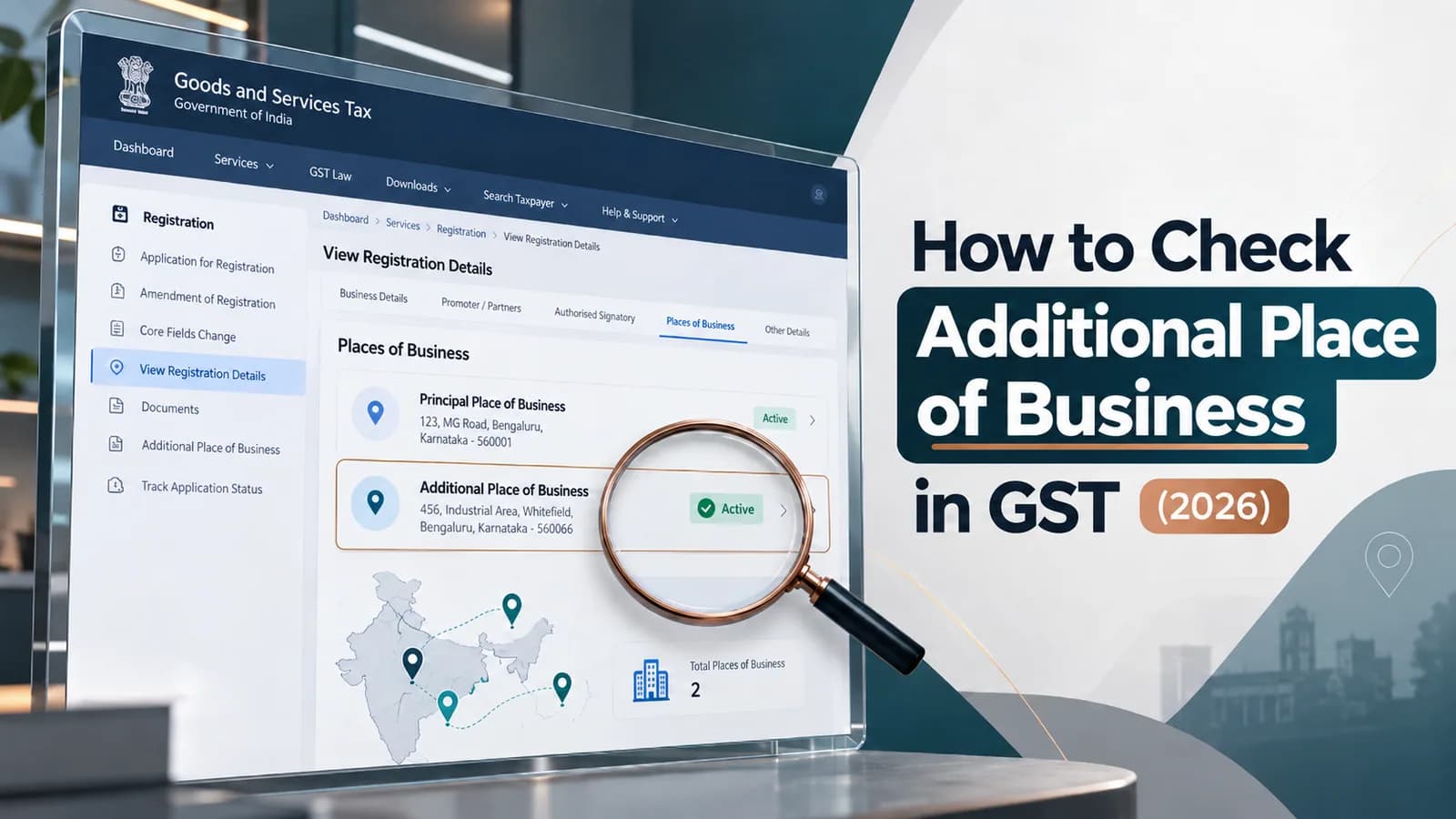
Most GST registration applications are not rejected because the business is fake. They are rejected because the address proof did not hold up — an expired agreement, a bill in the wrong name, a floor number that appears on one document and not the other.
The frustrating part is that the law is not vague about this. CBIC published a document-by-document list in April 2025 precisely because officers were demanding papers that were never required. Most applicants have never read it, so they over-prepare in the wrong places and under-prepare in the places that matter.
This guide sets out exactly what constitutes proof of principal place of business under GST, possession type by possession type, plus the proof of constitution that sits alongside it, what an officer is not permitted to ask for, and the specific deficiencies that produce a notice. If you already hold a GSTIN and simply need to update the address, the procedure to change your principal place of business is a separate filing.
Section 2(89) of the CGST Act defines the principal place of business as the place of business specified as the principal place of business in the certificate of registration. Section 2(85) defines place of business inclusively — a place from where business is ordinarily carried on, including a warehouse or godown or any other place where a taxable person stores goods or provides or receives goods or services; a place where he maintains his books of account; and a place where business is carried on through an agent.
Notice what those definitions do not require. There is no minimum floor area. There is no requirement that you own the premises, that you hold it exclusively, or that anyone sits there full time. The limb that most small businesses actually satisfy is the second one: the place where the books of account are maintained.
So when an officer examines your file, he is not testing ownership. He is testing two things: that the premises exists and is identifiable, and that you hold it on a basis you have correctly declared. Every document in this guide exists to establish one of those two facts.
Under Rule 8 of the CGST Rules, the application is made in FORM GST REG-01, which carries an indicative list of documents. That list — not the officer's preference — is the benchmark.
The document list that governs: Instruction No. 03/2025-GST
CBIC Instruction No. 03/2025-GST dated 17 April 2025 (F. No. CBIC-20016/24/2025-GST, GST Policy Wing) superseded Instruction No. 03/2023-GST dated 14 June 2023. It was issued because officers were routinely seeking documents outside the REG-01 list and raising queries on presumptive grounds, and it sets out what is sufficient for each type of possession.
This is the single most useful document in the whole registration process, and almost no guide reproduces it accurately. Here it is, with the failure mode we see most often for each row.
How you hold the premises | What is sufficient | What officers must not demand | Where it usually goes wrong |
|---|---|---|---|
Owned | Any ONE of: latest property tax receipt, municipal khata copy, electricity bill, water bill, or a similar document prescribed under State or local law establishing ownership | Additional ownership documents; original physical copies | Uploading a document that predates a transfer, so the name on it is the previous owner's |
Rented or leased, agreement registered | Registered rent or lease agreement plus any ONE ownership document of the lessor | Identity proof of the lessor | The agreement is in the promoter's personal name rather than the entity's legal name |
Rented or leased, agreement unregistered | Agreement plus any ONE ownership document of the lessor plus a copy of the lessor's identity proof | The lessor's PAN or Aadhaar; a photograph of the lessor in front of or inside the property | Lessor ID omitted because the applicant assumed a registered-agreement standard applied |
Electricity or water connection already in your own name | That utility document together with the rent agreement | Any further lessor documents at all | Applicants still chase the landlord for papers they do not need |
Consent premises (spouse, parent, relative, group entity) | Consent letter on plain paper plus identity proof of the consenter plus any ONE ownership document of the consenter | Additional documents from the applicant | Consent letter permits use of the premises but never mentions GST registration |
Shared premises, agreement available | Agreement plus any ONE ownership document; add the lessor's ID only where the agreement is unregistered | Lessor ID where the agreement is registered | Nature of possession entered as Consent when a sub-lease actually exists |
Shared premises, no agreement | Consent letter on plain paper plus the consenter's ID plus any ONE ownership document of the consenter | Additional documents | No document identifies which part of the premises is yours |
Rented, agreement genuinely unavailable | Affidavit on non-judicial stamp paper of minimum value sworn before a First-Class Judicial Magistrate, Executive Magistrate or Notary Public, plus a possession document such as an electricity bill in your own name | — | Used as a shortcut when an agreement could in fact be produced |
SEZ unit or developer | Government of India issued SEZ documents or certificates | — | Commercial SEZ correspondence submitted instead of the issued certificate |
Proof of place of business, document by document
Electricity bill
The most commonly used ownership document, and the most commonly mishandled. Two points decide whether it works.
First, whose proof is it? If you own the premises, the bill is your ownership evidence and the nature of possession is Own. If you rent, the bill is the lessor's ownership evidence supporting a rented declaration — it does not make the possession Own. Selecting Own because the electricity bill happens to be in the landlord's name is a straightforward mismatch and it draws a notice.
Second, the address format. Utility companies print a consumer service address that frequently differs from the postal address on a lease — abbreviations, no floor reference, an older locality name. That difference is invisible to you and glaring to a verifying officer. Reconcile it before filing rather than explaining it afterwards.
Property tax receipt and municipal khata copy
The Instruction asks for the latest property tax receipt, so use the most recent cycle available rather than whichever copy is in the file. The municipal khata copy is a State-specific instrument, which is why the Instruction closes that row with "or a similar document prescribed under State or local law". If your State uses a different land or property record, that record is contemplated by the wording.
Worth knowing: the Instruction advises Principal Chief Commissioners and Chief Commissioners to issue trade notices addressing unique local systems, providing for acceptable documentary evidence to be submitted with the application. If your State has an unusual property record system, check whether a local trade notice already names the acceptable document. It saves an argument.
Rent or lease agreement
Three things determine whether an agreement does its job.
It must be in the applicant's own legal name. For a company or LLP that means the entity, not a director or designated partner personally. This single point accounts for a large share of company registration failures.
It must be current. An expired agreement, or one whose term ended before the application date, does not evidence present possession.
It must identify the premises specifically — floor, unit, shop or cabin reference — in wording that matches what you type into REG-01.
Whether the agreement is registered changes only one thing: an unregistered agreement additionally requires the lessor's identity proof. It does not make the agreement unacceptable, and nothing in the Instruction requires registration.
Consent letter or NOC
This is where a genuinely useful detail gets lost. The Instruction specifies a consent letter on plain paper. Not stamp paper. Not notarised. Plain paper, accompanied by the consenter's identity proof and any one ownership document of the consenter — and it records that additional documents from the applicant should not be demanded.
A workable consent letter names four things:
The consenter, with an address matching the ownership document being uploaded.
The applicant, by full legal name and constitution — the entity, not the promoter.
The premises, described exactly as it appears in the ownership document and as it will be typed into REG-01.
Express permission to use the said premises as a place of business for the purposes of GST registration. Those last five words matter. A letter granting permission to "use the premises" without naming GST registration is the most common consent-letter defect we see.
Date it, have the consenter sign it, and keep the signature consistent with the identity document you upload alongside.
Affidavit where the agreement is unavailable
Note the deliberate contrast with the consent letter. Here the Instruction does require non-judicial stamp paper of minimum value, sworn before a First-Class Judicial Magistrate, Executive Magistrate or Notary Public, together with a possession document such as an electricity bill in the applicant's own name.
Applicants routinely get these two backwards — notarising a consent letter that needed none, and submitting a plain-paper declaration where an affidavit was required. Consent letter: plain paper. Affidavit: stamp paper and sworn. That is the whole rule.
This route is for premises genuinely held without a written agreement. It is not a way around producing an agreement that exists.
Proof of constitution of business: the half nobody writes about
Every guide covers address proof. Very few mention that the Instruction addresses proof of constitution alongside it, and that a defect here stalls an application just as effectively.
Constitution | Proof of constitution |
|---|---|
Proprietorship | No separate constitution document; the proprietor's PAN establishes the entity |
Partnership firm | Partnership deed |
Limited Liability Partnership | Certificate of incorporation issued by the Ministry of Corporate Affairs |
Private limited or public limited company | Certificate of incorporation issued by the Ministry of Corporate Affairs |
Society, trust, club, association of persons or body of individuals | Registration certificate or proof of constitution |
Government department, local authority or statutory body | Registration certificate or proof of constitution |
Check the current indicative list in FORM GST REG-01 for your constitution before filing, since the schedule of documents is amended from time to time.
Paragraph 8 of the Instruction contains a line that is worth quoting in any reply you write. It directs that officers shall ensure that queries are not raised for minor deficiencies which are not relevant for establishing proof of place of business or constitution of business. That is the standard against which a nitpicking query should be measured.
Identity, authorisation and Aadhaar
Alongside the premises and constitution documents, the application carries the photograph, PAN and Aadhaar of the authorised signatory and of promoters or partners, together with a board resolution or letter of authorisation appointing the authorised signatory where applicable.
Aadhaar authentication is dealt with under Rule 8, and sub-rule (4A) provides for biometric-based Aadhaar authentication, photograph capture and verification of the original of the uploaded documents at a designated centre where the applicant is identified on the portal on the basis of data analysis and risk parameters.
Read the end of that sentence again, because it changes how you should prepare your file. Where biometric authentication is triggered, the originals of the documents you uploaded are verified in person. A scan that looked acceptable on the portal is checked against the paper. If the original agreement is unsigned on one page, or the utility bill you uploaded was a photograph of a photograph, that is where it surfaces.
The carve-out that decides whether you have to travel
The GST portal's Aadhaar authentication FAQ clarifies that the facility to complete biometric authentication in the applicant's home State is available only to Promoters or Directors of Public Limited, Private Limited, Unlimited and Foreign Companies — and not where that Director is also the Primary Authorised Signatory. Proprietorships, partnership firms and LLPs do not have that facility. If you run a proprietorship in Surat and are registering premises in Karnataka, plan for an appointment in the State of application. We have covered biometric Aadhaar authentication and physical verification in more detail separately.
Verify the current position before you book travel — the biometric rollout has expanded through successive notifications and the operating position has moved over time.
Bank account proof is not a registration document
A persistent misconception is that you need a bank account in the entity's name before you can register. You do not, and the sequencing is set out in Rule 10A.
Rule 10A provides that after the certificate of registration in FORM GST REG-06 has been made available and a GSTIN assigned, the registered person shall furnish bank account details on the common portal within thirty days from the date of grant of registration, or before furnishing details of outward supplies under section 37 in FORM GSTR-1 or using the invoice furnishing facility, whichever is earlier. Persons registered under Rule 12 or Rule 16 are outside this.
Whichever is earlier is the operative phrase. If you register on the 1st and need to file GSTR-1 for that month, your real deadline is the return date, not day thirty.
This is not a soft obligation. GSTN issued an update in December 2025 confirming that non-compliance with Rule 10A triggers automatic suspension of registration, with cancellation proceedings dropped once the bank details are furnished — automatically in most cases, and through a manual option where the system has not processed it. Getting the registration and then forgetting the bank account is a genuine way to lose a working GSTIN in the first month.
What an officer is not permitted to demand
Three separate restrictions sit in the Instruction, and they are worth knowing precisely because most applicants simply comply with whatever is asked.
Documents outside the list need senior approval
Paragraph 8 provides that where any document apart from the listed documents is required to be sought, the officer shall seek it only after the approval of the concerned Deputy or Assistant Commissioner. So a request for something outside the REG-01 list is not simply a matter of the assessing officer's discretion — there is an approval requirement behind it.
Presumptive queries are barred
Paragraph 7 lists queries that must not be raised. Three recur on address files:
That the residential address of the applicant, Managing Director or authorised signatory is not in the same city or State where registration is sought.
That the HSN code of the goods mentioned is banned or prohibited for sale in that State.
That the kind of activity mentioned in the application cannot be conducted from those particular premises.
The first matters enormously to anyone registering outside their home State — being queried simply for living elsewhere was, until this Instruction, routine. The third is the one that catches small offices: an officer questioning how a trading business can operate from a modest room is making an assumption, not identifying a defect.
Minor deficiencies are not grounds for a query
As set out above, officers are directed not to raise queries for minor deficiencies which are not relevant for establishing proof of place of business or constitution of business. If a query does not go to either of those two questions, say so in the reply.
The grounds on which a REG-03 notice can be issued
Instruction 03/2025-GST confines a notice in FORM GST REG-03 to specified grounds. In substance they are:
The document uploaded is illegible or incomplete.
The address does not match the document, or the proof of address is invalid or incomplete.
The address given is incomplete or vague.
A GSTIN linked to the same PAN has been cancelled or is suspended.
The timing follows the risk classification. The notice is to issue within seven working days of submission where the application has not been flagged as risky, or within thirty days where it has. You then reply in FORM GST REG-04 within seven working days, and the officer approves within seven working days if satisfied, or rejects in FORM GST REG-05 with reasons recorded in writing.
Ground four deserves attention because it has nothing to do with your new premises. If an old registration on the same PAN in another State is suspended for non-filing, it will surface here. Clear that first — it is one of the few grounds the officer is expressly entitled to raise, and no amount of good address documentation answers it.
How your documents are actually checked
Situation | What happens |
|---|---|
Application complete, not flagged as risky | Officer should approve within seven working days of submission |
Applicant identified on the portal through data analysis and risk parameters as not requiring further scrutiny | Rule 9A, effective 1 November 2025: registration granted electronically by the portal within three working days of submission |
Aadhaar authenticated but flagged risky; Aadhaar not authenticated or not opted; or the officer decides verification is warranted with the approval of an officer not below Assistant Commissioner | Physical verification under Rule 9 read with Rule 25; registration within thirty days |
Physical verification carried out | Report, documents and photographs uploaded in FORM GST REG-30 at least five days before expiry of the thirty-day period, with a specific report on existence or non-existence of the premises, the efforts made to locate it if not found, and a GPS-enabled site photograph |
The GPS-enabled site photograph is the honest answer to "will they actually come?". If verification happens, someone stands at your declared address and photographs it with coordinates attached. That is a factual, checkable standard, and it is why the name board and the identifiable unit matter more than any amount of paperwork polish.
Two related points on timing. If you are considering the optional simplified route under Rule 14A — electronic grant within three working days where self-assessed monthly output tax on supplies to registered persons does not exceed two lakh fifty thousand rupees, opted into at Part-B item 4.1 of REG-01 — be aware that Rule 14A(3) restricts obtaining another registration in the same State or Union territory under the same PAN under that rule. The consequences of that choice are set out in our guide to changing the principal place of business.
Situations that come up constantly
Registering from a residential address
Entirely permissible. Section 2(85) contains nothing about commercial premises, and a home where the books of account are maintained is a place of business. If you own the home, use an ownership document and declare Own. If you rent it, the agreement plus the lessor's ownership document applies as usual, and it is worth checking that the lease does not itself prohibit commercial use.
Premises owned by a spouse or parent
This is the classic consent case. Consent letter on plain paper, the consenter's identity proof, and any one ownership document of the consenter. Declare the nature of possession as Consent — not Own, which people select because the property is "in the family".
Shared premises and co-working space
Where an agreement exists, the agreement plus one ownership document, with the lessor's ID added only if the agreement is unregistered. Where there is no agreement, the consent-letter route. In either case the practical requirement is that some document identifies which part of the premises is yours — a cabin, desk or unit reference — because a verifying officer arriving at an open floor has to be able to locate you. If the premises will also be an additional place of business, the documents for an additional place of business follow the same possession logic.
A virtual office address as the principal place of business
GST law contains no category called a virtual office, so nothing special applies — the arrangement is tested against section 2(85) and the same Rule 8 document standards. Typically the possession is Shared or Rented, the agreement should carry a specific unit or desk reference, and the provider's NOC must expressly permit use of the address for GST registration. The details are in our guides to virtual office for GST registration and virtual place of business for GST.
Newly built premises with no utility bill yet
Where the property is owned, a latest property tax receipt or municipal khata copy serves in place of a utility bill — the Instruction lists them as alternatives, any one of which suffices. Where the premises is rented and the connection is not yet energised, the agreement with the lessor's ownership document remains the route.
Making three documents say the same address
Address mismatch is an expressly permitted ground for a notice, and it is the ground applicants create for themselves most often. The fix is procedural, not legal.
Choose the authoritative version — normally the address as written in the possession document you are uploading.
Compare it against the ownership document line by line: building name, unit or floor reference, road, locality, sub-locality, city, PIN.
Where they differ, obtain a short clarifying letter from the owner confirming that the two descriptions refer to the same premises, and upload it with the application rather than waiting for a notice.
Copy the final string into REG-01. Do not retype it. Retyping is how "2nd Floor" becomes "Second Floor" and a matching pair becomes a mismatch.
Check that the locality and sub-locality actually sit within the PIN code entered — the portal flags this, and the flag is worth heeding rather than overriding.
Pre-filing document checklist
Assemble all of this before opening the application, not during it.
Possession document for the premises, current and in the entity's legal name.
One ownership document for the premises — property tax receipt, municipal khata copy, electricity bill or water bill.
Lessor's identity proof, if and only if the agreement is unregistered.
Consent letter on plain paper expressly permitting use of the address for GST registration, where the premises is held on consent or shared without an agreement.
Proof of constitution appropriate to the entity type.
PAN of the entity; PAN, Aadhaar and photograph of the authorised signatory and of promoters or partners.
Board resolution or letter of authorisation for the authorised signatory, where applicable.
The agreed address string, written out once and used everywhere without retyping.
All files legible, in the accepted formats and within the portal's prevailing size limits — check the current limits on the portal at the time of filing, since these have changed before.
Name board with the entity name and, once granted, the GSTIN, ready to go up at the premises.
A plan for furnishing bank account details within the Rule 10A window after grant.
Common mistakes
Selecting Own as the nature of possession because the electricity bill is in the landlord's name.
A rent agreement in a director's or partner's personal name when the applicant is a company or LLP.
A consent letter that permits use of the premises but never mentions GST registration.
Notarising a consent letter that needed only plain paper, while submitting a plain declaration where an affidavit on stamp paper was required.
Uploading an expired lease, or one whose term ended before the application date.
Retyping the address instead of copying it, producing a mismatch across three documents.
Chasing lessor documents that are not required because the utility connection is already in the applicant's own name.
Delaying the application to open a bank account first, when Rule 10A allows bank details after grant.
Getting the GSTIN and then missing the Rule 10A window, leading to suspension.
Supplying every extra document an officer asks for without checking whether it is on the list at all.
Ignoring a suspended GSTIN on the same PAN in another State, which is an expressly permitted ground for a notice.
Expert tips from our filing desk
Build the file in the order the officer reads it: possession, ownership, constitution, identity. A file assembled in that sequence gets fewer questions than the same documents in a random order.
Name the uploaded files descriptively rather than leaving scanner defaults. An officer opening "Lease-Agreement-Unit-4B.pdf" is in a different frame of mind from one opening "IMG_20260812_004.pdf".
Scan, do not photograph. Legibility is the first listed ground for a notice, and a phone photo of a stapled agreement fails it more often than people expect.
Where the possession document and the ownership document describe the premises differently, obtain the clarifying letter before filing. Pre-empting the mismatch costs an afternoon; answering it after a notice costs a fortnight.
Where a query falls outside the REG-01 list, note in the REG-04 reply that documents beyond the listed set require the approval of the Deputy or Assistant Commissioner under Instruction 03/2025-GST — and attach the document anyway if you have it. Get registered first; make the point politely in the same breath.
Put the name board up before filing. If verification follows, an identifiable premises with signage is the difference between a clean report and a remark you cannot easily undo.
Government references
CGST Act, 2017 — section 2(85) place of business; section 2(89) principal place of business; section 22; section 25; section 37.
CGST Rules, 2017 — Rule 8 and Rule 8(4A) (application and biometric Aadhaar authentication); Rule 9 (verification and grant); Rule 9A; Rule 10A (furnishing of bank account details); Rule 14A; Rule 18; Rule 25 (physical verification of business premises).
Notification No. 18/2025 – Central Tax (CGST Fourth Amendment Rules, 2025), effective 1 November 2025 — inserting Rule 9A and Rule 14A and FORMS GST REG-32 and REG-33.
Notification No. 38/2023 – Central Tax — substituting the time limit in Rule 10A.
CBIC Instruction No. 03/2025-GST dated 17 April 2025, F. No. CBIC-20016/24/2025-GST — instructions for processing of applications for GST registration; supersedes Instruction No. 03/2023-GST dated 14 June 2023.
CBIC Instruction No. 04/2025-GST dated 2 May 2025 — grievance redressal mechanism for processing of applications for GST registration.
GST portal — FAQs on Aadhaar Authentication; indicative document list in FORM GST REG-01; GSTN update on mandatory furnishing of bank account details under Rule 10A, December 2025.
FORMS — GST REG-01, REG-03, REG-04, REG-05, REG-06, REG-30.
Rules, portal limits and document schedules change. Verify against the current text at gst.gov.in and cbic-gst.gov.in before relying on any of the above. This article is current as at August 2026.