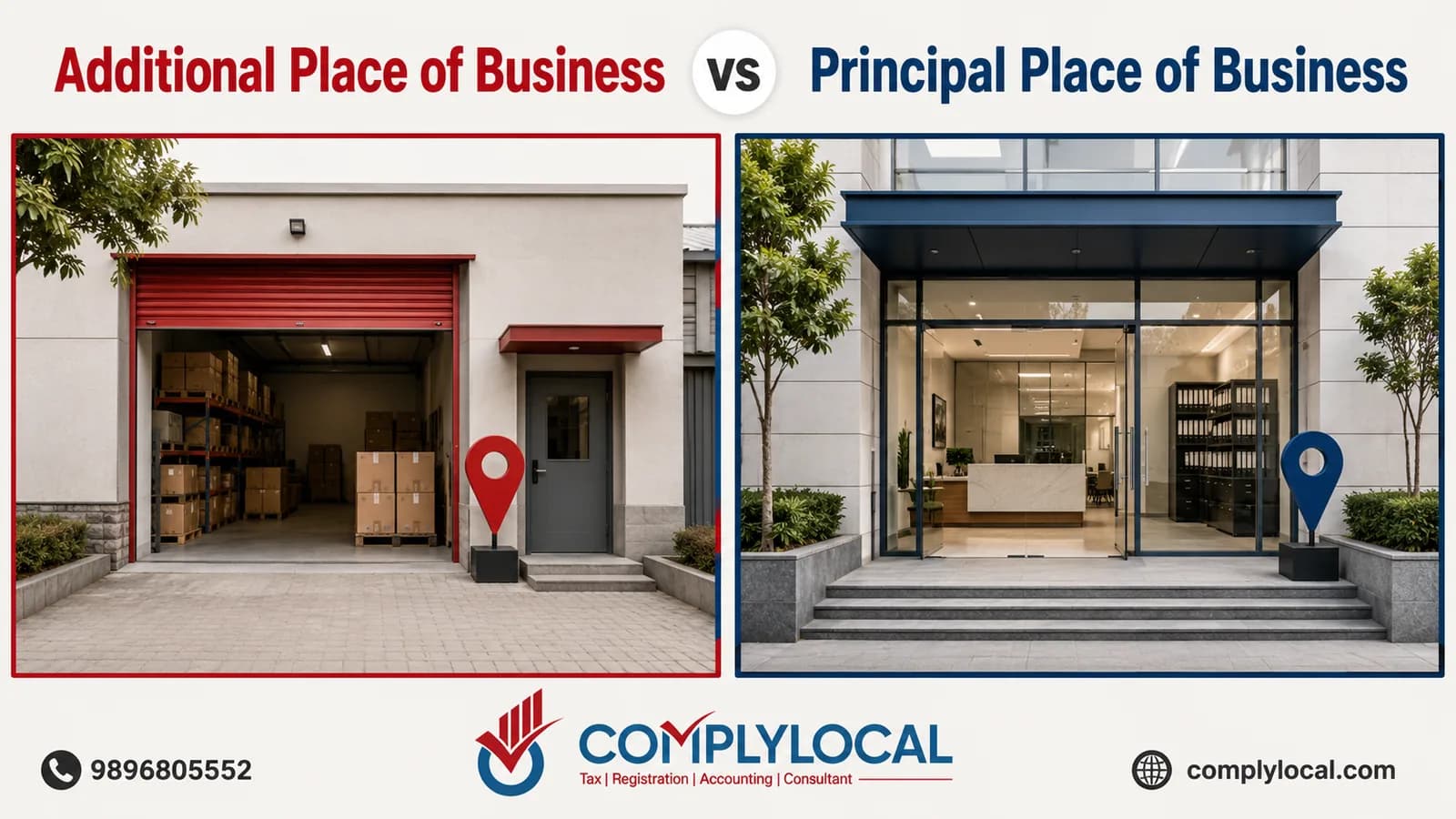

Every GST registration is built on two address concepts: one principal place of business, and everything else as additional places. The split looks like a formality until you have to make a real decision — should the factory or the office be the principal? Can the home be the principal and the godown the additional? What actually changes between the two labels?
I’m Keshav Sehgal from ComplyLocal Consultants. This guide puts the principal place of business (PPOB) and the additional place of business (APOB) side by side — the statutory definitions, every practical difference, how to choose which location carries the “principal” label, and the industry-wise structures that work. If you’re starting from zero on the APOB side, our complete guide to the additional place of business under GST covers that concept end to end; this article is about the comparison and the choice.
The Two Definitions, Side by Side
Both terms come straight from the CGST Act, and the asymmetry between them is the whole story:
Principal Place of Business — Section 2(89): the place of business *specified as the principal place of business in the certificate of registration*. It is a designation — the location you nominate as primary.
Place of business — Section 2(85): a wide functional definition — any place from where business is ordinarily carried on, including warehouses, godowns or any place where goods are stored, places where goods or services are received or supplied, where books of account are maintained, or where business is conducted through an agent.
The APOB is simply every location meeting the Section 2(85) test that is *not* the nominated principal. In other words: the law defines what a place of business is; you choose which one is principal; the rest become additional. That choice — and its consequences — is what the rest of this guide is about.
PPOB vs APOB: The Complete Comparison
Aspect | Principal Place of Business (PPOB) | Additional Place of Business (APOB) |
|---|---|---|
Statutory basis | Section 2(89) — the place specified as principal in the registration certificate | Section 2(85) — any other place of business in the same State |
How many per GSTIN | Exactly one | Multiple — the portal permits up to 500 |
What typically sits there | Books of account and core management, in most structures | Warehouses, branches, shops, fulfilment centres, back-offices |
On the REG-06 certificate | Shown as the principal place | Listed under additional places |
Field class on the portal | Core field — officer approval to change | Core field — officer approval to add, change, or delete |
Portal behaviour | Its tab carries the “Have Additional Place of Business” switch that unlocks the APOB tab | Tab stays locked until that switch is set to YES |
Documents | Same possession logic — owned/rented/consented proofs | Same possession logic — owned/rented/consented proofs |
Amendment window | Within 15 days of the change | Within 15 days of the change |
Geo-tagging | Geocoded — one-time per address | Geocoded — one-time per address |
State boundary | Fixed to the State of the GSTIN — change of State means a new registration, not an amendment | Same-State only — another State needs a separate GSTIN |
Read the table for what it says: most rows are identical. PPOB and APOB differ in count, in what the certificate calls them, and in where management usually sits — not in documents, timelines, or amendment mechanics. The comparison people expect to be complicated is mostly a naming decision with one strategic dimension, covered next.
What Makes a Location the “Principal” Place?
Legally, only one thing: it’s the place you specified as principal in the registration. Per the GSTN’s own framing, the principal place of business is the primary location within the State from which business is carried out. In practice, businesses anchor the choice to where the books of account and management sit — which is exactly the factor the dossier of official and practitioner guidance keeps returning to: a factory can be PPOB or APOB *depending on where books and management are located*.
Note the quiet power of Section 2(85) here: a location where books of account are maintained is itself a place of business. So wherever your accounts and control genuinely live, that location must be on the certificate anyway — making it the natural principal.
Which Location Should Be Your PPOB?
The CGST definitions allow either approach so long as every place is disclosed — the law does not force the factory, the office, or the warehouse into the principal slot. The working rule we apply:
Anchor to books and management. The place where accounts are maintained and decisions are made is the natural PPOB — the head-office-as-PPOB, sales-offices-as-APOB structure documented for multi-branch companies.
Let operations be APOBs. Depots, godowns, showrooms, and fulfilment centres slot in as additional places without disturbing the anchor.
Stability wins. Since a change of principal place is a core-field amendment (and a change of State isn’t possible at all), pick the address least likely to move.
Here’s how the split typically lands across industries, drawn from documented structures:
Industry | Typical PPOB | Typical APOB(s) |
|---|---|---|
Retail / MSME chains | Head office | Branch stores, godowns, back-offices |
Manufacturing | Factory or corporate office — either works, by where books/management sit | Depots, stock points, regional warehouses |
Service providers | Main office | Additional offices, training centres, co-working spaces |
E-commerce sellers | Own or virtual office (VPOB) | Marketplace FCs, own warehouses |
3PL clients | Own office | The 3PL godown holding the goods |
Home-based sellers | Home (with proper NOC/documents) | Rented warehouse as dispatch point |
When a Virtual Office Is the PPOB
One documented structure inverts the usual intuition: the principal place can be a virtual place of business provided by a service provider, while the client’s real warehouses and offices sit as APOBs under the same GSTIN. E-commerce sellers expanding into new States run on exactly this — virtual PPOB anchoring the State registration, marketplace fulfilment centres as APOB underneath it. The “principal” label follows the registration anchor, not the biggest building.
How Each Is Added or Changed
Both are core fields, so both run through the same route: Services → Registration → Amendment of Registration (Core Fields), using the Principal Place of Business and Additional Places of Business tabs, with officer approval, an ARN, and an updated REG-06 at the end. The first-time quirk sits on the PPOB tab — “Have Additional Place of Business” must be set to YES before the APOB tab unlocks. The filing walkthrough is in how to add an additional place of business, and the change/delete mechanics — including shifting which address is principal — are in the APOB amendment lifecycle guide. Both carry the same 15-day window from the change.
Common Confusions, Cleared
“APOB needs its own GSTIN.” No — APOB lives under the same GSTIN. Separate registrations per place exist as an *option* under Section 25(2)/Rule 11, not a requirement.
“A residential address can’t be the principal place.” It can — with proper NOC and documents, home addresses serve as PPOB or APOB, common for small online businesses.
“The factory must be the PPOB.” No — the definitions allow the factory as PPOB or APOB; disclosure of every place is what’s mandatory, not which label goes where.
**“An APOB in another State is fine.”** Never — both concepts are State-bound; another State means another GSTIN. The warehouse APOB rules guide covers how this plays out for godowns and FCs.
Expert Tips from ComplyLocal Consultants
Choose the PPOB once, for stability — anchor it to books and management, and let every operational site join as APOB.
Disclose first, optimise later: the compliance risk is an undisclosed location, not a suboptimal label.
Keep the certificate honest as you grow — every new branch, godown, or FC is a 15-day amendment event on the APOB side.
Structuring a new State or a marketplace launch and unsure which address should carry the principal label? Our APOB registration service sets up the PPOB/APOB (and VPOB) structure end to end.
Government References
CGST Act, Section 2(89) — definition of principal place of business.
CGST Act, Section 2(85) — definition of place of business, including warehouses, storage, books of account, and agents.
CGST Act, Section 25(2) and CGST Rules, Rule 11 — the optional separate-registration route for multiple places in a State.
GST Portal Manuals — “Additional Places of Business” and “Amendment of Registration (Core Fields)”: PPOB and APOB as core fields, tab behaviour, and the amendment route.
GST Council Registration Flyer — the 15-day amendment window for changes to place of business.
GSTN FAQs — the principal place as the primary location within the State.
Conclusion
The PPOB vs APOB comparison resolves into one sentence: the law defines what counts as a place of business, you nominate one as principal, and everything else in the State joins the certificate as additional. The mechanics — documents, amendments, timelines, geocoding — are nearly identical on both sides. Spend your judgment on the one real decision (anchor the principal to books, management, and stability) and your discipline on the one real obligation: every active location, disclosed, within 15 days.
— Keshav Sehgal, E-commerce GST, APOB, VPOB & PPOB Specialist, ComplyLocal Consultants