
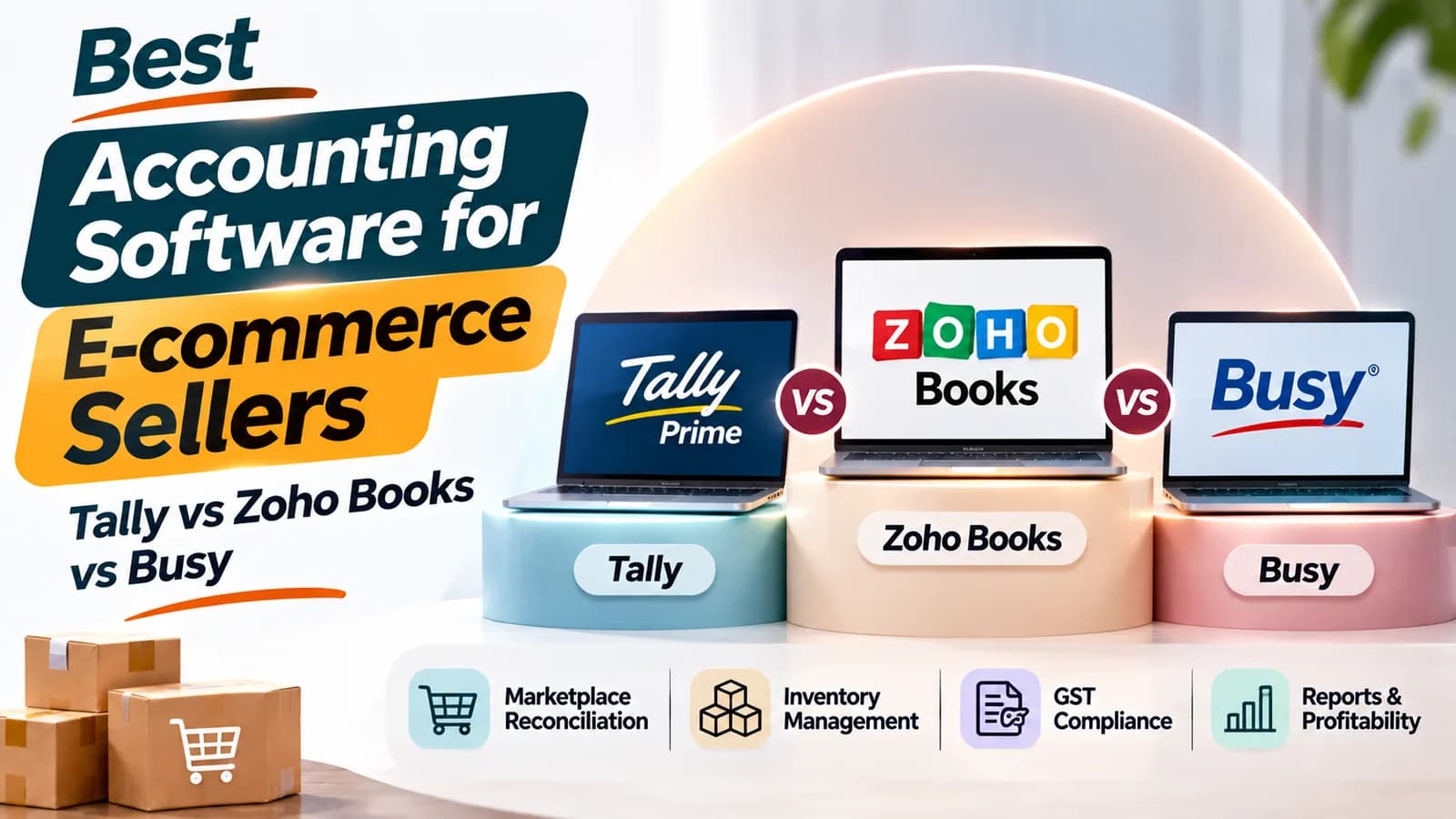
The best accounting software for an e-commerce seller in India is the one that handles four things without workarounds: several GSTINs, stock across many warehouses including marketplace fulfilment centres, high volumes of sales and returns imported from platform reports, and an audit trail. TallyPrime, Zoho Books and Busy all cover GST invoicing and returns; they differ on multi-GSTIN handling, cloud access, marketplace connections and price.
No software reconciles a marketplace settlement for you. Each of the three records what you import into it, and the quality of the books depends on how settlement, tax and return reports are brought in every month. Choose the tool that fits your volume and team, then build the import routine around it.
Point | TallyPrime | Zoho Books | Busy |
|---|---|---|---|
Deployment | Desktop, with paid cloud access option | Cloud | Desktop |
Licence model | Subscription or lifetime licence | Subscription per organisation | Perpetual licence with renewal, or subscription |
Multi-GSTIN | Supported in one company | Additional GSTIN through a paid Locations add-on | Enterprise and POWER editions |
Inventory and godowns | Full, multiple godowns and stock journals | Advanced inventory with warehouses in Elite and Ultimate plans | Full, multiple godowns |
Marketplace connections | Through third-party connectors | Amazon and Shopify connections listed in Elite and above | Through third-party connectors |
E-invoicing and e-way bill | Included | E-invoicing included from Standard | Included in GST editions, with limits by edition |
What e-commerce accounting software must handle
An online business stresses accounting software differently from a trading firm. Before comparing names, check each tool against these requirements:
Multiple GSTINs, with separate GSTR-1, GSTR-3B and ledgers for each registration.
Inventory across godowns, including stock sitting in marketplace fulfilment centres.
Bulk import of sales, returns and settlements from Excel or CSV reports.
Separate ledgers for fees, GST on fees, GST TCS and income-tax TDS for each platform.
Credit notes linked to original invoices, for the Section 34 time limit.
E-invoicing once aggregate turnover crosses ₹5 crore, and e-way bills for stock transfers.
An audit trail that cannot be switched off, which companies have needed since 1 April 2023 under the Companies (Accounts) Rules.
A tool that fails the first or third point will cost more in staff time than its licence saves.
TallyPrime for e-commerce sellers
TallyPrime suits sellers with an in-house accountant, many godowns and heavy inventory. It handles multiple GSTINs inside one company, has full stock journals for moving goods between your warehouse, fulfilment centres and a damaged-returns godown, and includes e-invoicing and e-way bills.
Its gaps are cloud access and marketplace data. Tally is a desktop product, with cloud access sold separately, and marketplace reports come in through third-party connectors or Excel imports rather than built-in integrations. On Tally's pricing page on 5 November 2026, the single-user Silver edition was listed at ₹8,100 for 12 months or ₹22,500 for a lifetime licence, and the multi-user Gold edition at ₹24,300 for 12 months or ₹67,500 lifetime, all plus 18% GST.
Our guide to the sales return entry in Tally shows how marketplace returns are posted in it.
Zoho Books for e-commerce sellers
Zoho Books suits D2C brands that want cloud access for founders, an accountant and a CA in different places, and that sell through a small number of channels. E-invoicing is included from the Standard plan, and the Elite plan adds advanced inventory with warehouses and listed connections to Amazon and to up to two Shopify stores.
Its limits for sellers are multi-GSTIN and cost at scale. Each additional GSTIN needs the Locations add-on, and advanced inventory starts only at Elite. On Zoho's India pricing page on 5 November 2026, Elite was listed at ₹4,999 a month billed annually, and the Locations add-on at ₹600 a month per location, each excluding GST.
Busy for e-commerce sellers
Busy suits trading and distribution businesses that also sell online, especially those that want a perpetual licence and full desktop inventory. Its GST editions include e-invoicing and e-way bills, and the Enterprise and POWER editions support multiple GSTINs.
Like Tally, it relies on imports or connectors for marketplace data. On Busy's pricing page on 5 November 2026, the perpetual Standard edition was listed at ₹16,500 and Enterprise at ₹22,000, with yearly renewals for updates, while the subscription SMART and POWER editions were listed at ₹8,000 and ₹12,000 for 360 days, all excluding GST.
Tally vs Zoho Books vs Busy by seller type
The right choice follows how you sell, not which tool is most popular:
Seller profile | Usually the better fit | Why |
|---|---|---|
Marketplace seller, one GSTIN, under ₹2 crore, founder does the books | Zoho Books Standard or Professional | Cloud, low entry cost, simple invoicing |
D2C brand on its own website with one or two marketplaces | Zoho Books Elite | Shopify and Amazon connections, warehouses, cloud |
Multi-State seller with FBA or fulfilment centre stock in several States | TallyPrime | Multi-GSTIN in one company, godowns, stock transfers |
Distributor or wholesaler adding online channels | Busy or TallyPrime | Desktop inventory depth, perpetual licence option |
Brand above ₹5 crore with a finance team | TallyPrime Gold or Zoho Books Premium and above | Multi-user, e-invoicing, audit trail |
For brands running their own store, our guide to Shopify D2C accounting covers the gateway and COD side that any of the three must handle.
Importing marketplace data into any software
The import routine matters more than the software. Each month, bring in the platforms' tax reports for sales and returns, and their settlement reports for fees, TCS, TDS and payouts, as separate imports.
At Complylocal, the books we rebuild most often were kept in perfectly good software but imported from settlement reports alone. Settlements are net of fees, taxes and returns and arrive late, so sales, GST and TCS all end up in the wrong months. Post sales from the tax report and settlements from the payment report, then reconcile the two.
Our guide to accounting entries for TDS receivable and GST TCS shows the ledgers every import should feed.
Costs beyond the licence
The licence is the smallest part of the cost of e-commerce accounting. Connectors for marketplace imports, extra users, cloud access, additional GSTINs and the accountant's time to clean and post data usually cost more over a year.
Cost | TallyPrime | Zoho Books | Busy |
|---|---|---|---|
Extra users | Gold edition | Per-user add-on | Edition-based |
Cloud access | Separate add-on | Included | Not standard |
Extra GSTIN | Included in the company | Locations add-on | Enterprise or POWER edition |
Marketplace imports | Third-party connector or Excel | Built-in for some channels in Elite and above | Third-party connector or Excel |
Prices change often. Check each vendor's live pricing page on the day you buy, and compare the full year's cost for your number of users and GSTINs.
Questions to ask in a demo before you buy
A vendor demo shows invoicing; e-commerce problems show up elsewhere. Ask the vendor or reseller to show these with your own data:
Import one month of a marketplace tax report with returns, and show the credit notes it creates.
Post one settlement with fees, GST on fees, TCS and TDS on separate ledgers.
Move stock from your warehouse to a fulfilment centre in another State and generate the e-way bill.
Produce GSTR-1 for two GSTINs from the same data.
Show the audit trail of an edited voucher.
If any of these needs a workaround in the demo, it will need one every month in practice.
How to switch accounting software mid-year
Switch at the start of a quarter, after that quarter's returns are filed. Carry over opening balances for every ledger, party-wise outstanding for each marketplace, GSTIN-wise input and output tax balances, and stock by godown at cost.
Keep the old software readable for at least the GST and income-tax record-keeping period, because scrutiny questions are answered from the books of the year in question. Our guide on accounting for an e-commerce business lists the monthly close that the new software must support.
Want the software chosen and the marketplace imports set up for you? Talk to Simran's team about e-commerce accounting and bookkeeping.