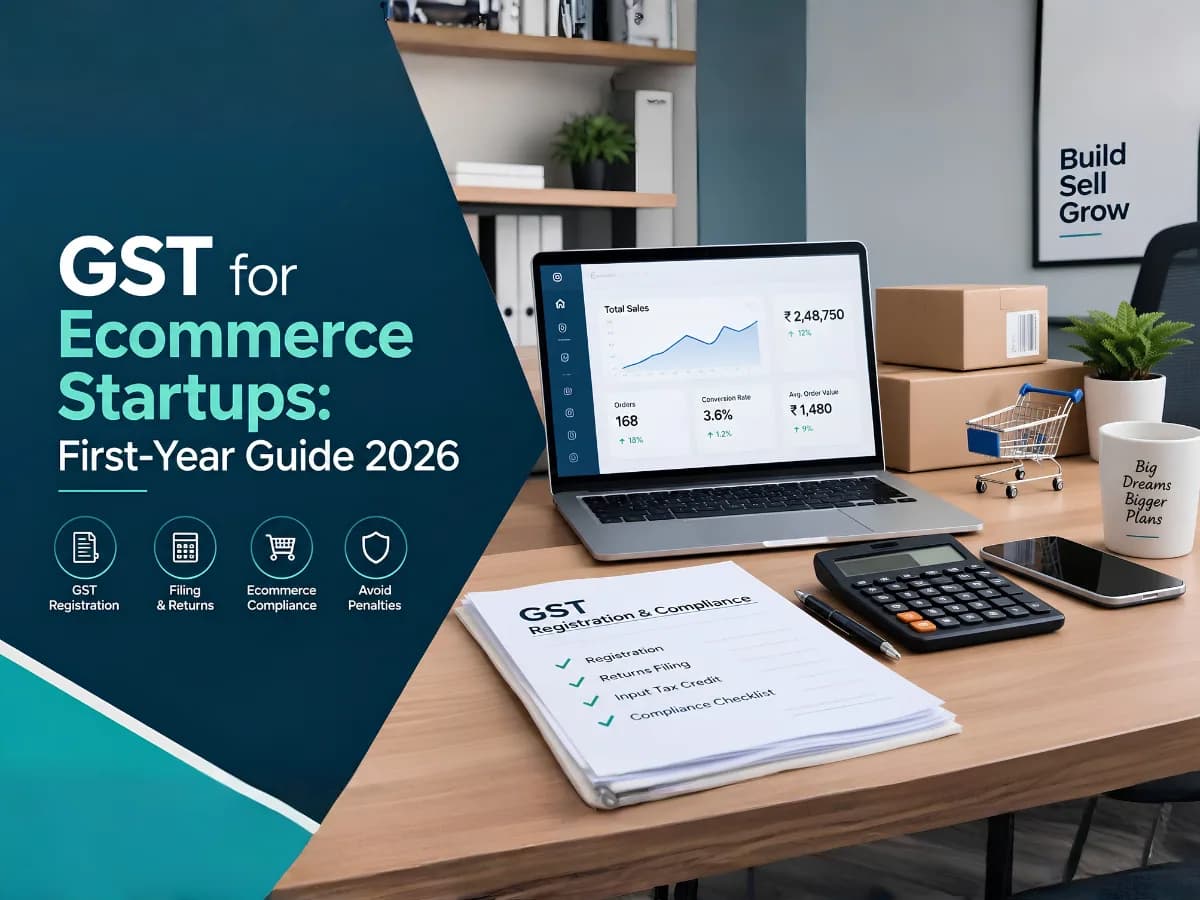
An ecommerce startup needs its GSTIN before its first listing goes live, not before its first ₹40 lakh. Marketplaces validate GST at onboarding for taxable categories, and Section 24 of the CGST Act removes the turnover threshold for most online sellers.
The sequence matters more than the paperwork. Registration taken in the wrong order, or in the wrong entity name, costs weeks that a launch calendar rarely has.
When should an ecommerce startup register for GST?
Before the first listing, and in the correct legal name.
Two provisions remove the threshold for most new online sellers. Section 24(ix) covers supply of goods through an operator liable to collect TCS. Section 24(i) covers any inter-state taxable supply, which a nationally listed product produces on its first out-of-state order. Either one alone is enough.
The narrow exemption under Section 23(2) with Notification No. 34/2023-Central Tax dated 31 July 2023 applies only to single-state sellers below the threshold holding an enrolment number, and it fails on the first inter-state order. Our guide on whether GST is mandatory for online sellers sets out the full test.
The order to do things in
Decide the entity first, since the GSTIN is issued in that entity’s name and PAN.
Open the business bank account in the same name.
Arrange proof for the principal place of business, matching the address on the utility bill or rent agreement.
Apply for GST registration in the home state with Aadhaar authentication.
Onboard to the marketplace using that exact legal name and GSTIN.
Add any fulfilment-centre state as an additional place of business before sending stock there.
Set the filing frequency, monthly or QRMP, at the start rather than mid-year.
Step one is where founders lose the most time. A GSTIN issued to a proprietorship cannot simply be transferred when the business incorporates six months later. Incorporating first means one registration; incorporating after launch means a new registration, a new marketplace onboarding and a gap in the middle where listings go inactive.
Step three causes the most rejections. The address on the electricity bill has to match what is entered in REG-01. A mismatch on the principal place of business is the single most common reason a first application gets queried.
Which entity to choose before registering
Entity choice drives cost, credibility and the compliance you carry for the rest of the business’s life.
Entity | Suits | Watch out for |
|---|---|---|
Proprietorship | Solo founder testing a category, low capital | Cannot take investment, no separate legal identity, conversion later means fresh registrations |
LLP | Two or more founders, service-led models | Not eligible for presumptive taxation under Section 58 of the Income-tax Act, 2025 |
Private limited | Anyone raising capital or planning to scale | ROC filings from year one, including AOC-4 and MGT-7 |
The GST process is identical across all three. What differs is what happens later, and changing entity after launch means redoing registration, bank accounts and every marketplace account.
Can a new online seller use the composition scheme?
Only for intra-state supply of goods, and rarely usefully.
Composition taxpayers were permitted to supply goods within a single state through an ecommerce operator from 1 October 2023. Inter-state supply through a platform stays outside the scheme, which rules it out for any seller listing nationally.
Even where it fits, the arithmetic usually does not. A composition dealer cannot claim input tax credit, and marketplace commission, fulfilment and advertising all carry GST at 18%. For a seller paying 20% of turnover in platform fees, surrendering that credit costs more than the lower composition rate saves.
Monthly filing or QRMP in year one
QRMP is available where aggregate turnover is up to ₹5 crore, which covers almost every startup. It is not automatically the right choice.
Monthly | QRMP | |
|---|---|---|
GSTR-1 | 11th of the following month | 13th of the month after the quarter |
B2B invoices in months 1 and 2 | In the monthly GSTR-1 | Optional, through IFF by the 13th |
Tax payment | With GSTR-3B on the 20th | PMT-06 by the 25th for months 1 and 2 |
GSTR-3B | 20th of the following month | 22nd or 24th after the quarter, by state group |
QRMP reduces the number of returns, not the number of payments. Tax still moves monthly through PMT-06. Our recommendation for a first-year B2C seller is QRMP, because the return count falls and no buyer is waiting on credit. For a seller with B2B customers, monthly filing is usually worth the extra work, since skipping the IFF leaves your customer without input tax credit for two months out of three.
Stock in another state changes everything
The moment your goods sit in a fulfilment centre in another state, that state needs its own registration.
GST registration is state-wise under Section 25 of the CGST Act, and supplies made from a warehouse are made from that state. Sending stock to an Amazon centre in Haryana without a Haryana registration means supplies with no valid GSTIN behind them.
Each new state adds a full return set, not a line item. Two states means four returns a month rather than two. Plan expansion around that cost, and take the additional place of business registration before the stock moves rather than after.
The first-year compliance calendar
Filing | Due | Applies to |
|---|---|---|
GSTR-1 | 11th monthly, or 13th after the quarter under QRMP | Every GSTIN |
Action on inward invoices in IMS | Before GSTR-2B generates on the 14th | Everyone claiming input tax credit |
GSTR-3B | 20th monthly, or 22nd/24th after the quarter | Every GSTIN |
PMT-06 | 25th of months 1 and 2 of a quarter | QRMP filers |
Input tax credit cut-off | 30 November following the financial year | Everyone, under Section 16(4) |
GSTR-9 | 31 December following the financial year | Aggregate turnover above ₹2 crore |
A first-year seller usually falls below the GSTR-9 threshold. The ₹2 crore exemption is notified by CBIC each year and was notified for FY 2024-25 by Notification No. 15/2025-Central Tax, so confirm the current year’s notification before deciding to skip it.
Expert view: three things worth getting right in month one
Register the business before you register for GST. Founders who launch as a proprietorship and incorporate at month nine pay for the same setup twice and lose selling days in the gap. If a private limited company is the destination, start there.
Set up the accounting structure at the same time as the GSTIN. A chart of accounts with a separate ledger for each platform fee, and separate asset ledgers for TCS and TDS receivable, takes an afternoon in month one and takes weeks to retrofit in month twelve.
And open the TCS credit screen every single month from the first month. Sellers who build the habit early never lose the credit. Sellers who discover the screen in year two usually find that part of what accumulated is already outside the Section 16(4) window.
Planning a launch this quarter? Talk to Keshav’s team at Complylocal Consultants about ecommerce GST registration services.