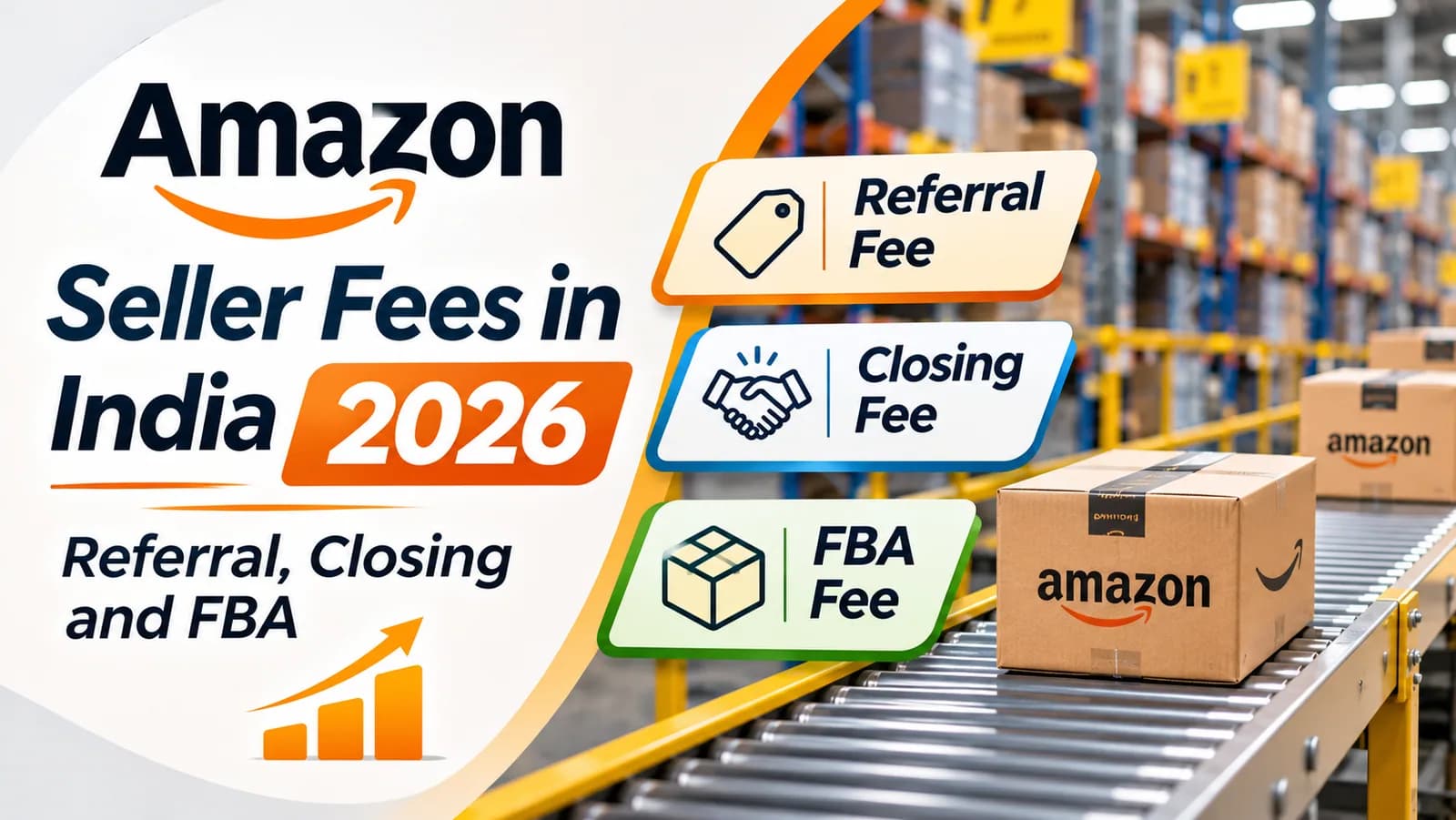
Amazon seller fees in India are four separate charges deducted from each order: a referral fee that varies by category and price, a fixed closing fee by price band, a shipping or weight handling fee, and Fulfilment by Amazon (FBA) charges if Amazon stores and packs your stock. Since 16 March 2026, products priced under ₹1,000 in more than 1,800 categories carry a zero referral fee.
Zero referral fee is not zero fees. Closing and shipping fees still apply, closing fees rose again from 7 September 2026, and every fee line attracts 18% GST. On top of that, Amazon deducts 0.5% GST TCS and 0.1% income-tax TDS from the same settlement, so the payout you see is three layers removed from the selling price.
Fee or deduction | What it is | 2026 position |
|---|---|---|
Referral fee | Percentage of the selling price, set by category and price band | Zero under ₹1,000 in 1,800+ categories from 16 March 2026; reduced for many categories above ₹1,000 |
Closing fee | Fixed amount per unit by price band and fulfilment channel | Self Ship cut from 16 March 2026; raised by ₹1 (up to ₹500) and ₹3 (above ₹500) for FBA, Easy Ship and Seller Flex from 7 September 2026 |
Shipping or weight handling | Charged per shipment for Easy Ship and FBA, by weight, size and distance | Easy Ship fees cut for items under ₹300 from 16 March 2026 |
FBA fees | Pick and pack, storage and related charges for stock in Amazon fulfilment centres | Billed per unit and per month of storage |
GST on fees | 18% on every fee line, invoiced to your GSTIN | Claimable as input tax credit |
GST TCS | 0.5% of net taxable sales | Credited to your GST cash ledger |
Income-tax TDS | 0.1% of gross sales | Claimed in your income-tax return |
Amazon referral fee and the zero referral fee under ₹1,000
The referral fee is Amazon's commission: a percentage of the total price the buyer pays, including any shipping charged. The percentage depends on the product's fee category and its price band, so the same category can carry different rates below and above ₹1,000.
According to Amazon's seller fee change guide for 2026, from 16 March 2026 products priced under ₹1,000 across more than 1,800 categories pay no referral fee, and referral fees above ₹1,000 fell by 4% to 9.5% in categories such as fashion, home and grocery. Not every category moved to zero, so check your own category's band before repricing.
How the ₹1,000 price edge changes your pricing
The referral fee band applies to the whole price, so crossing ₹1,000 by a rupee switches the fee on for the entire sale. A product at ₹999 may pay no referral fee while the same product at ₹1,049 pays the category rate on all ₹1,049.
Run the margin at both prices before you move across the line. If the category rate is 8%, the ₹50 price rise brings in about ₹50 more revenue but adds about ₹84 of referral fee plus GST on it, so the higher price earns less. Bundles and multi-packs priced just above ₹1,000 deserve the same test.
Amazon closing fee by price band and channel
The closing fee is a fixed charge per unit, set by the item's price band and how it is fulfilled: FBA, Easy Ship, Self Ship or Seller Flex. It hits low-priced items hardest, because a fixed rupee amount is a larger share of a small sale.
Two changes in 2026 moved it in opposite directions. From 16 March 2026, the Self Ship closing fee fell from ₹45 to ₹20 for items under ₹300, and from ₹35 to ₹26 for items between ₹300 and ₹500. From 7 September 2026, closing fees for FBA, Easy Ship and Seller Flex rose by ₹1 for products up to ₹500 and by ₹3 above ₹500.
Read the closing fee from the live fee page or Amazon's revenue calculator for your exact channel. A rate card saved before September is already out of date.
Shipping and weight handling fees
Weight handling is Amazon's shipping charge for Easy Ship and FBA orders. It depends on the shipment's weight, its size tier and how far it travels: local, regional or national.
Volumetric weight matters as much as actual weight. A light product in an oversized box is billed on the box, so packaging decisions show up directly in this fee. Self Ship sellers pay their own courier instead, but still pay the referral and closing fees.
FBA fees for stock in Amazon fulfilment centres
FBA adds charges for picking, packing and storing your stock, on top of weight handling. Storage is billed monthly on the space your inventory occupies, so slow-moving stock costs money every month it sits in a fulfilment centre.
FBA also changes your GST position. Stock stored in a fulfilment centre in another State makes that warehouse your additional place of business, which needs registration in that State; our guide to Amazon APOB under GST covers the requirement.
FBA, Easy Ship or Self Ship by cost
Each channel moves a different cost onto your side of the ledger. Choose by order profile, not by the fee on one order.
Channel | Who ships | Fees you pay Amazon | Costs you carry yourself |
|---|---|---|---|
FBA | Amazon, from its fulfilment centre | Referral, closing, weight handling, pick and pack, storage | Inbound freight to the fulfilment centre, APOB registration where the warehouse is in another State |
Easy Ship | Amazon's delivery network collects from you | Referral, closing, weight handling | Packing, storage, staff |
Self Ship | Your own courier | Referral and closing only | Courier contract, returns handling, delivery promise risk |
Seller Flex | Amazon operates from your warehouse | Referral, closing, weight handling | Warehouse space and staff |
High-volume, fast-moving SKUs usually justify FBA's storage charge; slow movers rarely do.
GST on Amazon fees, TCS and TDS
Amazon charges 18% GST on every fee line and issues tax invoices for its fees to your GSTIN. That GST is input tax credit, not a cost, provided the invoices reach your GSTR-2B and you claim them.
Separately, Amazon deducts two taxes from your settlement on its own behalf as collector:
Deduction | Rate | Where you recover it |
|---|---|---|
GST TCS | 0.5% of net taxable sales | GST cash ledger, after accepting it on the portal |
Income-tax TDS | 0.1% of gross sales | Income-tax return, via Form 168 |
Our guides to TCS under GST and Section 194-O TDS explain how to claim each.
At Complylocal, the most common fee error we find in an Amazon seller's books is the fee invoice booked at its GST-inclusive amount as an expense. The 18% GST on referral, closing and FBA fees then never reaches the ITC claim, and the seller's platform cost looks 18% higher than it is.
How to calculate Amazon fees on one order
Work out the fees per unit before you set a price, then check them against the settlement. The order of calculation:
Find the product's fee category and price band on Amazon's fee page.
Apply the referral fee percentage to the full price the buyer pays, or zero if the band qualifies.
Add the closing fee for your price band and fulfilment channel.
Add weight handling for the shipment's weight, size tier and zone, or your own courier cost for Self Ship.
Add FBA pick, pack and storage charges per unit, if you use FBA.
Add 18% GST on the fee total.
Note 0.5% TCS and 0.1% TDS separately; they reduce the payout but are recoverable.
An illustrative order shows how the layers stack. The fee amounts here are assumptions for the arithmetic, not Amazon's rate card.
Line | Amount |
|---|---|
Selling price, GST inclusive at 5% | ₹1,260 |
Taxable value | ₹1,200 |
Referral fee (assumed 8% of ₹1,260) | ₹100.80 |
Closing fee (assumed) | ₹30.00 |
Weight handling (assumed) | ₹65.00 |
GST at 18% on fees | ₹35.24 |
TCS at 0.5% of ₹1,200 | ₹6.00 |
TDS at 0.1% of ₹1,200 | ₹1.20 |
Payout | ₹1,021.76 |
The ₹60 GST on the sale is your output tax, payable in GSTR-3B. The real cost of this order is the ₹195.80 of fees. The ₹35.24 of GST on fees is ITC, and the ₹7.20 of TCS and TDS is recoverable tax; booking them as costs overstates Amazon's take by ₹42.44 on a single order.
How to check Amazon fees on your settlement
Check fees monthly, not order by order. Download the date-range transaction report from Seller Central, total each fee type, and compare it with the fee invoices Amazon issues for the month.
Three checks catch most overcharges: the fee category assigned to each listing, the weight and size Amazon recorded for FBA units, and the referral band applied after a price change around ₹1,000. Fee reimbursement claims for wrong dimensions or lost FBA stock go through Seller Central, so log every discrepancy with the order ID. Our guide to Amazon and Flipkart payment reconciliation shows the settlement match in full.
Want fees, returns and taxes turned into a SKU-level margin every month? Talk to Simran's team about e-commerce profitability analysis.