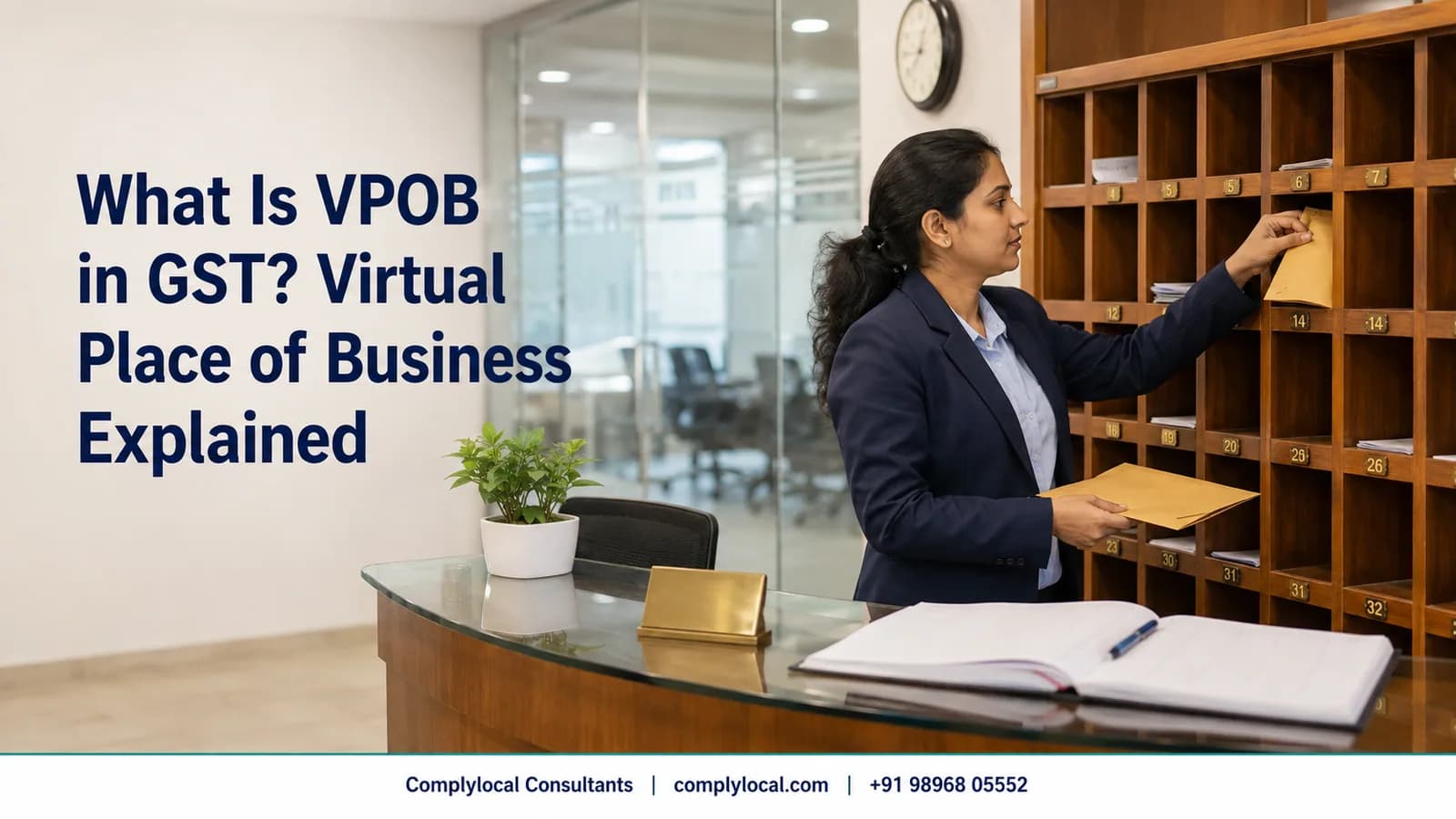
VPOB stands for Virtual Place of Business. It is not a term you will find anywhere in the CGST Act, the CGST Rules, or a single CBIC circular. It is trade shorthand, invented by the e-commerce seller community, for one specific arrangement: using a virtual office address as the principal place of business (PPOB) on a state GST registration.
That distinction matters more than it sounds. Sellers routinely ask us whether VPOB is "allowed" or "approved" under GST. The question cannot be answered as framed, because the law has no category called VPOB to allow or disallow. What the law has is a definition of place of business, a document list for proving possession of premises, and an officer with the power to visit the address. A VPOB either satisfies those three things or it does not.
This article explains the term, the structure behind it, and how the address is actually tested. If you want the full legal treatment of whether the arrangement holds up, that sits in our guide to virtual office for GST registration.
Where the term came from
Three provisions, read together, create the entire VPOB market:
Section 25(1), CGST Act. Registration is state-wise. There is no pan-India GSTIN. Every state you are liable in needs its own registration.
Section 24(ix), CGST Act. A person supplying goods through an e-commerce operator required to collect TCS must register compulsorily, irrespective of turnover.
Section 2(85), CGST Act. To register in a state, you must declare a place of business in that state.
Now add the commercial reality. Marketplace fulfilment models store your stock in fulfilment centres spread across states. Supply is made from the state where the stock physically sits. To use a fulfilment centre in Karnataka, you need a Karnataka GSTIN. To get a Karnataka GSTIN, you need an address in Karnataka.
A seller in Surat with no premises in Karnataka has two honest options: lease real space there, or obtain a documented address from a provider who already holds premises there. The second option is what the market named VPOB. Nothing about the obligation is optional — the stock in that state is real, the supply is real, and the tax that state collects is real. The only thing being economised is office rent.
VPOB, PPOB and APOB are three different things
This is where most confusion starts, because sellers use the three terms interchangeably. They are not interchangeable, and mixing them up produces genuine filing errors.
Term | Statutory? | What it means | How many per state GSTIN |
|---|---|---|---|
PPOB | Yes — s.2(89) | The address specified as the principal place of business in the registration certificate | Exactly one |
APOB | Concept yes; term used in portal forms and Circular 61/35/2018 | Any other premises within the same state from which business is carried on under the same GSTIN | Many (the portal allows a large number) |
VPOB | No — market term | A virtual office address used as the PPOB for that state's GSTIN | Not a portal field at all |
VPPoB | No — marketplace term | Amazon's own wording inside its state-expansion documentation | Not a portal field at all |
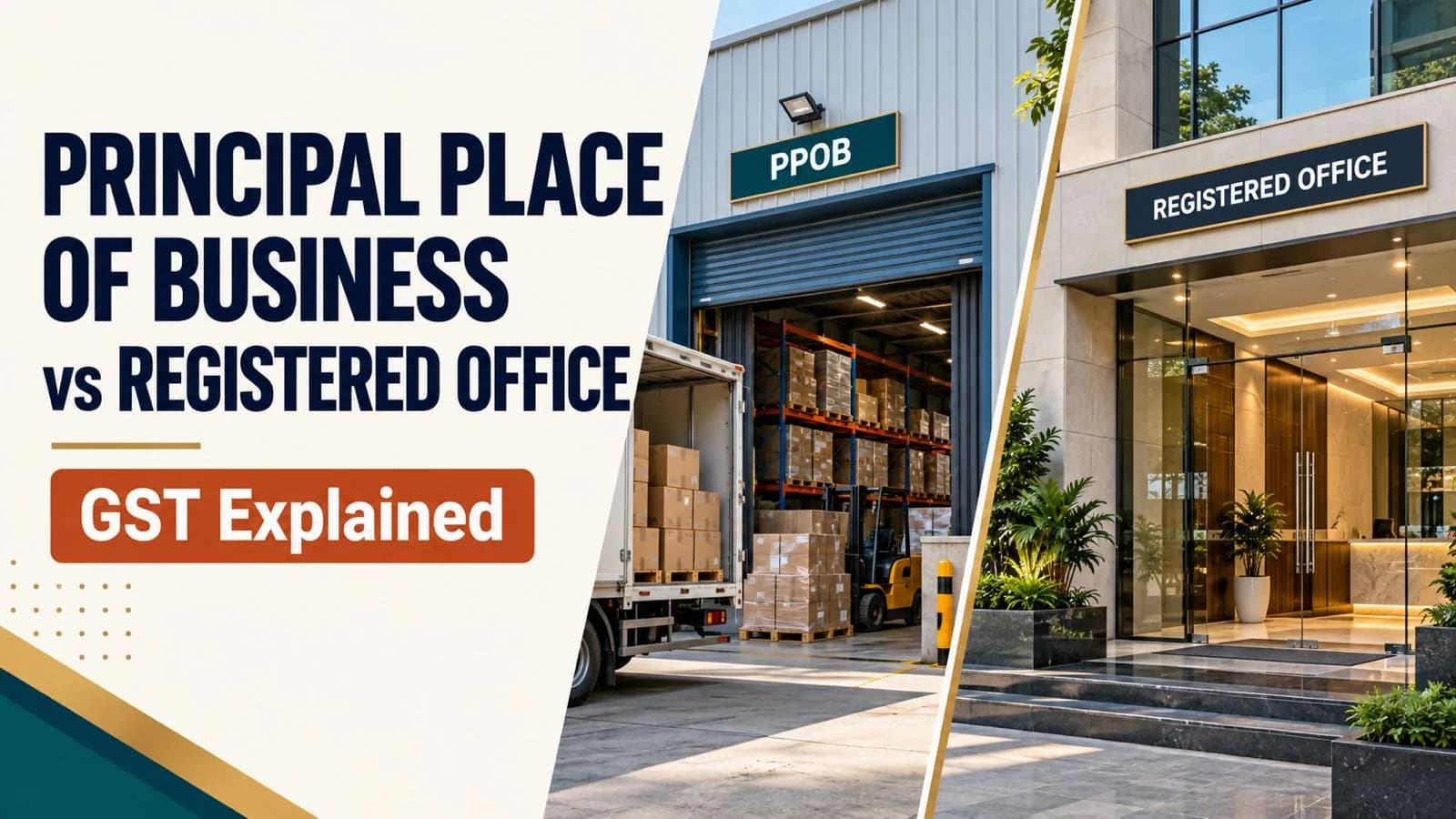
There is no dropdown on the GST portal that says VPOB. When you file FORM GST REG-01, you declare a principal place of business and, if applicable, additional places of business. A VPOB is simply what the trade calls the first one when the address came from a provider. For the full side-by-side, see our comparison of VPOB, APOB and PPOB.
The three-address structure of a multi-state seller
Once you see the structure, the vocabulary sorts itself out. A seller expanding into one new state ends up with three distinct locations, only two of which appear on that state's GSTIN. Sellers on marketplace fulfilment models will recognise it from our GST guide for e-commerce sellers:
Location | Status on the new state GSTIN | What actually happens there |
|---|---|---|
Home-state office or home | Nothing — it sits on a different GSTIN | Books maintained, business run, orders managed |
Virtual office in the new state | PPOB | The registered address. Records accessible from here; correspondence and notices land here |
Marketplace fulfilment centre | APOB | Stock physically stored; supplies dispatched to customers in that state |
The fulfilment centre is added by a core-field amendment under Rule 19 after the GSTIN is granted, not during the original application. Sellers who skip this step end up shipping stock to a premises that is not declared on their registration, which is a separate compliance problem entirely. Our guide to the additional place of business amendment covers that filing.
One consequence worth stating plainly: on any given day there is no stock at the VPOB address. There need not be. The stock for that state sits at the fulfilment centre, which is declared as the APOB. What the PPOB carries is the registration, the records and the correspondence.
What the law actually tests
Since VPOB is not a legal category, the address is tested through the ordinary machinery. Section 2(85) defines place of business inclusively — it covers a place from where business is ordinarily carried on, a place where a taxable person maintains his books of account, and a place where business is done through an agent.
Read that middle limb carefully. It sets no minimum floor area, no requirement of exclusive possession of the whole building, no staffing requirement, and no requirement that goods be stored there. A properly documented virtual office where the seller's records are anchored fits the definition on its own terms. This is the strongest argument available and almost nobody makes it explicitly.
On documents, CBIC Instruction No. 03/2025-GST dated 17 April 2025 sets the standard. For shared premises with an agreement, the sufficient set is the agreement plus any one ownership document of the premises, with the lessor's identity proof added only where the agreement is unregistered. A standard virtual office file — sub-lease or leave-and-licence in the seller's name, provider's electricity bill or property tax receipt, provider's NOC and ID — sits inside that safe harbour. The full document list is worth checking line by line before you file.
The biometric carve-out most sellers get wrong
VPOB marketing almost universally promises a fully remote, sit-at-home process. That promise has a specific hole in it, and it is worth understanding before you plan your expansion.
Under Rule 8(4A), an application flagged by the portal's risk analysis goes to biometric Aadhaar authentication at a designated GST Suvidha Kendra. GSTN later introduced a facility letting a Promoter or Director complete that step at a GSK in their home state instead of travelling. Useful — but the conditions are narrow, and the GST portal's own Aadhaar FAQ sets them out:
It applies only to companies. The facility covers persons listed in the Promoter/Partner tab of a Public Limited, Private Limited, Unlimited or Foreign Company. A proprietorship, partnership firm or LLP does not get it.
It does not apply where the Promoter/Director is also the Primary Authorised Signatory. In that case the PAS must visit the jurisdictional GSK — in the state where registration is sought — for biometric authentication and document verification.
It does not apply where the home state and the registration state are the same, and it is a one-time selection that cannot be changed once made.
Put those together and you get the honest position: for a single-owner proprietorship — which is most e-commerce sellers — there is no home-state route at all. If the application is flagged, someone travels. For a one-person private limited company where the director is also the authorised signatory, the same is true.
The timing matters too. If the required persons do not complete biometric authentication and document verification within 15 days of submitting Part B of REG-01, no ARN is generated — the application is simply not treated as submitted. Our walkthrough of physical verification and biometric authentication covers what to carry and what to expect.
A defensible VPOB versus a paper one
The department is not hunting virtual offices. It is hunting addresses that do not exist. The difference between the two is visible on a site visit, and under Rule 25 the officer's report must include a GPS-enabled site photograph uploaded in FORM GST REG-30. That is a factual, checkable standard, and it is exactly what a paper address fails.
Defensible | Paper only — will not survive a visit |
|---|---|
Real commercial premises the provider can produce on demand | Address exists on documents alone |
Agreement in your legal name naming a specific cabin, desk or booth | Generic agreement with no unit reference |
Provider attends and supports the officer's visit | Provider unreachable when the officer arrives |
Name board displayed and REG-06 on display at the premises | Nothing at the site identifies you |
Records accessible at or from the address, including electronically | No records connected to the address in any form |
Registration count proportionate to the floor area | Hundreds of GSTINs stacked on one small floor |
On that last row: there is no legal ceiling on registrations per address, and anyone quoting you a specific number is inventing it. What exists is address-level risk scoring. A very dense address raises your chance of being flagged, which raises your chance of a visit — and a visit is only a problem if the premises cannot answer for itself.
City-level choices follow the same logic — an address in Bengaluru, Chennai or Hyderabad produces a Karnataka, Tamil Nadu or Telangana registration respectively, not a city one.
When you do not need a VPOB
We would rather lose an enquiry here than have a client register in a state they never needed. Four situations where the answer is no:
Situation | Need a VPOB? | Why |
|---|---|---|
You ship interstate to customers from your home-state stock | No | Interstate supply from your home state runs on your home-state GSTIN |
You have actually taken a warehouse in the new state | No | A real premises exists — register that as the PPOB |
You are a service provider delivering remotely to clients in several states | Usually no | Place-of-supply rules generally do not force a registration per client state |
You want a prestige address for branding or MCA purposes | Not a GST question | That is a registered-office matter, not a place-of-business one |
The core use case is narrow and specific: you sell goods through a TCS-collecting marketplace, your stock is going to sit in a fulfilment centre in another state, and you have no premises there. That is when a VPOB earns its cost.
Mistakes we see repeatedly
Retyping the address into REG-01 instead of copying it, producing a mismatch between the agreement, the utility bill and the portal field.
Selecting the wrong nature of possession — picking "Consent" when a sub-lease exists, or "Owned" because the provider owns the building.
Accepting a generic NOC that permits use of the premises but never mentions GST registration.
Declaring the PPOB's business activity as "Warehouse" when no goods are stored there.
Treating the ARN as the finish line and shipping stock before the certificate is issued.
Forgetting the APOB amendment for the fulfilment centre once the GSTIN is live.
Letting the provider agreement lapse, so the address quietly stops being defensible.
If a query or notice has already landed, do not answer it casually — the reply becomes part of the record. Our GST notice and litigation support page sets out how a REG-03 should be handled, and what to do if the registration is suspended.
Government references
CGST Act, 2017 — sections 2(85), 2(89), 22, 24(ix), 25, 29, 122, 125.
CGST Rules, 2017 — Rules 8, 8(4A), 9, 11, 19, 21, 25.
CBIC Instruction No. 03/2025-GST dated 17 April 2025 — processing of applications for GST registration.
GST portal user guide — FAQs on Aadhaar Authentication, including the home-state GSK facility.
In re Spacelance Office Solutions Pvt. Ltd., AAR Kerala, KER/45/2019 — separate registrations at a shared workspace.