
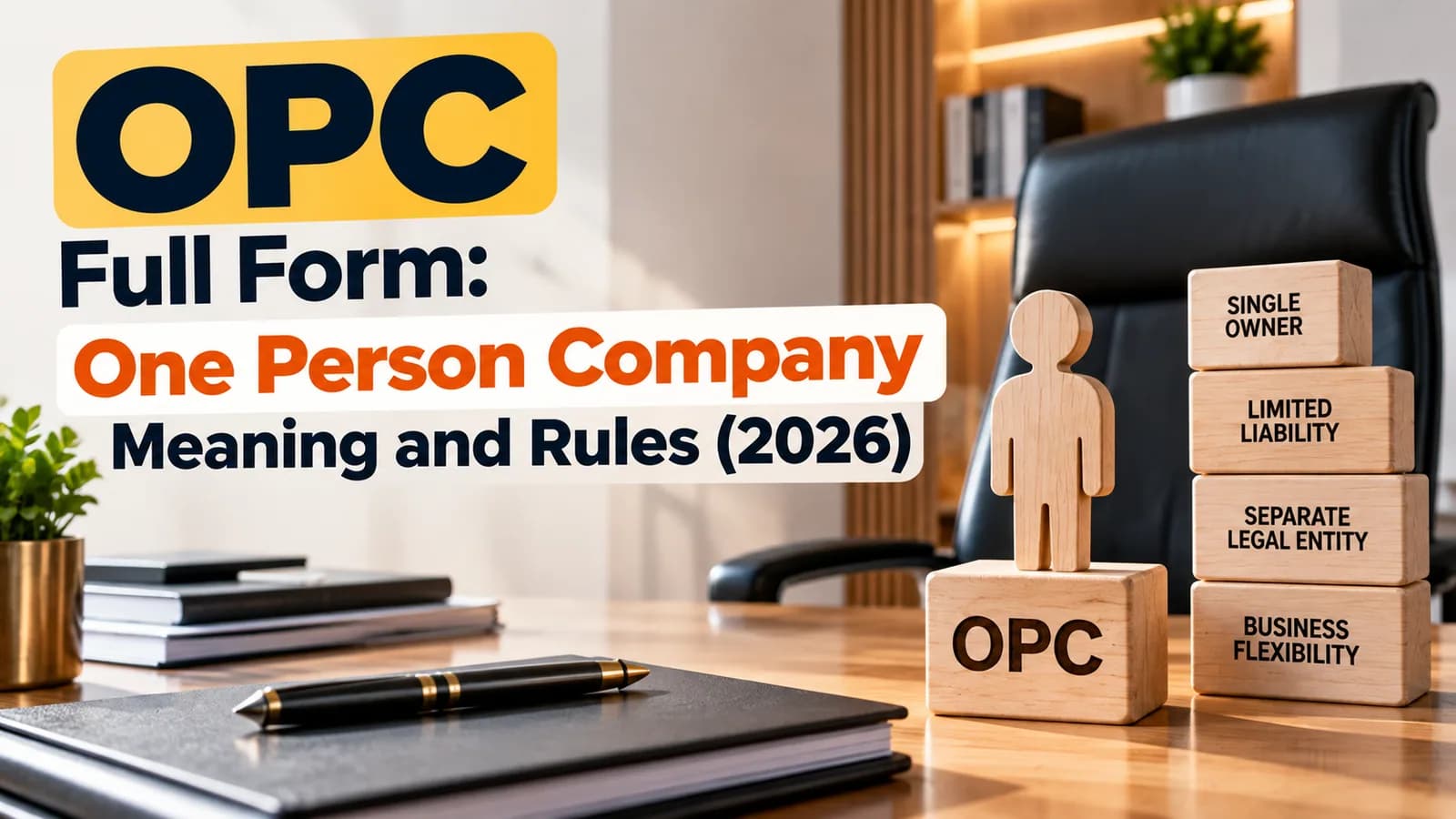
OPC stands for One Person Company. Under Section 2(62) of the Companies Act, 2013, it is a company with only one person as its member, registered as a private company. The owner's liability is limited to the share capital, and a nominee named at incorporation takes over if the member dies or becomes incapable.
An OPC gives a solo founder the limited liability and credibility of a company without needing a second shareholder. Below: who can form one, the rules that come with it, what changed in 2021, and how it compares with a proprietorship and a private limited company.
One person company at a glance
Point | Position |
|---|---|
Full form | One Person Company |
Definition | Section 2(62), Companies Act, 2013: a company with only one person as member |
Type | Private company; the name ends with "(OPC) Private Limited" |
Member | One natural person who is an Indian citizen, resident in India or not |
Nominee | Mandatory; consents in Form INC-3 |
Directors | Minimum 1, maximum 15 |
Capital | No minimum; no upper limit on capital or turnover since 1 April 2021 |
Registration | SPICe+ on the MCA portal, like any company |
What does one person company mean?
An OPC is a full company with one owner. It has a separate legal identity, owns assets and signs contracts in its own name, and the member's personal assets are protected from the company's debts beyond the unpaid share capital.
Example: a Jaipur-based software developer registers "Priya Tech Solutions (OPC) Private Limited" as sole member, names her brother as nominee, and appoints herself as the only director. Client contracts, the bank account and the office lease sit with the company. If a client dispute ends in a damages award against the company, it is paid from the company's assets, not from her savings.
Who can form an OPC?
Only a natural person who is an Indian citizen can form an OPC or be its nominee. The Companies (Incorporation) Second Amendment Rules, 2021 opened this to citizens whether resident in India or not, so non-resident Indians can now form OPCs, and reduced the residency period used in the rules from 182 days to 120 days.
Rule | Effect |
|---|---|
One OPC per person | A person cannot form more than one OPC or be nominee in more than one |
No minors | A minor cannot be a member or nominee |
No NBFC activity | An OPC cannot carry on non-banking financial investment activity, including investing in other companies' securities |
No Section 8 | An OPC cannot be incorporated as, or converted into, a Section 8 company |
Foreign citizens | Cannot form an OPC; they can use a private limited company or LLP |
What changed for OPCs in 2021
Before 1 April 2021, an OPC had to convert into a private or public company once its paid-up capital crossed ₹50 lakh or average annual turnover crossed ₹2 crore, and could not convert voluntarily for two years. The 2021 amendment removed both limits and the waiting period.
An OPC can now grow without a forced conversion and can convert into a private or public company whenever it chooses, after bringing in the minimum members and directors that structure needs. Much older advice online still quotes the ₹2 crore rule; it no longer applies.
Compliance for a one person company
An OPC carries lighter company compliance than a private limited company, but it is still a company, and its accounts must be audited every year regardless of turnover.
Area | OPC position |
|---|---|
Board meetings | At least one in each half of the calendar year, at least 90 days apart; not needed if there is only one director |
Annual general meeting | Not required |
Financial statements | Cash flow statement not required |
Audit | Mandatory every year |
Yearly MCA filings | Financial statements and annual return, plus DIR-3 KYC for the director |
Our annual ROC filing service covers these for OPCs.
OPC vs proprietorship vs private limited company
Point | Proprietorship | OPC | Private limited |
|---|---|---|---|
Owners | One | One | Two or more |
Liability | Unlimited | Limited | Limited |
Separate legal entity | No | Yes | Yes |
Registration | No single registration | MCA | MCA |
Raising equity | Not possible | Must convert first | Yes |
Yearly compliance | Tax returns only | Moderate, with audit | Highest, with audit |
A proprietorship is cheaper to run but leaves your personal assets exposed; our proprietorship firm registration page covers that route. If a co-founder or investor is on the horizon, a private limited company avoids a later conversion.
Is an OPC right for you?
Our view: an OPC suits a solo professional or trader whose clients or contracts are large enough that personal liability matters, or whose customers prefer dealing with a company. It is less suited to a business that will add a partner within a year, because conversion is another filing, or to a very small business where the annual audit and company filings cost more than the protection is worth.
Comparing structures? See how to register a company in India for the process, or talk to our team about one person company registration at ComplyLocal →