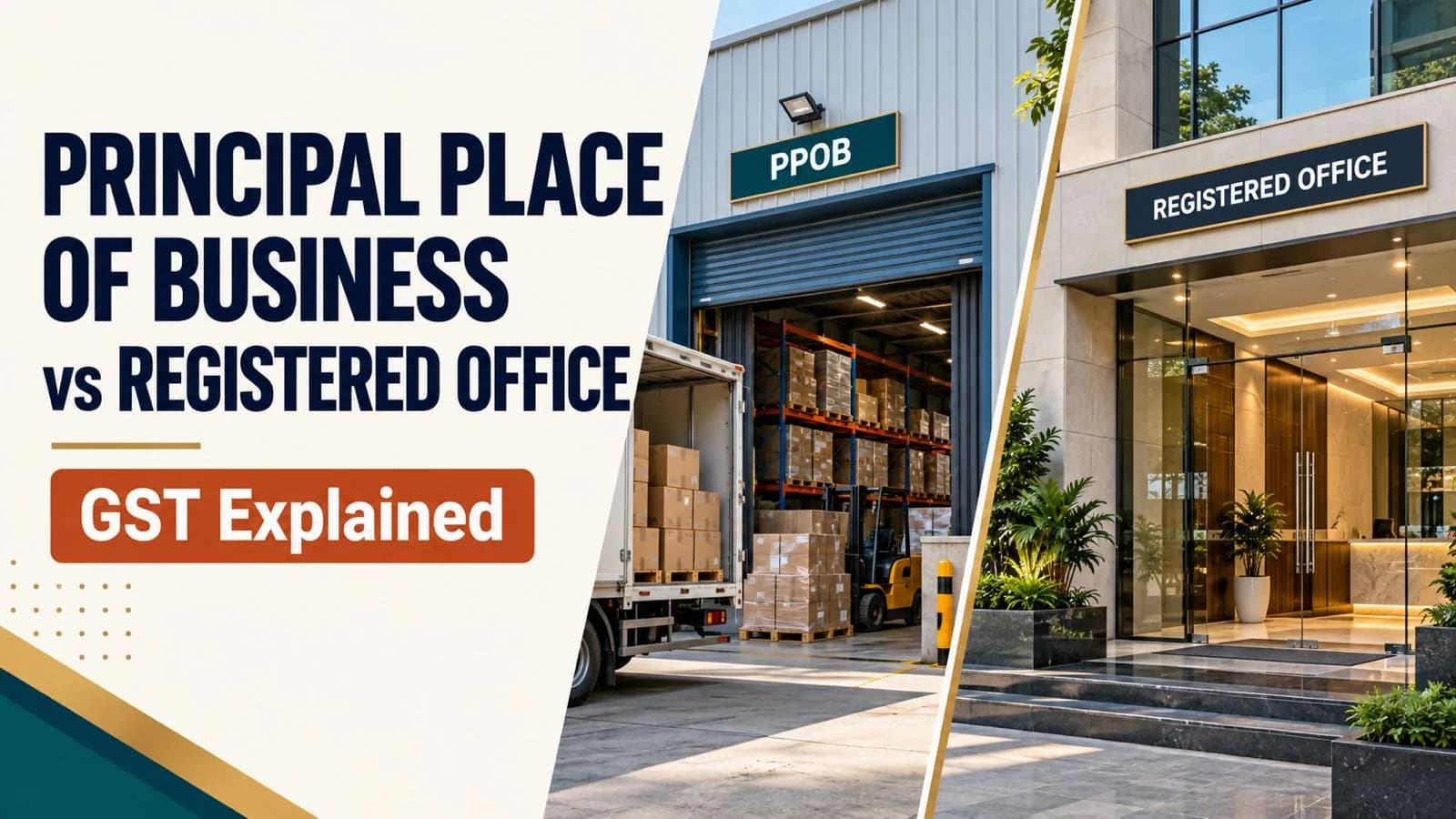
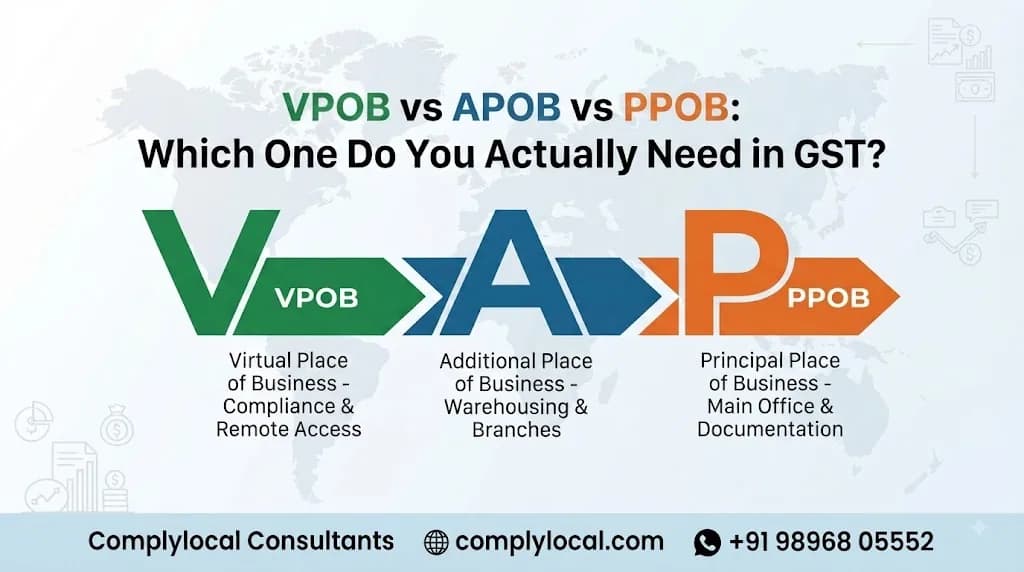
Almost every week someone sends us a message along the lines of: "I have taken VPOB in Karnataka, now do I need APOB or PPOB?" The question cannot be answered because the three terms are not alternatives to each other. Two are statutory concepts. One is trade slang. Mixing them up produces genuine filing errors — wrong dropdown selections, wrong forms, and applications that come back with queries.
Here is the clean separation, and then a framework for working out what your own business actually needs.
The one-line difference
Term | What it is | Where it lives |
|---|---|---|
PPOB | The single principal place of business named on your registration certificate for that state | Section 2(89); declared in REG-01 and shown on REG-06 |
APOB | Any other premises in the same state used for business under the same GSTIN | Section 2(85); declared in REG-01 or added later by amendment |
VPOB | Trade slang for using a virtual office address as your PPOB | Nowhere in the law; not a portal field |
Read that last row carefully, because it settles most of the confusion. VPOB is not a third category of address. It describes how you obtained your PPOB, not what the PPOB is. On the portal you will never select "VPOB" — you will declare a principal place of business, and the address happens to have come from a provider.
PPOB: one per state, and it decides your jurisdiction
Section 2(89) of the CGST Act defines the principal place of business as the place specified as such in the certificate of registration. One GSTIN, one PPOB. It is not necessarily where you work, and not necessarily where your goods are.
What it does control matters more than sellers expect. Your PPOB determines the jurisdictional officer who processes your application, the office that issues notices, the address a physical verification visits, and the premises where your REG-06 certificate must be displayed. Choose it as an address you can actually answer for, not just one that gets you approved.
For the difference between principal and additional in detail, our explainer on additional place of business vs principal place of business goes provision by provision.
APOB: same state, same GSTIN, as many as you need
Section 2(85) defines place of business inclusively — a warehouse or godown, any place where goods are stored or supplies made or received, a place where books of account are kept, and a place where business is done through an agent. Any such premises within the same state that is not your PPOB is an additional place of business.
The two things sellers get wrong here are both important:
APOB cannot cross a state border. You cannot add a Tamil Nadu warehouse as an APOB on a Karnataka GSTIN. Another state means another registration under section 25(1). This is the single most repeated mistake in the entire topic.
APOB is a core field. Adding one after registration is a core-field amendment under Rule 19 requiring officer approval — not an instant self-service change.
Marketplace fulfilment centres are the classic APOB. If your stock is going into an FC, that FC address belongs on your registration before the stock arrives, not after. Our APOB amendment service and our guide to warehouses as an additional place of business cover the filing and the documents.
VPOB: a commercial product, not a legal status
A virtual office is a service. A provider who holds real premises gives you the documented right to use that address, with a demarcated cabin or desk identified in the agreement. VPOB is what the seller ecosystem calls it when that address becomes your PPOB for a state registration.
Because it is not a legal category, nothing about it is separately "approved" or "banned". The address is tested through ordinary machinery: does it satisfy section 2(85), and do the possession documents satisfy Rule 8 as clarified by CBIC Instruction No. 03/2025-GST dated 17 April 2025. Our guide to what VPOB actually means unpacks the terminology properly.
How they stack up in one state
A seller expanding into one new state usually ends up with exactly two declared addresses on that state's GSTIN:
Address | Declared as | What happens there |
|---|---|---|
Virtual office from a provider | PPOB | Registration anchored here; notices land here; records accessible from here; certificate and name board displayed |
Marketplace fulfilment centre | APOB | Stock physically stored; supplies dispatched to customers in that state |
Your home-state office | Neither | Sits on a different GSTIN entirely |
On any given day there is no stock at the PPOB. There need not be. What the PPOB carries is the registration and the paperwork; what the APOB carries is the goods.
Decision framework
Your situation | What you need |
|---|---|
Starting out, selling only from your home state | One GSTIN with your own address as PPOB. No APOB, no VPOB |
Opened a second shop or godown in your home state | Add it as an APOB on your existing GSTIN |
Stock going into a fulfilment centre in a new state, no premises there | New state GSTIN with a virtual office as PPOB, then the FC as APOB |
Stock going into an FC in a state where you already have premises | New state GSTIN using your own premises as PPOB, then the FC as APOB. No VPOB needed |
Only shipping interstate from home-state stock | Nothing new. Your home GSTIN covers it |
Same state, want separate books for two verticals | Optional separate registration per place under section 25(2) with Rule 11 — weigh it carefully |
Row five is the one that saves people money, and no provider will tell you about it. Interstate supply made from your home state runs entirely on your home GSTIN. Registration becomes necessary when the stock sits in the other state. Our guide to registering in another state without an office runs through that test before you spend anything.
If you are still deciding whether the new state is needed at all, our page on GST registration for e-commerce sellers and the principal place of business explainer are the right starting points.
Common mistakes
Trying to add an out-of-state address as an APOB. It is not possible and the application will be rejected.
Assuming APOB means a fresh GSTIN. It sits under the existing registration.
Filing an APOB change as a non-core amendment when it is a core field requiring approval.
Declaring the virtual office PPOB's business activity as "Warehouse" when nothing is stored there.
Moving stock into a fulfilment centre before the APOB amendment is approved.
Treating VPOB as a status that survives on its own, rather than as a PPOB that must stay documented and current.
Government references
CGST Act, 2017 — sections 2(85), 2(89), 24(ix), 25(1), 25(2), 29.
CGST Rules, 2017 — Rules 8, 9, 11, 19, 21, 25.
CBIC Circular No. 61/35/2018-GST — transporter's godown as an additional place of business.
CBIC Instruction No. 03/2025-GST dated 17 April 2025 — processing of registration applications.